The photograph of King George V and Queen Mary on the Buckingham Palace balcony at the 1935 Silver Jubilee became the defining image of a stable royal marriage. But the relationship it captured was not what it appeared to be. Mary, then known as Princess Victoria Mary of Teck, was not originally chosen for George. She was engaged to his older brother, Prince Albert Victor, who died of pneumonia at Sandringham in January 1892, just six weeks after the engagement was announced.
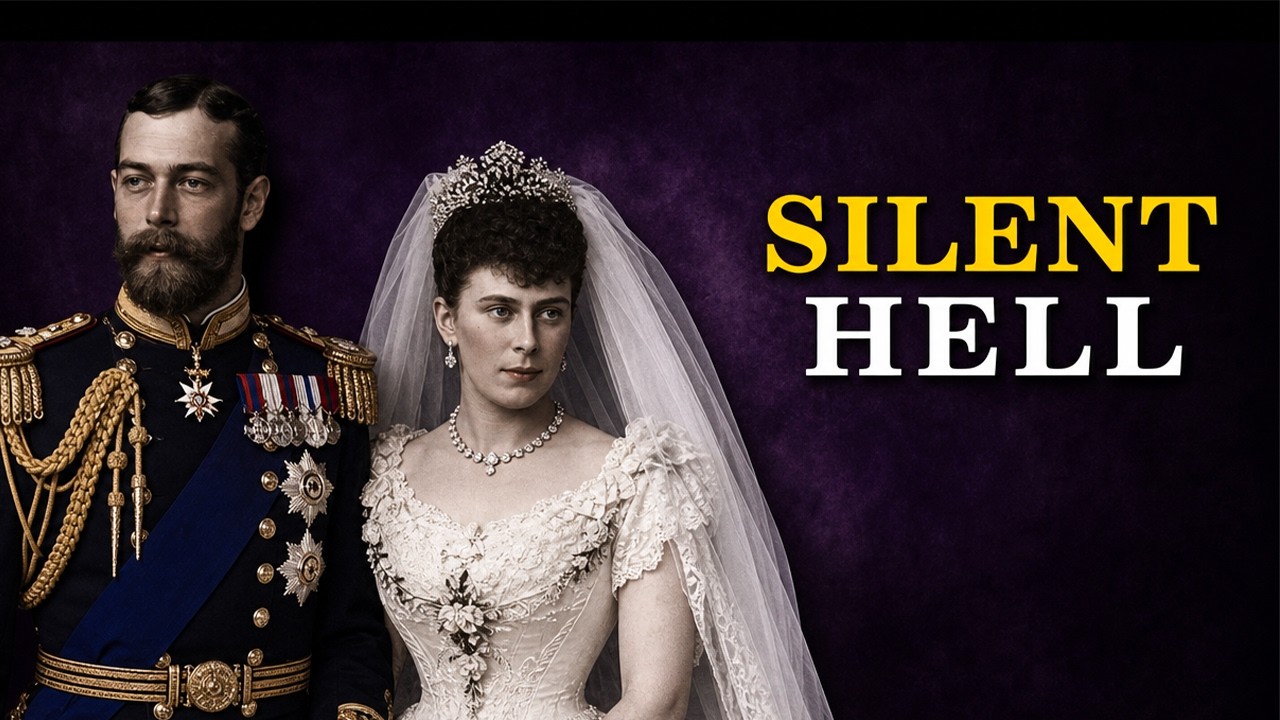
Her bridal wreath of orange blossom was placed on his coffin instead of worn at a wedding. Within months, the same people who had selected her for the dead brother began steering her toward the living one. Queen Victoria had spent two years vetting European princesses before deciding May, as she was known, had more character than any other candidate. When the position changed hands, the qualification did not expire.
May had been shaped by an unusual childhood. Born at Kensington Palace in 1867, she grew up in a family with royal rank but no money. Her father, the Duke of Teck, came from a morganatic marriage, which made his children not quite royal enough for German courts but too royal for the British aristocracy. In 1883, the family’s debts forced them to flee England for Florence to escape creditors.
May was 16. In exile, she taught herself the thing that would define her later life: knowing exactly what a thing is, where it came from, and who owned it before. She also learned that her mother’s enormous public warmth had cost them everything, so she returned composed, self-contained, and nearly impossible to read. In 1891, Queen Victoria summoned May to Balmoral, observed her, and approved the match with her grandson.
Prince Eddie proposed at a house party in Bedfordshire, and May accepted. She was 24, her family’s finances were a running joke in London society, and she had just been offered the future of the British monarchy. After Eddie’s death, Prince George, now the heir, was pulled off his naval career and handed a destiny he did not want. He and May spent a year grieving together.
By 1893, the match had been arranged on both sides, and George proposed on 3 May in the garden at Sheen Lodge. There is one detail the official version could not use. When James Pope-Hennessy researched his authorized biography of the Queen in the 1950s, one of her former ladies-in-waiting told him that May had confided she had once been in love with a man named Arthur Grosvenor, later Viscount Hood, before any of it. She had understood she could never marry him.
That recollection remained sealed in Pope-Hennessy’s notes for 50 years. The wedding took place on 6 July 1893 at the Chapel Royal in St James’s Palace. The crowds were warm, and Britain had decided to like her for having lost one prince. But she had not chosen the church, the date, the guest list, or the groom.
Every element had been arranged by a family that regarded her as a fixture rather than a person. The house they were given tells more about the marriage than any letter. York Cottage sat a few hundred yards from Sandringham House and had previously been overflow accommodation for bachelor guests. It was small, dark, and cramped.
George had it furnished before the wedding by Maples of Tottenham Court Road. Harold Nicolson, writing the King’s official life decades later, called it a servant’s villa. She lived there on and off for 33 years. Six children were born in it.
She was Queen of the United Kingdom and Empress of India while still living in it, because the big house belonged to her mother-in-law. Queen Alexandra stayed at Sandringham House for 15 years after her husband Edward VII died in 1910, and nobody made her move. The reigning Queen walked past her own principal country residence to reach a cottage with a cramped dining room. The strangest part is that the couple were, in their own bent way, devoted to each other.
George never took a mistress, despite being heir to a family that had produced Edward VII. He wanted her near him and grew anxious when she was not. They simply could not say it out loud. Their letters are extraordinary for what they reveal.
Two adults who slept in the same house wrote to each other about not being able to speak. He apologized for being shy with her. She apologized for being shy with him. Each explained in ink that the feeling was real but the mouth would not produce it.
They kept doing this for 40 years. The children arrived quickly: David in 1894, Bertie in 1895, Mary in 1897, Harry in 1900, George in 1902, and John in 1905. The nursery is where both parents come out badly. The first nurse favored David to the point of derangement, and is said to have pinched him just before carrying him in to his parents so he would scream and be sent straight back to her.
The same woman allegedly neglected Bertie so badly during feeding that she gave him the stomach trouble that lasted his whole life. She was dismissed after about three years when the under-nurse spoke up. The story reaches us through the under-nurse’s recollections and the Duke of Windsor’s memoirs, published half a century later. It is not a contemporary document, but it is believed by essentially every serious biographer because the parents’ side is corroborated.
For three years, neither the Duke nor the Duchess of York noticed the woman in the attic was hurting their children. May was not absent in the sense of being elsewhere. She was in the same small house. She sat with her children, read to them, taught them history and how to look at objects.
But she had made a decision early and never revised it: her husband came first, before the children, before herself. Her husband was a shouter at the dinner table, bullying the boys about their clothes, posture, and handwriting. Bertie’s stammer arrived in that room. When George was angry, and he was often angry, she did not intervene.
The most quoted sentence in the entire George V literature, that he said his father was frightened of his mother, that he was frightened of his father, and he was determined to make his children frightened of him, is almost certainly not real. It surfaced in 1959 in a book by Randolph Churchill, attributed secondhand decades after the King’s death. Kenneth Rose, who wrote the modern biography with archive access, treated it with open skepticism. The invented quote is actually softer than the documented material.
In November 1910, a Republican paper printed in Paris ran an article under the headline “Sanctified Bigamy. ” It claimed George, as a young naval officer, had secretly married an admiral’s daughter in Malta, abandoned her, and that his 1893 marriage was therefore invalid. Kings do not usually sue, because suing repeats the lie. This king sued.
Mylius was convicted on 1 February 1911 before the Lord Chief Justice. The admiral’s daughter testified she had met the king once at a ball and never in Malta. Her sister had died unmarried. The Crown Advocate of Malta arrived carrying the island’s marriage registers and produced them in open court.
Mylius was sentenced to 12 months. He called no witnesses. A few months later, the couple sailed for India and put on the Delhi Durbar in December 1911, a hundred thousand people on the plain, the pair in new crowns under a golden dome receiving the homage of the princes of India. She was magnificent at it.
Public duty was the one place the armor she had built in Florence became an asset instead of a wall. They came home to the cottage and to the youngest child, who had begun having seizures. Prince John was four when the first fit came in 1909. By 1917, the epilepsy had worsened, and he was moved permanently to Wood Farm, a plain farmhouse on the far side of the Sandringham estate, with his nurse and a small staff.
His tutors were dismissed. His education stopped. His mother arranged for local children to come and play with him. It was the standard medical advice of the period, and it was also an erasure.
The youngest son of the King of England was kept where photographers were not. His mother’s diary around the time of the move recorded the thing that had broken her: a big, strong boy with the mind of a small child, and it made her unhappy. He died at Wood Farm on 18 January 1919 after a seizure in his sleep. He was 13.
What she wrote that day is the most quoted line she ever produced: “A great shock, though for the poor little boy’s restless soul, death came as a great relief. ” She told her husband, and they drove down together. The public got a two-line announcement and learned for the first time that the boy had been ill at all. Here the story turns quietly over about 15 years through objects.
She had never had a house or authority over so much as a curtain, so she took the one territory nobody in that family wanted and conquered it completely: the Royal Collection. She went through the palaces room by room, read the old inventories, tracked down royal possessions that had been given away or sold off over a century, and got them back by buying, trading, or asking in a way that was famously difficult to refuse. She labeled things and wrote provenance on the backs of miniatures. The modern royal collection is organized on foundations she laid.
She also built the image. From 1913 to 1950, she wore essentially the same silhouette, the toque, the long skirt, the parasol, the ropes of pearls. A monarchy that had watched its Russian and German cousins go over the side needed to look permanent, and she made herself the visual proof. In 1924, she commissioned a doll’s house from Edwin Lutyens with working plumbing and a library of miniature books written by living authors.
People treated it as a charming eccentricity. It was also the first house she had ever furnished entirely to her own taste at a scale she could control, in front of two million paying visitors. Queen Alexandra died in November 1925. In 1926, after 33 years, the Queen moved into Sandringham House.
She was 58. George nearly died of septicemia in 1928, and she nursed him through months of illness and convalescence. His temper softened toward everyone except his elder son. In May 1935, at the Silver Jubilee, the crowds came out in numbers that genuinely startled him.
He had spent his life assuming he was tolerated rather than liked, and afterward he said he was beginning to think they must really like him for himself. He died at Sandringham on 20 January 1936. For 50 years, the country believed he had slipped away peacefully while the family kept vigil, under the bulletin that entered the language: “The King’s life is moving peacefully towards its close. ” In 1986, the historian Frances Watson published what was in Lord Dawson of Penn’s private notes.
Dawson had hastened the end with an injection and wrote down his reason: he wanted the death announced in the morning papers rather than the evening press. His wife telephoned London to hold the presses. The notes record that the family had made clear they did not want the King’s life prolonged. Eleven months later, her elder son abdicated to marry Wallis Simpson.
She never accepted it. In a letter to him in the summer of 1938, she told him plainly he had put a woman before his country and that it had been a blow she had never got over. She refused to receive his wife. In May 1937, she did something no dowager queen in British history had done: she went to the coronation of her second son and sat in Westminster Abbey in full view, publicly certifying that the throne had not been damaged.
She survived 17 years past her husband. Harold Nicolson published the official life of George V in 1952 under family supervision. Privately, he described the job as impossible. After her death, James Pope-Hennessy was commissioned for her biography, and he interviewed everyone still alive who had known her.
His 1959 biography is admiring and careful. His raw notes he sealed for 50 years. They came out in 2018, where the household finally speaks in its own voice. She died on 24 March 1953, ten weeks before her granddaughter’s coronation, having made it explicit that mourning for her was not to delay it.
The Abbey went ahead on schedule. The woman standing at the King’s side in that balcony photograph is not a consort being loyally decorative. She is the only person in the frame who chose to be there. Everything else had been assigned: the fiance, the second fiance, the cottage, the furniture, the seat below her mother-in-law’s.
The pose was the one thing she manufactured herself, and she wore it for 40 years until the country mistook it for her nature. The marriage was never a romance, and it was never a fraud. It was a treaty between two people who could not speak, honored to the letter by both. She could not tell her husband she loved him without a pen in her hand.
So she spent the last 17 years deciding what everybody else would be allowed to say about him.