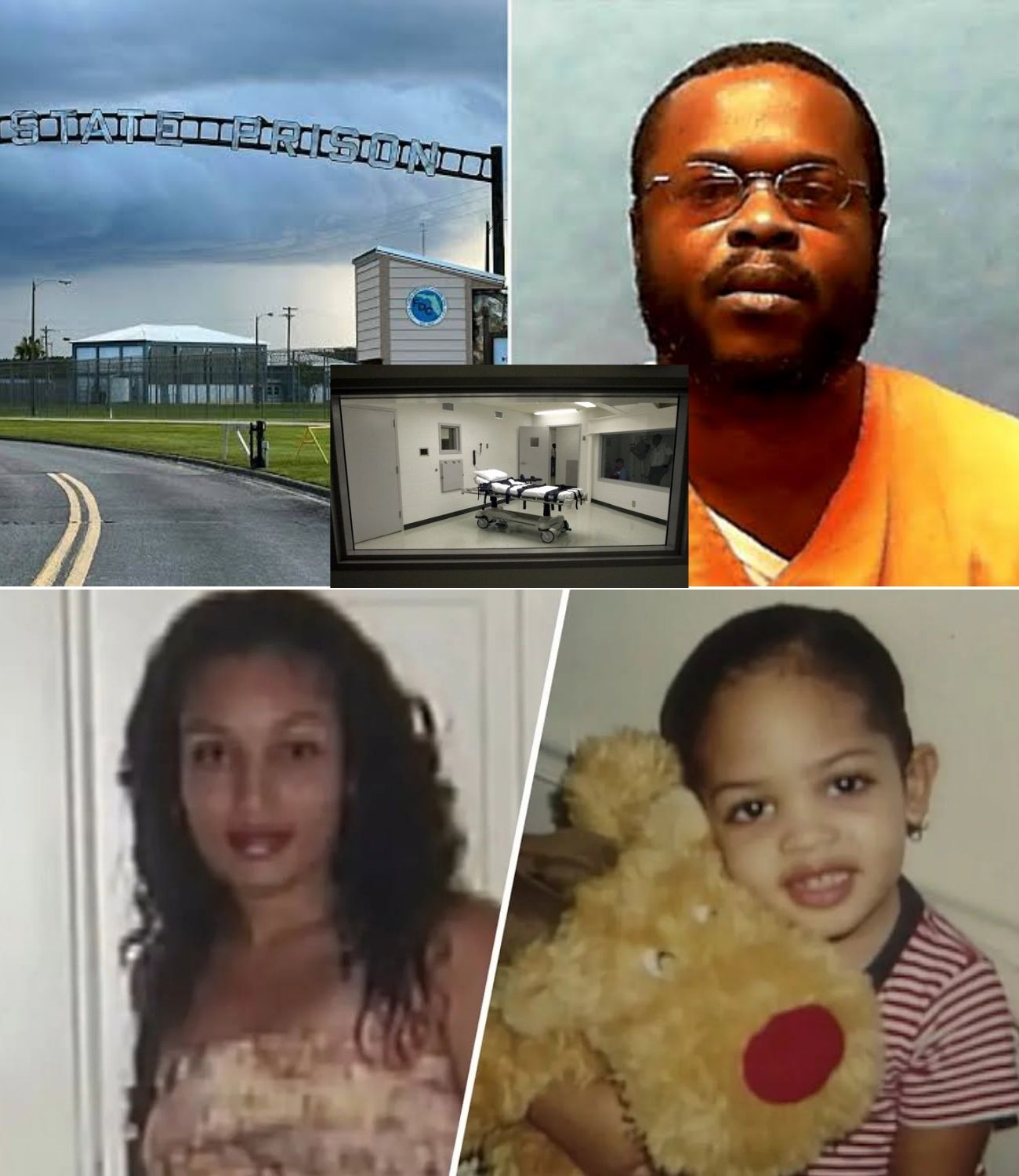

In their Coral Springs apartment 26 years ago, a mother and her 4-year-old daughter were stabbed dozens of times.
The little girl, Hanessia Mullings, was found curled in a fetal position near a closet door, surrounded by pieces of broken knives. The body of her mother, 24-year-old Odessia Stephens, was found in the living room with more pieces of knives scattered around her. She was six weeks pregnant.
The convicted killer, a man who had been raised by Hanessia’s father’s family, is scheduled to be executed Thursday at Florida State Prison.
Richard Knight, now 47, was sentenced to death in 2006, six years after the brutal stabbing murders. He had been living in the Coral Springs apartment at the time with Stephens, her daughter and Hans-Peter Mullings, who was Stephens’s boyfriend and the girl’s father.
A resident of Green Glades Apartments called 911 just before midnight on June 28, 2000, after hearing banging and crying coming from the apartment directly beneath her.
When Coral Springs Police Officer Vincent Sachs arrived minutes later, no one answered his knock at the door, he told the South Florida Sun Sentinel this week.
Looking into the apartment through a window, Sachs recalled seeing blood on the dining room carpet. He walked around to a sliding glass door that led into the main bedroom and discovered Hanessia’s body.
“I still see the child on the floor now,” Sachs said. “In the same way it was when I was there.”
Another officer climbed into the apartment through a window and discovered 24-year-old Stephens, Sachs recalled.
In the time it took Sachs to walk around the apartment, he said, Knight escaped from a window, but he did not go far.
The second officer who had arrived at the apartment saw Knight near some bushes about 100 yards away from the building, and the officers questioned him, court records say. He had scratches on his chest and shoulder and cuts on his hands. He was visibly wet while wearing dress clothes and shoes but told the officers he had been out for a jog.
“He realized that there were too many of us already coming, so he turned around and walked back up like he could explain it all,” Sachs said. “I had him knock, go ahead and knock on the door … He knew she wasn’t going to come.”
Sachs also still recalls feeling “devastated because you weren’t there quick enough.”
Just before the murders, Stephens and Mullings had asked Knight, 22 at the time, to move out, court records say. Stephens and Knight had argued that night about the decision. He left the apartment as Stephens and her daughter went to bed. Knight attacked them when he returned.
“He was being asked to move out because he was so disruptive,” attorney Tony Loe, who prosecuted the case, told the Sun Sentinel recently. “He would bring people over late at night when the little girl should be sleeping instead of awakened by loud music. He was so disruptive, and they said we need you to move out. And that date came, and the thanks he gave for being allowed to live in that apartment for several months, was to murder Odessia and Hanessia.”
Knight maintains that he has been wrongfully held as the sole person responsible for the murders, his attorneys wrote in a brief filed in the 4th District Court of appeal earlier this month after Gov. Ron DeSantis signed a death warrant for Knight on April 22, his eighth of 2026.
A total of 19 people were executed in Florida last year, the highest number in the state since 1972, according to a report released Monday by Amnesty International, a human rights advocacy organization that opposes the death penalty and all executions.
The state’s total fueled the national total number of executions to its highest since 2009. Nearly half of all executions in the U.S. in 2025 were in Florida, the report said.
‘One of their own’
When Knight was no more than 3, his mother left him in front of a hospital in Port Maria, Jamaica. The abandoned boy was taken in by Mullings’ aunt and raised with the Mullings-Knight family, who were also from Jamaica.
Knight and Mullings saw one another as family rather than friends; they referred to each other as cousins.
Family members of Stephens, Hanessia and Mullings did not respond to voicemails seeking interviews for this article.
“The Mullings were wonderful people and took him as if he was one of their own,” Loe said.
The family gave him an upbringing with love and care, according to a transcript of Knight’s sentencing hearing on March 28, 2007. In his neighborhood in Jamaica, with both adults and local children, Knight had a good reputation and was admired.
When the family moved to the U.S., Knight immigrated with them, Loe told the Sun Sentinel.
Knight had lived in the U.S. for two-and-a-half years before the murders, according to the sentencing hearing transcript. In that time, he had been convicted of indecent assault on a child under the age of 16 and lewd and lascivious battery on a person over the age of 12 and under the age of 16.
One of the reasons Stephens wanted Knight to leave their apartment was that Knight had a romantic relationship with a 14-year-old girl at the time, the Attorney General’s office said in a recent 4th District Court of Appeal filing.
A Broward County grand jury indicted Knight in the killings in 2001. He had spent the year in between in the jail on a charge of lewd and lascivious battery involving a minor girl.
“He was a suspect from virtually right after the police discovered the homicide,” Loe told the Sun Sentinel. “But we wanted to make sure that we did a thorough investigation before we charged him … He was a suspect within, if not minutes, hours.”
Stephens tried to escape the attack by crawling to the living room. Knightfollowed and continued to stab her, according to court records. In the bedroom as she was attacked, Hanessia also tried to escape but never managed to move from lying in the fetal position by a closet door.
The clothes Knight wore when Sachs and the second Coral Springs officer found him had blood on them, and clothes that were found in the apartment bathroom also had blood on them, court records say.
DNA testing showed the blood was from both Stephens and the girl. Scrapings from Stephens’s fingernails matched Knight’s DNA. A man who shared a cell with Knight while he was held in the Broward County jail testified that Knight had confessed to him that he committed the murders, according to court records.
Defense argues ‘unanswered doubts’
Attorneys representing Knight in the 4th DCA argued, in part, in their initial brief earlier this month that the forensic evidence shows at least one other person was at the crime scene “and responsible for these crimes,” and that a print found on one of the knives used in the murders remains unidentified today.
The print had been run through the Broward Sheriff’s Office’s Automated Fingerprint Identification System before Knight’s trial, but there was no match to anyone in the database at the time, the filing said. Knight recently filed a motion seeking the print be run through the system again, now that millions more fingerprints have been entered, but his request was denied by the lower court.
“If there is a match, then the parties should be made aware of it and investigate the matter further,” his attorneys wrote in the court filing. “If there is no match, then the unanswered doubts still linger about the true participants in these terrible murders while Mr. Knight’s sentence will be carried out.”
While Knight does not contest that forensic evidence ties him to the scene, his attorneys wrote that Knight asserts at least two other people were there at the time of the murders.
DNA testing of a blood stain found on the shower curtain in the bathroom showed it was a mixture from two people — the majority being Hanessia’s and a minor profile of a teenage girl who Knight was known to be romantically involved with, according to appellate court records.
“Equally as troubling, there remains an unanswered question as to the identity of yet another individual, who unquestionably was present at the scene of the murders as an active participant and who left a patent print of comparison value on a broken knife blade in the room where Hanessia was found,” Knight’s attorney wrote in the filing.
His defense attorney in the 4th DCA and the attorney who represented Knight at trial did not respond to emails sent Tuesday.
Two senior assistant attorneys general in their reply brief last week argued that the existence of the print has been known since before Knight’s trial and in the 14 years since Knight’s case became final, “but at no time during that period did he seek to have the print run through the AFIS system.”
At trial, witnesses were cross-examined about the unidentified print, “implying that another person was present during the crime,” but the jury rejected the theory and found him guilty, the state’s attorneys wrote.
They categorized the argument about the print as “a spectacular inferential leap.”
“Knight’s theory is purely speculative because there is no evidence of when either the DNA or the print were created,” the attorneys wrote. “Further, to argue that not only were the samples put there on the night of the crime, but that the individuals linked to the samples were there, takes the speculation to atmospheric heights. Nothing in the record supports that theory.”
Unanimous death recommendation
Despite the many years that have passed, Loe still remembered the day the trial was halted temporarily after Mullings broke down on the witness stand.
“I asked him when he was on the stand to tell the jury about that morning, the last time he saw his wife and daughter,” Loe said. “He said that Hanessia would say, ‘Robot, daddy, robot.’ And she would climb on top of his shoes and hold his hands and he would have to pretend to be a robot. And he was re-enacting that for the jury.”
The jury unanimously recommended that Knight be sentenced to death on July 24, 2006.
At Knight’s sentencing hearing, Mullings stood in the courtroom and recounted the pain he endured for the seven years between the murders and that day and the memories he’d miss: Sneaking to the fridge to eat cookie dough with Hanessia in the middle of the night, Hanessia running to hug him the moment he walked into their house, all of the questions she would ask him and to which he’d be able to tell her the answers, which he said made him feel “like a king.”
“We didn’t get to take her training wheels off her bicycle,” he said according to a transcript of the hearing. “We didn’t take her floaties off.”
Stephens had always been in his corner no matter what, he told the court.
“I don’t think I’ll ever have that again in my life,” Mullings said. “She’s beautiful … I tell her she’s beautiful, but I regret I didn’t tell her more, how much I love her.”
Odessia Stephens’s mother, Eunice Belan, said she had questioned God since her daughter’s murder.
“Every day is like a new hurt,” she said, according to the transcript.
Information from the Sun Sentinel archives was used in this report