A Collection of Fictional Internet Horror Stories Inspired by Modern Urban Legends
Every generation has its own ghost stories.
Long before smartphones, people whispered about haunted roads, abandoned hospitals, mysterious disappearances, and voices echoing through empty forests. Most of those stories were impossible to verify. Yet they survived for decades because they all shared one unsettling trait—they sounded just believable enough to make people wonder.
Today, technology has replaced candlelight. Smart locks guard our homes. Security cameras watch every corner. GPS tracks every mile we travel. Hospitals are filled with digital systems that monitor every heartbeat.
But what if technology doesn’t always reveal the truth?
What if, every once in a while, it records something it was never designed to explain?
The following stories are works of fiction inspired by the style of modern internet horror. They aren’t meant to prove the paranormal exists. Instead, they explore a single question:
What happens when ordinary people experience something they can’t explain—and the evidence refuses to disappear?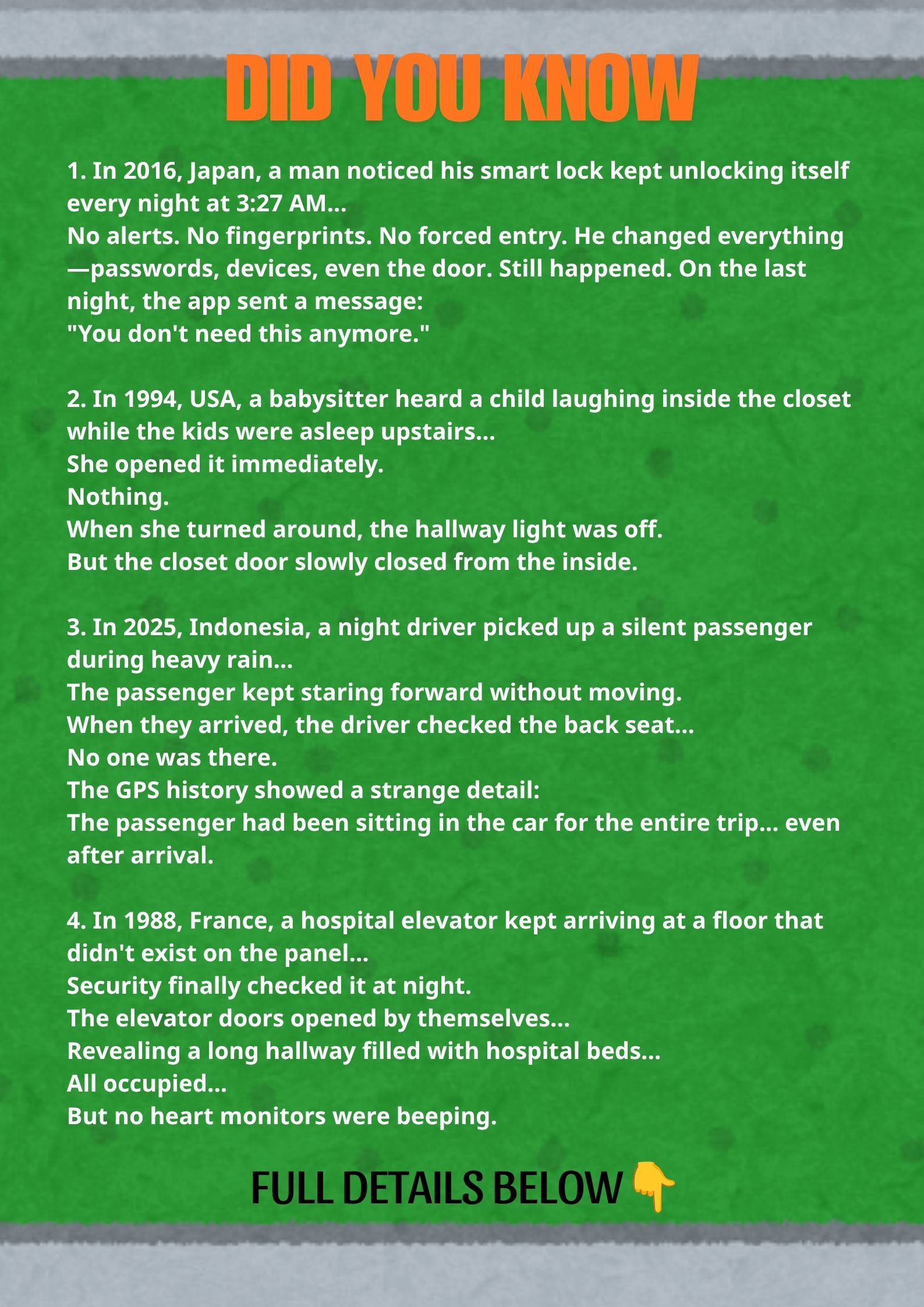
Story One: The Lock That Didn’t Need Permission
Tokyo, Japan.
March 2016.
Kenji Sato had always trusted technology more than people.
As a software engineer, he filled his apartment with the latest smart devices. Motion sensors. Security cameras. Voice assistants. An expensive biometric lock that promised military-grade encryption.
It was impossible for anyone to enter without his authorization.
Or so he believed.
The first notification appeared at exactly 3:27 AM.
Door Unlocked.
Kenji assumed it was a software bug.
He checked every camera.
Nothing.
The hallway outside his apartment remained completely empty.
No movement.
No sounds.
No explanation.
The following night…
The same notification arrived.
3:27 AM.
Again.
And again.
Every single night.
He contacted the manufacturer.
They replaced the lock.
The problem continued.
He changed every password connected to his account.
Nothing changed.
He purchased an entirely new phone.
Still…
Every morning at 3:27, the system insisted someone had unlocked the front door.
Except no fingerprints were recorded.
No facial recognition.
No Bluetooth devices nearby.
No failed login attempts.
Nothing.
Weeks later, exhausted and desperate, Kenji decided to stay awake.
At exactly 3:26, he stood in front of the door.
His phone vibrated.
Door Unlocked.
He heard it.
A soft metallic click.
The lock slowly turned by itself.
But the handle never moved.
No one entered.
No one left.
The hallway remained empty.
Shaking, he deleted the security app from his phone.
The next morning…
It reappeared.
Installed automatically.
Waiting for him.
One final notification sat unread.
He opened it.
There was no logo.
No sender.
Only six words.
“You don’t need this anymore.”
The apartment was empty when he moved out.
Yet according to building maintenance…
The lock continued unlocking itself every night.
Exactly at 3:27 AM.
Story Two: The Closet That Laughed
Ohio, United States.
Autumn 1994.
Emily had babysat dozens of children before.
Nothing frightened her.
Not thunderstorms.
Not power outages.
Not old houses.
The Wilson family’s home looked perfectly ordinary.
Two children.
A golden retriever.
A quiet suburban neighborhood.
At 9:00 PM, both kids were asleep upstairs.
Emily settled onto the couch with a book.
That’s when she heard it.
A child laughing.
Soft.
Playful.
Coming from the hallway closet.
She smiled.
Maybe one of the children had climbed downstairs.
She opened the closet.
Coats.
Shoes.
Storage boxes.
Nothing else.
She laughed at herself and shut the door.
Then…
The laughter came again.
This time louder.
Much closer.
She yanked the door open.
Still empty.
Suddenly…
The hallway lights went out.
The house became completely silent.
No television.
No refrigerator.
Not even the ticking clock.
Emily slowly backed away.
Without warning…
The closet door began closing.
Very slowly.
Not because of wind.
Not because of gravity.
Something on the other side was pulling it shut.
From the inside.
She ran upstairs.
Both children were asleep exactly where she’d left them.
The next morning she told the children’s grandmother.
The old woman’s face lost all color.
She whispered only one sentence.
“If you ever hear it laugh again…”
“…don’t let it know you heard it.”
Emily never babysat there again.
The Wilson family moved away six months later.
The house remained empty for nearly fifteen years.
Story Three: The Passenger Who Never Left
West Java, Indonesia.
November 2025.
Heavy rain had emptied the roads.
Ride-share driver Ardi expected one final fare before ending his shift.
The request appeared from a small roadside bus stop.
One passenger.
Cash payment.
No profile picture.
When he arrived, a woman wearing a gray raincoat climbed into the back seat.
She never spoke.
Never moved.
Never looked at her phone.
She simply stared straight ahead.
The GPS estimated forty-three minutes.
The silence became unbearable.
Ardi tried making conversation.
Nothing.
No response.
Not even a nod.
Finally they reached the destination.
He parked.
Turned around.
The back seat was empty.
The rear door had never opened.
His dashcam showed the woman sitting there during the drive.
Then…
Between two video frames…
She simply wasn’t there anymore.
The ride ended automatically.
Payment completed.
Passenger dropped off.
Curious, Ardi reviewed the GPS log.
Everything appeared normal.
Until he zoomed into the passenger tracking feature.
A tiny gray icon still showed someone sitting in Seat B.
The trip had already ended.
His car had already returned home.
Yet the passenger marker never disappeared.
Every trip afterward displayed two occupants.
The driver.
And someone else.
Always in the back seat.
Always silent.
Always facing forward.
Story Four: The Floor That Was Never Built
Lyon, France.
Winter 1988.
Saint Vincent Hospital officially had twelve floors.
Everyone knew that.
Patients.
Doctors.
Maintenance workers.
The elevator panel confirmed it.
B1.
Ground.
1 through 12.
Nothing else.
Yet night security repeatedly reported seeing the elevator stop somewhere above the twelfth floor.
Impossible.
There was no such floor.
The engineers blamed electrical faults.
The logs showed no errors.
Finally, one guard volunteered to investigate.
At 2:14 AM he entered the elevator alone.
Without touching a button…
The doors closed.
The elevator began rising.
Past twelve.
Past where the building should have ended.
It finally stopped.
A soft chime echoed.
The doors opened.
Beyond them stretched an impossibly long hospital corridor.
Rows of beds lined both sides.
Every single bed was occupied.
Patients lay perfectly still beneath white sheets.
No doctors.
No nurses.
No voices.
Only silence.
The guard noticed something else.
There were no heart monitors.
No IV machines.
No medical equipment.
Nothing that suggested anyone there was alive.
Then…
Every patient opened their eyes at the same time.
The doors slammed shut.
The elevator descended on its own.
When it reached the lobby, the guard stumbled out shaking.
He resigned before sunrise.
Years later, maintenance crews discovered no evidence that an additional floor had ever existed.
Yet the old elevator logs contained hundreds of identical entries.
Destination: 13.
A floor that had never appeared on any blueprint.
Most people dismiss stories like these as fiction, coincidence, or products of overactive imaginations—and they’re probably right.
Yet there is something fascinating about tales that linger long after you’ve finished reading them. Perhaps it’s not the monsters hiding in the darkness that unsettle us most. Perhaps it’s the possibility that the ordinary world—the homes we lock, the roads we drive, the elevators we trust, the technology we rely on—might one day behave in ways we cannot explain.
And if that ever happens, remember one simple rule shared across nearly every old ghost story:
The scariest part isn’t seeing something impossible.
It’s realizing you’re the only one who saw it.