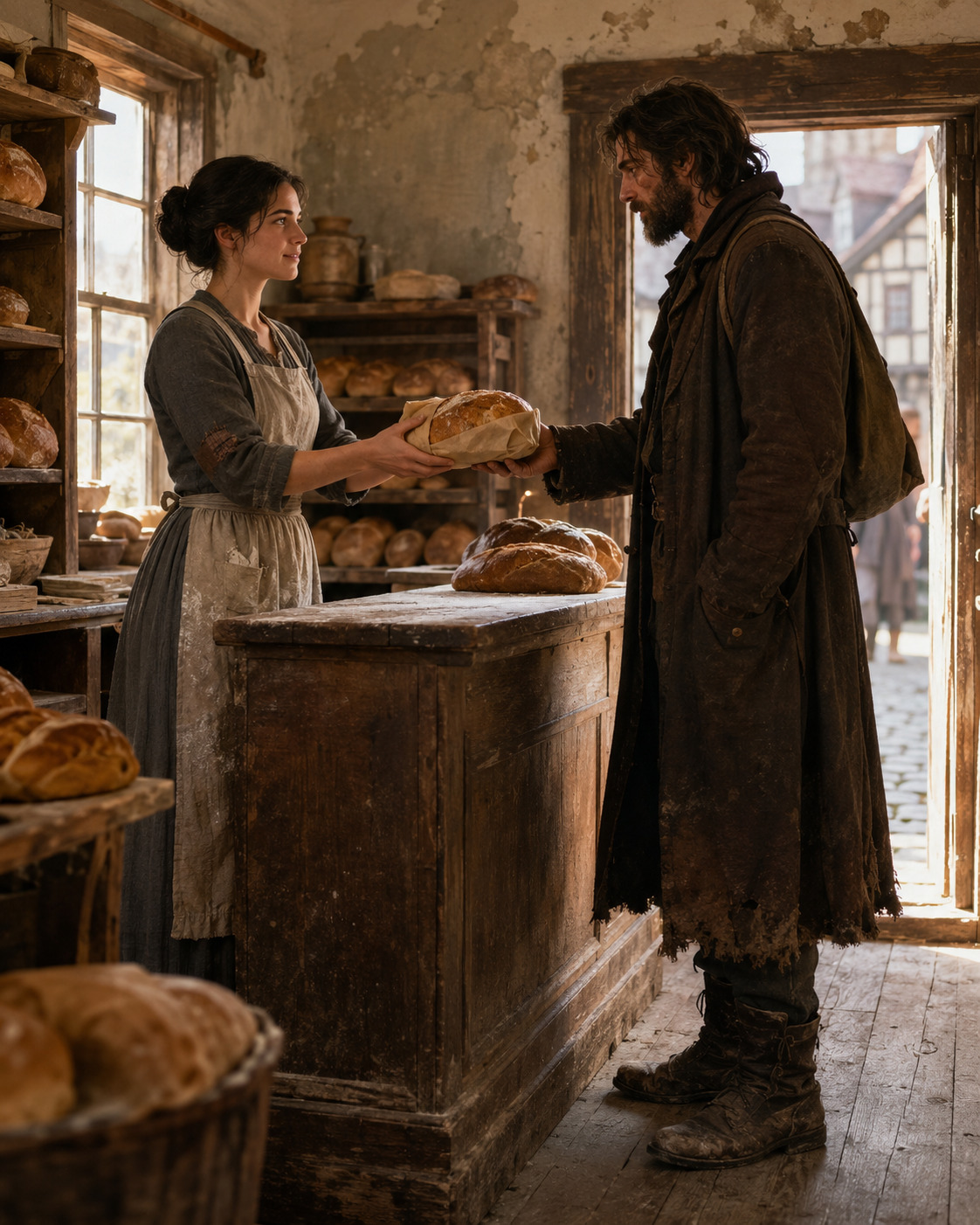
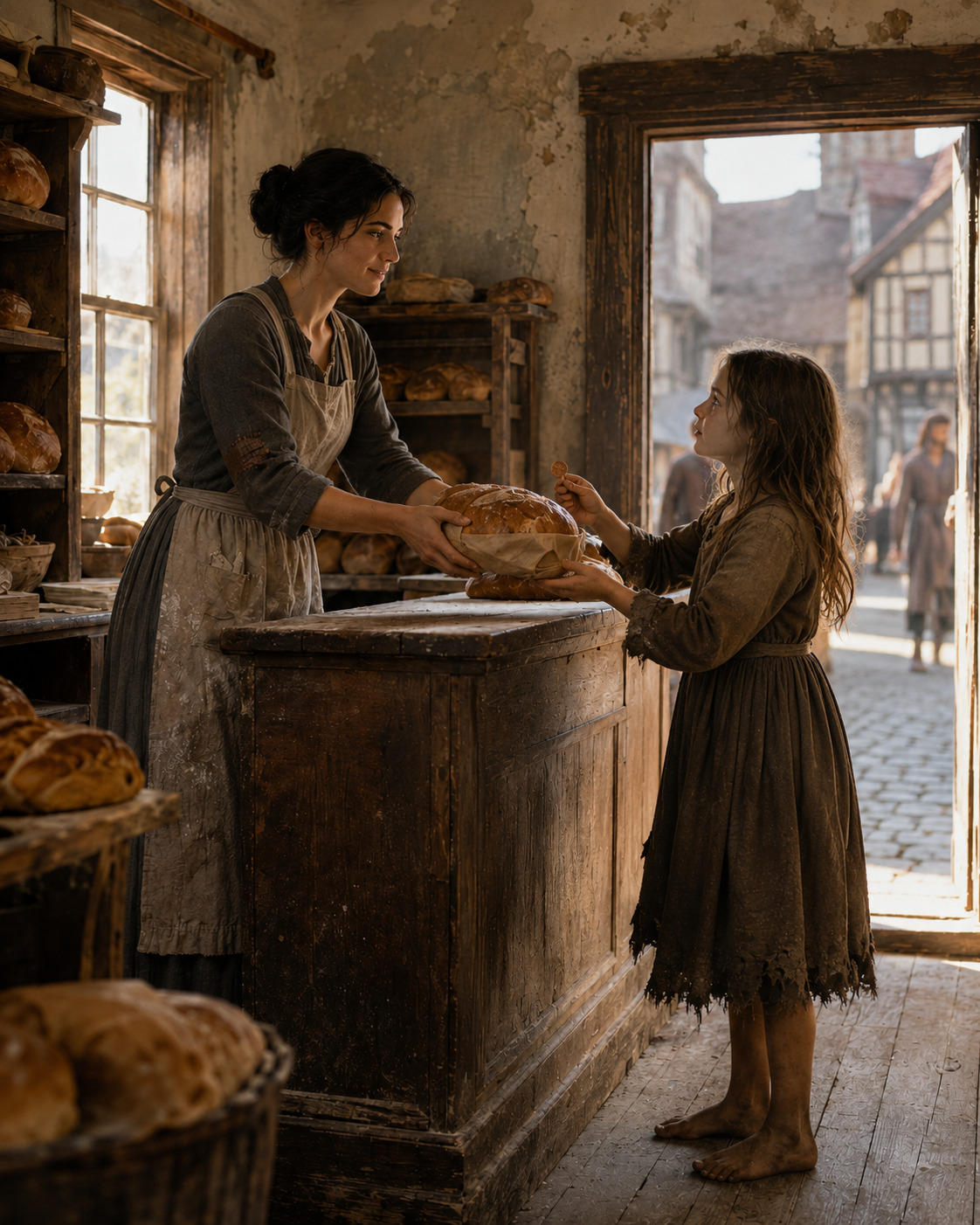
My name is Maren Vale, and at twenty-two, the only thing I owned was a small bakery on Mill Lane. The walls were old, the wooden floor creaked, and some days the money box beneath the counter held barely enough coins to buy flour for the next morning, but the shop had belonged to my father, and before he died he taught me one rule I never forgot: “A baker who turns away a hungry person is no baker at all. He is only someone with bread.” That was why, when a barefoot girl entered one morning with only one copper coin and asked for half a loaf, I wrapped an entire loaf and told her the price had gone down. It was also why, later that same morning, when a tall stranger in a dirty brown coat stepped through my door and admitted he had no money, I gave him bread without asking for anything in return. His name was Dorian, or so he told me. He had cracked boots, a dark beard, and the exhausted eyes of a man who had walked a very long way. Most hungry men took what I offered and left, but Dorian stayed long enough to ask me one strange question: “Why?” I simply answered, “Because you are hungry, and I have bread.”
He returned the next morning and every morning after that. I never asked him for payment, and he never explained where he came from. We spoke only of small things: the rain, the price of flour, the bird nesting above my door. One morning, he arrived with a fresh cut across his hand, and I ordered him to sit while I cleaned it and wrapped it in linen. He looked uncomfortable, as though no one had cared for him in a very long time. “Why are you kind to me?” he asked. I told him the truth: “Because no one has ever been kind to me without wanting something, and I do not want you to know that feeling.” He went completely still. After that, something changed between us. I began saving the best-shaped loaf for him, though I pretended I did not, and when he came in soaked from the rain, I let him sit beside my small fire and gave him the last piece of cheese in the shop. I had not eaten since the previous morning, but I told him I was not hungry. He pretended he disliked cheese and left it behind for me. We both knew we were lying.
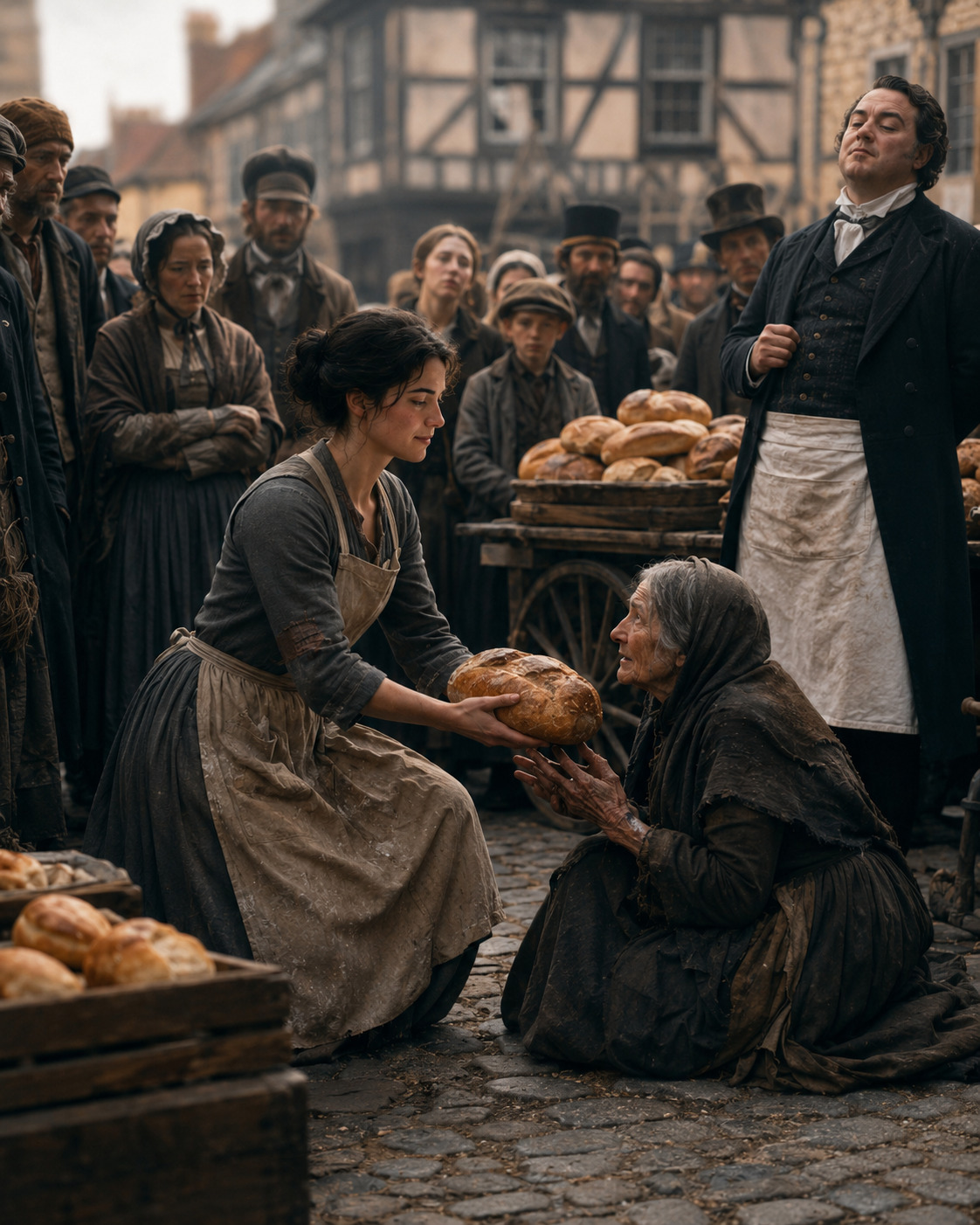
Then one morning, I found ten gold coins pushed beneath my door with a note that read, “For the bread, and for the rest.” I knew the money had come from him, but I could not understand how a penniless traveler possessed more gold than my bakery earned in months. Before I could confront him, market day arrived, and Mr. Pell, the wealthy baker from the High Street, stopped in front of my stall to humiliate me. He called my bread coarse, said women could not run businesses, and predicted I would be in the workhouse by Christmas. A crowd gathered, waiting for me to cry or fight. Instead, I picked up the loaf he had thrown onto the ground, brushed away the dirt, carried it across the square, and placed it in the hands of an old beggar woman. “Eat slowly,” I told her. “It is still warm in the middle.” Then I returned to my table and continued selling. I did not know Dorian had watched everything from across the square, or that he had nearly stepped forward before realizing I did not need a man to fight my battles.
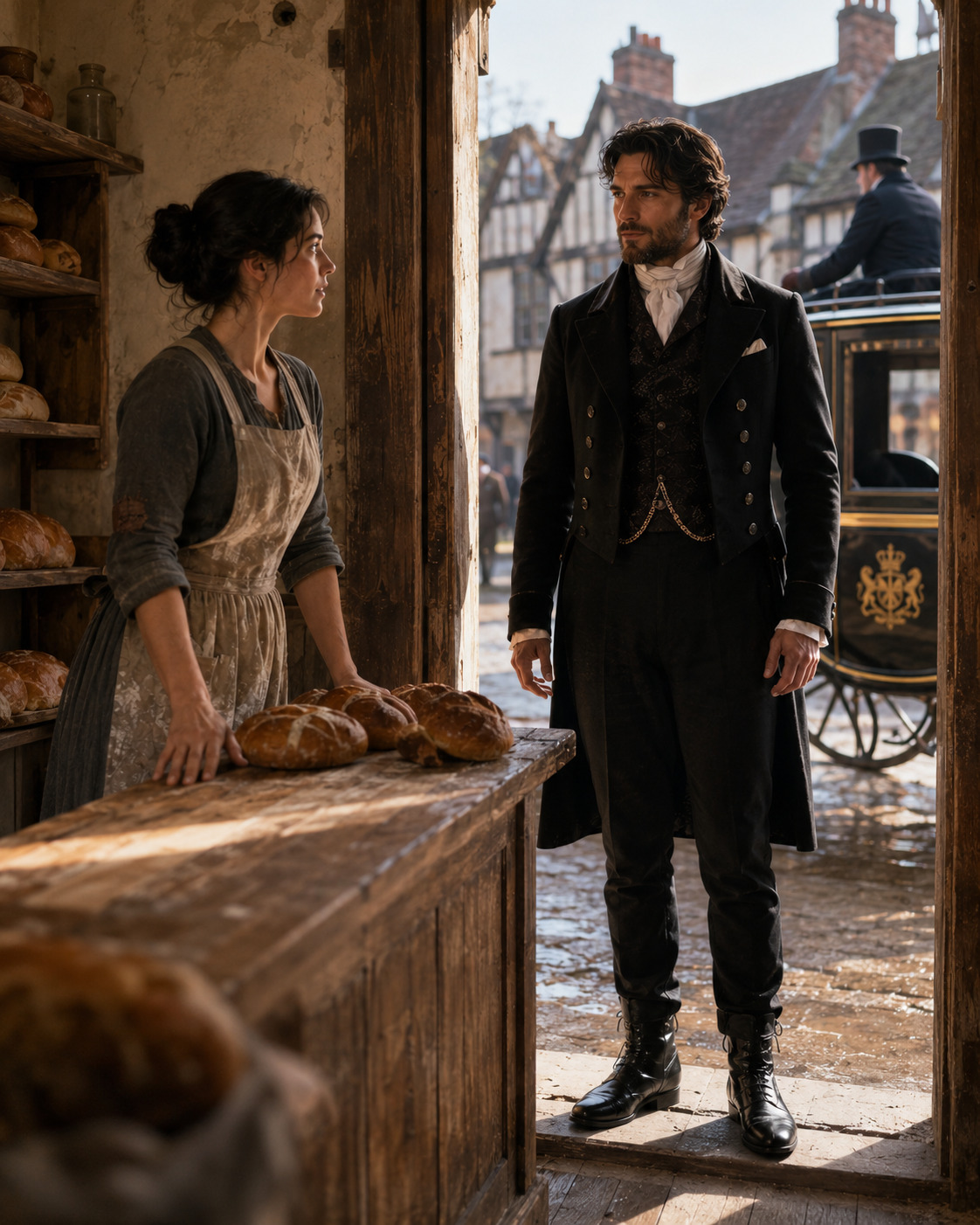
The following morning, Dorian did not come. He stayed away for two days, and although I told myself beggars always moved on, his absence hurt more than I wanted to admit. On the third morning, a polished black carriage stopped outside my bakery. A footman opened the door, and Dorian stepped down wearing a dark coat with silver buttons, polished boots, and the unmistakable authority of a man born to command. The beard was gone, the dirt was gone, but his eyes and voice were the same. “Who are you?” I demanded. He removed his gloves and told me his real name was Dorian Vance, Duke of Hartstone. He owned vast estates, thousands of acres, and more wealth than our town could imagine. He had disguised himself because three women had claimed to love him while secretly wanting only his title and fortune. He came to our town to discover whether kindness without calculation truly existed. “So you tested me,” I said. “You watched me go hungry while you pretended to have nothing.” He tried to explain that I had restored his faith in people, but all I could feel was betrayal. I told him to leave and never return unless I sent for him.
He obeyed. For three weeks, he remained at the inn without appearing at my door. During that time, I learned things he had never intended me to know. He had secretly paid for an old widow to keep her cottage, covered a mill worker’s medical bills, bought a warm coat for a homeless man, and helped families throughout town without allowing anyone to speak his name. An elderly woman told me Dorian spent each afternoon sitting alone beside the inn window and barely touched his meals. That night, I finally understood the difference between a wealthy man buying gratitude and a lonely man quietly trying to become worthy of the kindness he had received. I walked to the inn and found him in a small room wearing a simple shirt, looking thinner and more exhausted than before. He admitted that he had wanted something from me from the beginning, not my bakery or obedience, but proof that someone like me was real. “I wanted to return every loaf, every bandage, and every kindness a hundred times,” he said. “I have not slept because I do not know whether you will ever forgive me.”
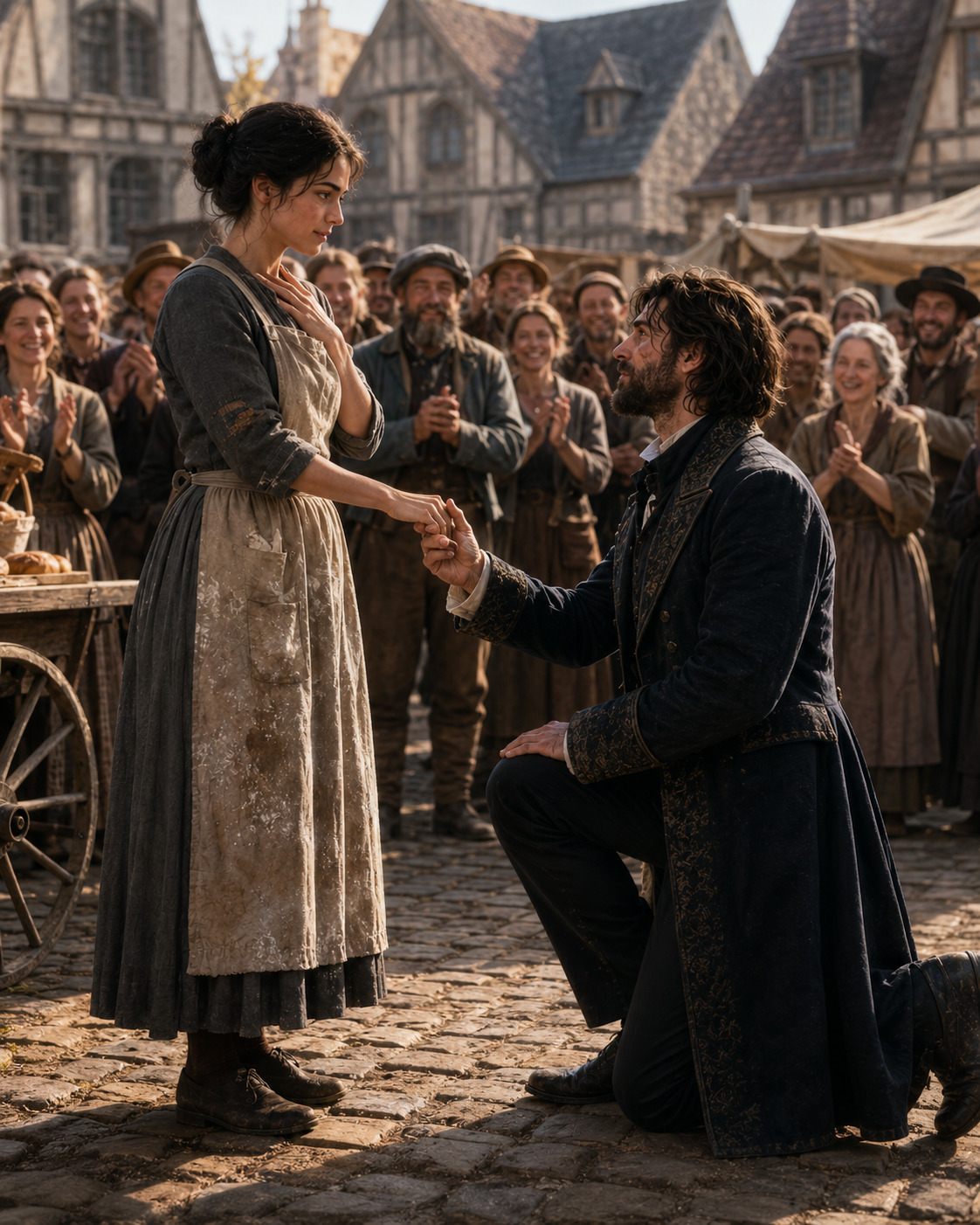
I took his healed hand and told him I forgave him, but forgiveness did not erase what he had done. Trust would have to be rebuilt honestly, without disguises or tests. He agreed. The next morning, he came to my bakery on foot, dressed as himself, and paid one ordinary coin for one ordinary loaf. He returned the next day and the next, helping me carry sacks of flour, drinking tea beside my fire, and allowing the entire town to watch a duke learn the rhythm of a small bakery. When Mr. Pell publicly called me a fortune hunter, Dorian warned him never to speak of me disrespectfully again. Then, in front of the entire market, he took my hand and asked me to marry him. I said yes, not because he was a duke, but because beneath the title stood the same man who had helped a stranger repair a broken cart, refused my last piece of cheese, and learned that kindness mattered only when it expected nothing in return.
One year later, I stood in the great kitchen of Hartstone shaping loaves with flour on my hands while Dorian watched from a wooden table. I was a duchess now, but I still baked every morning. Hungry children came to the kitchen door, widows found rooms on the estate, and no traveler was turned away because he lacked a coin. One morning, I wrapped the finest loaf and handed it to a poor boy whose mother was ill. “Tell her the price went down today,” I said. Dorian smiled because he remembered. I had once given bread to a penniless stranger, believing I was helping someone who had nothing. In truth, I gave him something his wealth had never been able to purchase: proof that goodness still existed. He gave me a larger home and a powerful name, but I gave him the courage to look at the suffering he had once been taught to ignore. And together, we built a life where bread was never only bread. It was dignity, mercy, and the quiet promise that no one standing hungry at our door would ever be treated as invisible.