At ten o’clock at night, Yulia stood at the window of a stranger’s apartment, looking into her own life as if it were an aquarium. The light was on only in the kitchen. Maksym walked back and forth, making tea or coffee, talking cheerfully to someone she couldn’t see. She raised the binoculars a little higher and froze.
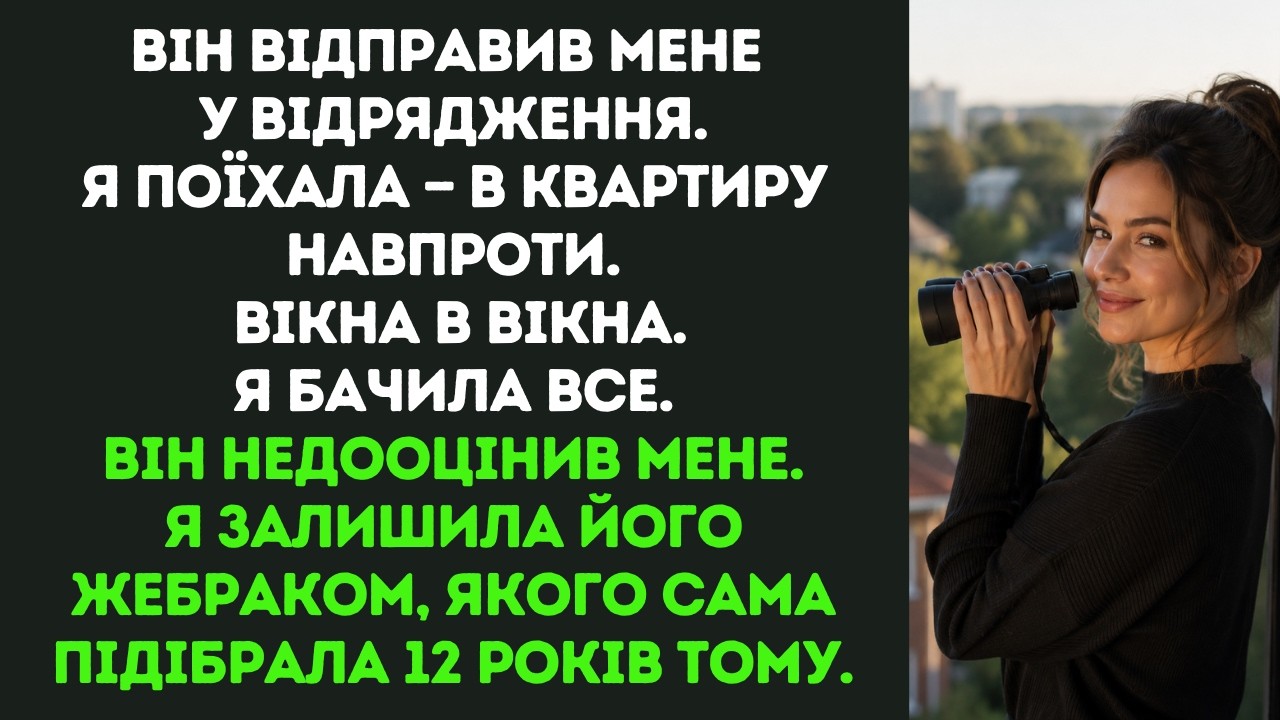
A shadow moved in the hallway behind him. She lowered the binoculars, took out her phone, and typed a message to Dmytryk’s nanny. All fine. I’ll be away on a business trip for a week.
Her fingers were shaking as she pressed send. In her apartment across the street, the kitchen light went out. A second later, the bedroom light came on. Three days before that evening, she had still believed she was just overthinking things.
Yulia met Maksym twenty years ago, when he sang in the underground passages of Khreshchatyk for spare change and dreamed of his own album. She worked at an advertising agency, knew how to negotiate with people, and could stretch money further than anyone. She believed in his voice before anyone else did. She sold her brand-new car to pay for his first studio session.
She drove him to concerts for years, wrote letters to wedding and corporate event organizers, while he learned how to hold a microphone. Now Maksym had two million subscribers, a contract with a major concert agency, and a schedule booked six months in advance. She remembered his first big concert at the Palace of Sports as clearly as if it were yesterday. He forgot the lyrics for the second verse, stopped in the middle of the song, and the hall went silent for a second.
Yulia stood backstage and silently sang the rest for him. Then he winked at the audience, laughed into the microphone, and said: Sorry, forgot who I’m singing for. The crowd erupted. After the show, he lifted her up in the corridor, right there among the equipment cases, and spun her until she was dizzy.
Maksym rarely gave her those moments anymore. Last year, for Dmytryk’s birthday, they celebrated at a restaurant. Maksym kept leaving the table to take calls while the boy blew out his candles, staring at his father’s empty chair. Yulia photographed the cake to show him later.
He looked at it for three seconds, nodded, and said, Looks great, without lifting his eyes from his phone. Three months ago, Maksym started placing his phone face down everywhere—on the table, on the nightstand, in the kitchen. He never used to think about it. She asked him about it one morning, casually.
He gave her a long look and laughed. Are you serious, Yulia? I trust you completely. But if you’re noticing that, maybe you’re the one hiding something.
She didn’t answer. Two weeks later, Nastenka called—an old friend from university. You won’t believe it, I can’t find decent renters for that apartment across from you. It’s been empty for a month.
Then she laughed. Why do you want it? You don’t have enough space? I just need it for a week, Yulia said.
Nastya stopped laughing. There was silence. Yulia? Are you there?
Is everything okay? Everything’s fine, Yulia said, looking at her cold coffee. Just a little tired. Nastya waited for her to say more, but she didn’t.
Fine, she said at last. Pick up the keys from the concierge. Just don’t forget to water the flowers on the windowsill. The previous tenant left them.
Inventing the business trip was the easiest part. The head of the concert department had really been hospitalized with appendicitis two days before the equipment exhibition in Lviv. Yulia simply told Maksym she would go instead for a week. He didn’t ask for details.
He nodded, scrolling through his phone. She left at seven in the morning, drove around the city on the ring road, and forty minutes later was carrying her suitcase into the apartment across from her own building. For the first evening, she just sat in the dark and watched ordinary life continue without her. Dmytryk did homework at his desk.
The nanny, Halyna Petrivna, cooked dinner. Maksym came home late and went straight to the shower. Yulia sat on the floor with the binoculars in her lap and thought she must look insane. A grown woman, spying on her own apartment as if it were someone else’s.
For five days, she recorded times and license plates of cars that arrived late at night and left at dawn. She photographed everything with the flash off, storing the images in a folder labeled Work Notes. Among the photos was a bank notification about a rent payment—for some apartment, paid from the agency’s account. She photographed it out of habit, along with everything else.
It looked like a routine expense for artist accommodation during tour. On the third day, Roman, the agency director, called her. Yulia, I’m not getting into your personal life, but you asked me about that clause in the contract. I looked at it again.
If you have evidence, not just suspicions, you have the right to request a review of your shares. Just tell me when you’re ready, and I’ll help you handle it properly. She thanked him and hung up. At that point, she trusted Roman more than anyone except maybe Nastya.
On the fourth day, Maksym suddenly walked to the window of the living room and stared directly at the building across the street, as if he sensed something. Yulia stepped back into the darkness, pressed her back against the wall, and held her breath until she saw him move away. Her heart was pounding so hard she could hear it in her ears. She sat on the floor for another twenty minutes before daring to approach the window again.
That evening Nastya called just to check on the apartment. Yulia looked at her own reflection in the dark window: pale face, messy hair, a cup of coffee in her hand. It’s fine, she lied, and hung up. On the sixth day, she finally saw her face.
It was Alina, the backing vocalist from the last tour. A twenty-six-year-old girl Maksym had hired on the sound engineer’s recommendation. Yulia had seen her before at rehearsals: quiet, smiling, always carrying a notebook. Now that girl was standing in Yulia’s kitchen, wearing Yulia’s silk robe, frying eggs while Maksym wrapped his arms around her from behind.
Yulia sank to the floor by the window, hugged her knees, and sat there without moving until it got light. That morning she wrote to Roman: I’m ready. What should the evidence look like for the notary? He answered within a minute.
Come to the office tomorrow. We’ll do it right. Yulia came home after a week, as promised, with her suitcase and exhibition booklets in her bag for credibility. Maksym met her at the door with flowers, kissed her cheek, said he’d missed her.
She kissed him back and asked how his week had been. The usual, work, rehearsals, he said, not looking at her. Dmytryk ran to meet her, and for a few seconds she forgot everything. She just held her son and breathed in the smell of his hair.
For two weeks she lived a double life. At home she made breakfasts and smiled. At night, when everyone was asleep, she wrote to Roman. She met the notary during working hours, while Maksym was at rehearsals.
Roman helped her process the photographs, print the call records, get a statement from the building security guard. Everything was done neatly, with stamps and dates. Three weeks later, the concert agency unexpectedly cancelled the New Year corporate tour. The main partner, a baby food manufacturer, had caught wind of the scandal involving the backing vocalist.
They didn’t want their brand near Maksym. The contract cost the company over a million hryvnias in lost profit. Maksym came home furious. Who leaked this to the press?
Who did this? Yulia stood in the kitchen, holding a bread knife, and didn’t move. I have no idea what you’re talking about. Don’t lie to me.
He slammed the counter with his fist. Yulia flinched, but she didn’t drop the knife. The next night, after Dmytryk had fallen asleep, she heard Maksym’s footsteps in the hallway. He stopped in the doorway of the bedroom, shadowed, his voice flat.
You’re not as clever as you think. If you try to take me to court, I’ll make sure everyone knows what you did. I’ll take Dmytryk. I’ll make sure you lose everything.
She lay still, staring at the ceiling. She kept her voice even. We’ll let the lawyers decide what you get to take. He left the next morning like nothing had happened.
At breakfast, he kissed the top of Dmytryk’s head and told Yulia he’d be late from rehearsal. She nodded, scraped his plate into the sink, and thought: this is what it looks like when a man believes you will never leave him. That afternoon she texted Roman: I’m ready. They met at a small café.
Roman looked at her for a long moment over his coffee. You understand this kills the old contract, right? There’s no coming back from it. She slid a folder across the table.
Inside were photographs, timestamps, security logs, the lease payment notification, the press article. I’ve been watching him for a week from the apartment across the street. I have what I need. Roman flipped through the pages slowly.
A muscle in his jaw tightened. You know this won’t stay private. The press will have a field day. Yulia smiled without warmth.
Maybe. But I’ll have the company, and I’ll have my son. Let them talk. Words don’t pay the bills.
That night she sat in the living room until after midnight, looking at the light in the window across the street. Maksym was still at the studio. She thought about the girl in her kitchen, in her robe, frying eggs. She thought about how she had built a career for a man who once couldn’t afford a microphone.
She thought about the years of letters to wedding planners, of driving him to gigs in a car she’d sold for his dream. She was not a victim. She had been a builder. Now she was just taking back the bricks.
The next morning, Maksym found the folder on the kitchen counter. He flipped through it in silence, then looked up at her. His face had gone pale. You’ve been planning this for months.
Years, she said quietly. He tried to laugh, but it fell short. You think you’re going to take everything from me? I’ll fight you on this.
She didn’t blink. You have two choices, Maksym. We can settle quietly, and you walk away with your career and some dignity. Or I hand this to the press, and you watch it burn down from the outside.
Either way, I’m walking with Dmytryk and half the company. The only question left is whether you want to be smart about it. He stared at her for a long time, waiting for her to blink. She didn’t.
That evening he packed a suitcase and left. The next day, Yulia sat at the kitchen table with Dmytryk. He looked up from his pancakes. Will Papa come back?
She thought about the right answer. She had been giving him the right answers for years. I don’t think so, baby. But you and I are going to be okay.
That she could promise. He nodded, apparently satisfied. Can I have more syrup? She handed it to him and watched him eat.
Outside the window, the light in the other apartment flicked off. She had spent a week watching her own life from across the street. Now she was back inside it, sitting with her son, holding the pieces. Moment after moment, she replayed that last argument in her head.
Maksym had stood in the kitchen, veins pulsing in his neck, and she had simply watched him, arms crossed, calm as frozen water. When he finished, she asked, Are you done? He blinked. What?
Are you done? Because I am. She set the folder down in front of him. I recorded everything.
For the last eight months, I kept the receipts. I have bank records, call logs, dates, times, and a very talkative sound engineer who doesn’t like you anymore. You can sign an agreement to leave quietly, or the media can call it an exit scandal. Your choice.
His hands had been shaking. Where is this coming from? A woman who’s done being invisible, she said, and pushed the pen across the table. He signed.
His signature was jagged, almost illegible. She folded the paper before his hand could retreat. Now, two weeks later, she was still standing in the kitchen after Dmytryk had gone to school. She heard mice in the walls, pigeons on the balcony, but no voices.
The house was quiet in a way it hadn’t been in years. She looked at her phone. Twelve missed calls from the agency. She didn’t pick up.
She scrolled to his number one last time, opened the chat, looked at how the conversation had ended. A single message from her: Goodbye. She deleted the thread, then his contact, and watched his name vanish from the list. She didn’t feel the urge to call him.
She felt nothing at all, like a paused song. That emptiness, she decided, was growing back into peace. Dmytryk came home that afternoon holding a picture he had drawn at school. It was a stick figure woman and a small boy, holding hands under a big yellow sun.
She taped it to the refrigerator, right where old photos used to hang. He looked up at her. Mama, are you sad? She noticed his small hand was still wrapped around her fingers.
Not anymore, sweetheart. He squeezed and ran to his room to play. She stood by the fridge with her cup of tea. She thought about the mistake she’d made.
It wasn’t loving someone the wrong way. It was not noticing that she’d been the one doing all the loving. The next time, she would build a mirror instead of a monument. When the front door clicked open, she didn’t jump.
She didn’t run. She simply set down the cup, squared her shoulders, and turned toward the future. This time, she was the one deciding.


