The rain was coming down hard when Marco Ferretti spotted the woman on the bench. She was soaked through, shivering, her expensive white blazer clinging to her skin. Her hands trembled as she mumbled to herself. He approached carefully.
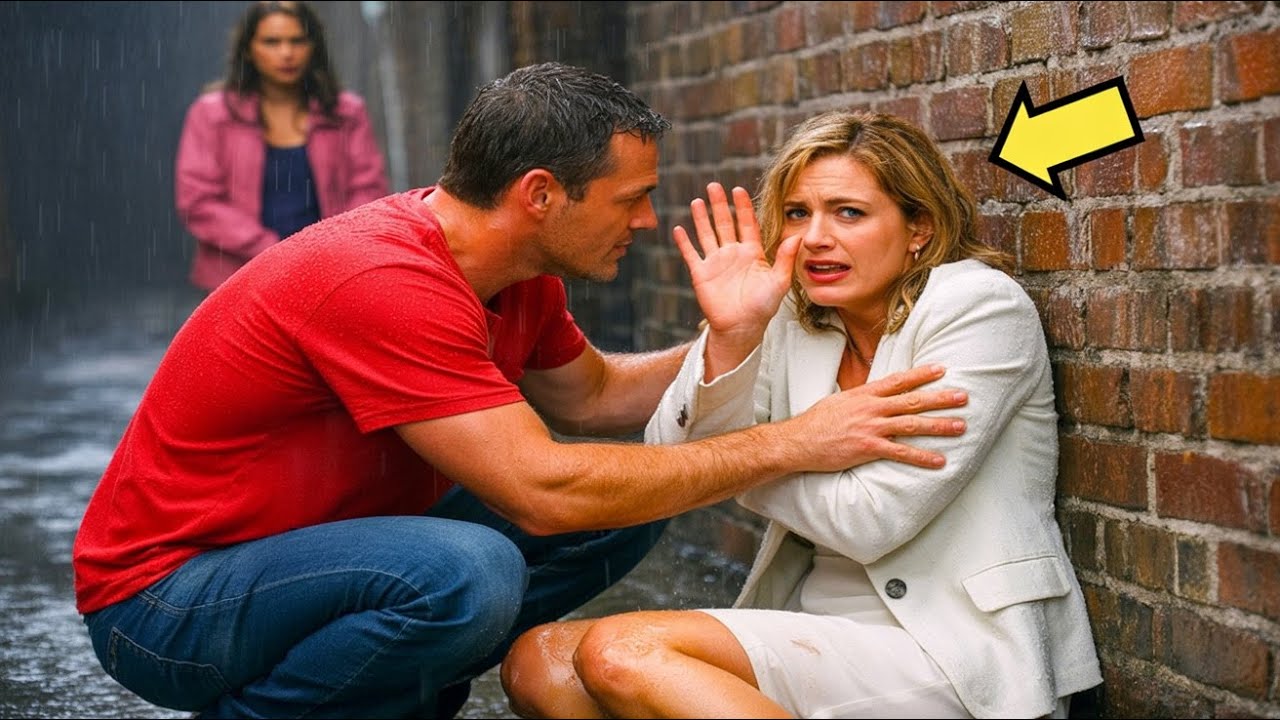
“Signora, are you all right? ”
Her eyes snapped to him, wild with fear. “Please, don’t hurt me. I haven’t done anything wrong.
”
Marco stopped, keeping his distance. She was maybe fifty, blond hair plastered to her face, a gold watch on her wrist. “My name is Marco. I won’t hurt you.
Are you lost? ”
“I don’t know where I am. ” Her voice was barely audible over the rain. “I went for a walk and now I can’t remember how to get home.
”
Something in her vulnerability hit him hard. He’d grown up taking care of his grandmother, who’d had memory problems before she died. “Do you remember your name? ”
She hesitated.
“Francesca. Francesca Rossi. ”
The name rang a bell, but he couldn’t place it. He took off his jacket and laid it over her shoulders.
“Signora Francesca, we need to get you out of this rain. Do you remember a phone number? ”
She closed her eyes, struggling. “There’s a number, but I’m scared.
When I call him, he gets very angry. ”
“Who gets angry? ”
She shook her head and wouldn’t answer. That’s when Marco’s daughter Giulia appeared, running across the square with a colored umbrella.
She was nineteen, studying nursing at the local university. “Papà, what are you doing here? ” Her eyes moved to Francesca. “Who’s this?
”
“This is Signora Francesca. She’s lost and needs help. ”
Giulia approached slowly, holding out her hand. “Hi, I’m Giulia.
I study nursing. Can I help you? ”
Francesca studied the young woman. “I’m not hurt.
At least not on the outside. ”
When Giulia asked when she’d last eaten, Francesca said she didn’t remember. “Yesterday, or the day before. Time gets confused in my head.
”
“Papà, we can’t leave her here,” Giulia whispered. “I have a small house,” Marco said to Francesca. “You can take a warm bath, eat something. Then we’ll figure out how to get you home.
”
Francesca looked between them, terror and hope warring on her face. “Are you good people? ”
“We try to be. My grandmother always taught me that we should take care of each other.
”
Tears mixed with rain on her cheeks. “Okay. ”
At their house, Giulia lent Francesca dry clothes while Marco heated soup. When Francesca came out of the bathroom, she looked different—fragile, but more present.
She clutched her handbag to her chest like it held something precious. “It’s been a long time since anyone treated me with kindness,” she said. Giulia poured tea. “Signora Francesca, do you live alone?
”
“No. I live with my brother, Alessandro. He takes care of me since my mind started getting confused. ”
The way she said “takes care of” made Marco and Giulia exchange a look.
“What kind of care is that? ” Marco asked carefully. “He says it’s for my own good. That I can’t go out alone because I might get lost.
That I can’t talk to strangers. That I have to take the medicines he gives me, even when they make me feel strange. ”
“What medicines? ” Giulia asked.
Francesca opened her bag and pulled out a plastic container full of pills. Giulia examined it, her face growing more serious with each moment. “Who prescribed these? ”
“A doctor Alessandro chose.
Our old doctor disappeared one day, and Alessandro said he found a better one. ”
Giulia showed the bottle to Marco, discreetly pointing at the names. He didn’t understand medicine, but he read the alarm in his daughter’s eyes. Later, Giulia pulled him aside.
“Papà, something is very wrong. Some of these aren’t even for Alzheimer’s, and the dosages are all wrong. One is used for sedation in psychiatric hospitals. Another is a strong antipsychotic that can cause confusion and memory loss if used incorrectly.
”
“Are you saying someone is giving her the wrong medicine on purpose? ”
“I’m saying these drugs could be making her condition worse, not better. ”
They went back to Francesca. Giulia asked about her daily routine.
“I don’t have one. Alessandro says it’s dangerous for me out of the house. So I stay home, watch TV, or sleep. Sometimes he takes me to medical visits or to the bank to sign documents.
”
“What kind of documents? ”
“I don’t know. He says they’re complicated business things I wouldn’t understand. He just points to where I should sign.
”
“Signora Francesca, how did you end up in the square today? ”
“Alessandro was out. I felt clearer this morning, like the fog had lifted a little. I went for a walk and I couldn’t stop walking.
It was like I was looking for something. ”
She was looking for help. Marco was certain of it. Then her phone rang.
Francesca went rigid, her face draining of color. “It’s him. Alessandro. ”
Marco gestured for her not to reveal where she was.
She lied, said she was in the square. Alessandro told her to wait—he was coming. “I have to go,” she said, scrambling to stand. “If he finds out I talked to strangers, he’ll send me away.
He’s threatened it before. ”
“Then we come with you,” Giulia said. They walked Francesca back to the square and positioned themselves near a tree, watching. Alessandro arrived in a black luxury car—tall, gray-haired, radiating impatience.
He grabbed Francesca’s arm hard. “Francesca, what the hell were you thinking? ”
“I just wanted some air. ”
“You have a disease.
You can’t just wander off like a normal person. ”
Marco’s hands clenched into fists. Giulia held him back. Alessandro noticed Francesca’s clothes.
“Where did you get these? They’re not yours. ”
“A kind woman lent me dry clothes. ”
Alessandro didn’t believe her.
He started pulling her toward the car, talking about extra medicine and documents she needed to sign at the bank. Francesca looked back once—and in that look, Marco saw a silent plea for help. The car drove away. “Papà, we can’t let this go.
”
Back home, Giulia checked the records. Alessandro had assumed control of Francesca’s businesses about a year ago, after getting power of attorney. In the months since, several properties had been sold at below market value—all to companies he controlled. Then their elderly neighbor called.
She’d seen a blonde woman trying to escape from a black car on their street, screaming for help. The next morning, Marco and Giulia went to the Rossi villa. Francesca let them in, terrified but relieved. The house was luxurious but neglected—dust on the furniture, dead flowers in vases, the smell of medication in the air.
Giulia examined the current medications. They were even worse than the ones before. “Papà, these could make a normal person seem severely demented. If she really does have Alzheimer’s, these are accelerating it.
”
Francesca told them something else: she’d remembered a conversation where Alessandro laughed about how easy it had been to get her signature on property sales. And she was certain—she had never given him full power of attorney. Only a limited one for managing accounts while she recovered. They contacted Dr.
Bianchi, the original doctor Alessandro had pushed out. He was still practicing and agreed to see her urgently. At the clinic, Dr. Bianchi was alarmed.
“These medications are not just inadequate for Alzheimer’s—some are contraindicated. They could cause severe confusion in a healthy person. ”
“So I don’t have Alzheimer’s? ” Francesca asked.
“You do. But it’s mild, early-stage. With proper care, you could maintain a good quality of life for many years. ”
Francesca began to cry.
“So I’m not going crazy? ”
“No. You’ve been systematically drugged to make it look like you were. ”
Then the doctor revealed more: Alessandro had visited him months earlier, asking when Francesca might be declared legally incapable.
When Dr. Bianchi said she was fine, Alessandro had grown cold. Shortly after, the doctor was pushed out of his hospital position under pressure. They brought in a lawyer, Laura Conti, who specialized in elder rights.
She was shocked by the evidence. Restraining order granted. Property sales suspended. Investigation opened.
Alessandro arrived at Marco’s door with lawyers and warnings of kidnapping charges. Francesca faced him herself. “I know about the sales. I know you sold my properties without authorization.
I know you gave me a false power of attorney. ”
Alessandro’s composure cracked. His lawyers whispered in his ear. He left with threats, but he was shaken.
The case moved fast. With Dr. Bianchi’s testimony and the documentation from the property office, Alessandro’s position collapsed. His lawyer offered a deal: return all the properties in exchange for no criminal charges.
Francesca accepted. “I want my freedom more than I want revenge,” she said. She moved back into her house, but it wasn’t a prison anymore. She asked Marco and Giulia to live with her on the property.
She created a foundation to protect elderly people from abuse, naming Marco as administrator. Giulia shifted her studies to gerontology. The foundation grew quickly. They helped more than a hundred families in the first year alone.
Dr. Bianchi joined as a medical advisor. An old nurse named Annaluisa, who had contacted Francesca years earlier about elder abuse, became part of the team. Then Alessandro requested a meeting.
He was a shadow of his former self—grayer, thinner, humbled. He apologized, confessed the full truth: the debts, the greed, the fear that had driven him to drug his own sister. Francesca listened silently. When he finished, she said, “I forgive you, Alessandro.
Not because you deserve it. But because I deserve to live without hatred in my heart. ”
She told him she never wanted to see him again—and added that his name was on the foundation’s plaque, a reminder of exactly why their work mattered. Years passed.
Francesca’s Alzheimer’s progressed, but she lived fully. She helped rescue Beatrice Moretti, another woman trapped by predatory relatives. She kept working until her mind wouldn’t let her. On one of her last clear days, she gathered Marco, Giulia, and Annaluisa.
“Promise me you’ll continue. Don’t make the foundation a memorial. Keep growing, keep helping, keep fighting. ”
They promised.
She died peacefully two weeks later, in her garden, with her chosen family around her. More than five hundred people attended her funeral. The foundation became one of Europe’s leading organizations for elder rights. Giulia became a national authority on elder abuse.
Marco wrote a book. Decade after decade, the work continued. Fifteen years after that rainy afternoon, Marco sat on the garden bench where Francesca used to rest. The moon was full overhead.
He closed his eyes and saw her again—soaked, terrified, alone on a bench in the square. “Grazie, Francesca,” he whispered. “For teaching me that family is a choice, not an accident. ”
A breeze moved through the flowers she had loved.
Somewhere in the city, another person was deciding to help a stranger instead of looking away. And the story that had started with a simple question—“Signora, è persa? ”—kept going, one act of kindness at a time.