At 7:30 a. m. Oksana’s phone pinged. Payment received: $340.
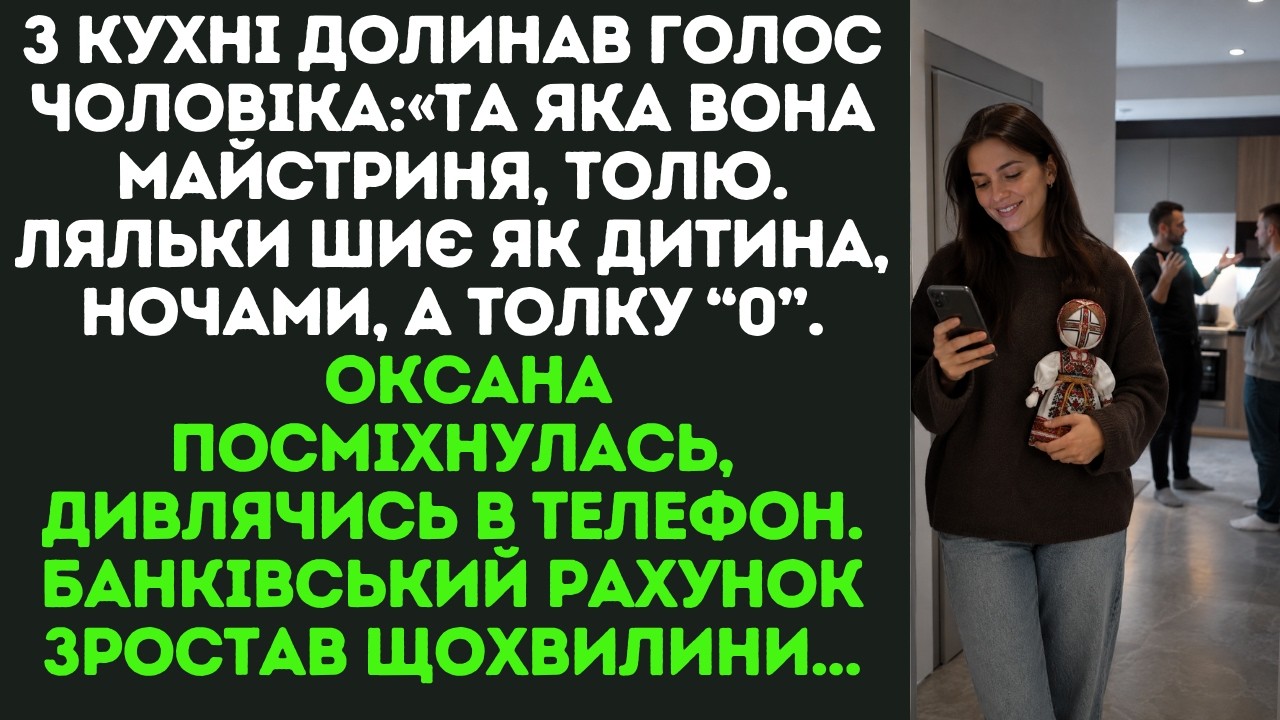
She stood in the hallway in her work coat, just back from a farm shift, still holding her boots. From the kitchen came Taras’s voice—her husband’s voice. He didn’t know she was home. “A craftswoman, Tolya?
She sews dolls like a child. ”
The phone pinged again. Another order, from Germany. Oksana set her boots down quietly, walked into the kitchen, and placed the phone screen-up on the table in front of him.
Three months ago, Oksana didn’t know the password to her own email. She kept it on a scrap of paper under the keyboard. She worked at the farm beyond the village, checking the milking line, changing filters, scrubbing pipes. The work was physical, monotonous, and shift-based.
Taras drove a tractor at the same farm and had an exemption because he was the only one who could fix the machinery. Their daughter Yarina, fourteen, spent her evenings on her phone and answered every request with “uh-huh” or “leave me alone. ” Their three-year-old son Danylo slept in the next room. It was because of him that any of this started.
When Danylo got sick in February, with a high fever, Oksana took a week of sick leave. At night, when the child finally slept, her hands wanted something to do. She found her grandmother’s old box of fabric scraps and made a motanka doll the way she’d been taught as a girl. The first was crooked.
The second was better. By the end of the week, five dolls sat on the windowsill, each with the same cross-stitch over the face where the eyes and mouth should be. Her grandmother had never explained why, only said it was so the soul wouldn’t get lost. Neighbor Galina came to visit Danylo, saw the dolls, and stopped.
“Oksana, did you make these yourself? Sell me one. ”
“Take one for free, Galya. It’s just a child’s toy.
”
“Then at least photograph them and put them somewhere. People pay real money for this. ”
Oksana laughed and forgot about it for a week. Then Yarina saw the dolls when she came looking for a phone charger.
“Mom, you made this? ” She turned the doll over, ran a finger across the stitch. “It’s actually beautiful. Let me take a real photo, not on your old phone.
”
It was the first approval Oksana had gotten from her daughter in a long time. She agreed. Yarina set up a page on a foreign craft site in one evening, while Oksana tried to figure out where the login button was. They set a low price, because Oksana insisted no one would pay much for such “nonsense.
”
First order in three days. Second in a week. By the end of the month, Oksana had twelve payment notifications on a phone she still barely knew how to use. She didn’t tell anyone.
She didn’t believe it would last. Taras saw her sewing every evening after a full shift, and said the same thing every time: “You should sleep. You have work tomorrow. ”
“This is work, Taras.
”
“Work is what pays normal money. Not some dollars from the internet once a month. ”
She didn’t argue. She put the money in a tea tin and hid it.
Then a repeat order came from Canada. The same woman ordered two more dolls and left a long comment. Oksana counted the money out loud at the table. It was almost one month of her farm salary.
“That can’t be,” Taras said, picking up the tin. “It can. ”
He went outside to smoke without another word. She watched him go and felt a cold surprise: he hadn’t been happy for her, hadn’t even been happy about the number.
The next morning, at the bus stop, women talked loud enough for her to hear. “They say she’s set up a whole workshop at home. ” “What workshop? She buys fabric by the penny and sews on her knees in the kitchen.
A grown woman, and she acts like a famous craftswoman. ”
Oksana said nothing. When she told Taras that evening, she wasn’t complaining, just reporting. “Why didn’t you say something?
You should have shut them up. ”
“Would you have said something in my place? ”
He didn’t answer. He went out to “fix” the tractor in the dark.
About a month later, Oksana found Yarina’s secret. Yarina had left the account logged in. Oksana, trying to print a receipt, found messages showing her daughter had been handling customers for two months. Yarina translated with a translator, corrected errors by hand, chose the shop name “Matusiv Dolls,” and kept a notebook of client preferences.
“You did all this yourself? ”
Yarina stood in the doorway, arms crossed, ready to fight. “What, I needed permission to help? You would have said, ‘No, I’ll manage.
’ And you would have spent a month fighting with passwords. ”
“Why didn’t you tell me? ”
“Because you’d check every word I wrote. ”
Oksana hugged her.
Yarina resisted, then let herself be held for a second, then pulled back. “Thank you,” Oksana said. “Really. Thank you.
”
Summer brought a new wave. Someone shared the page in a closed group for Ukrainian women abroad, and subscribers multiplied tenfold. Oksana couldn’t keep up. After farm shifts she sewed past midnight.
Her hands ached. Galina came to her almost pleading: “Take me as your assistant. I know how to make motankas too. My husband hasn’t been paid in three months.
”
Oksana didn’t think long. Galina took simple orders. Oksana kept the complicated ones. It was no longer a hobby; it had deadlines and responsibility.
Once Oksana was three days late because of a shift swap, and a client from Germany wrote angrily: “I paid in advance. Where is my order? ” She sat up all night finishing it. Taras watched her bent over her sewing at two in the morning, up again at five for the farm.
“Quit the farm,” he said, “since the dolls earn more. ”
“I can’t quit. I have seniority, pension contributions. The dolls aren’t stable.
Yet. ”
“Yet,” he repeated, jaw tightening. He didn’t speak for the rest of the evening. In late August Danylo started complaining of stomach pain.
The district pediatrician sent them to a surgeon. “Inguinal hernia,” the doctor said. “Small, but don’t wait. There’s a risk of strangulation.
Schedule the surgery as soon as possible. ”
They put him on the list for late October. The orders kept growing. Someone posted a photo of a doll in a blog about Ukrainian culture abroad, and the page gained another wave of subscribers.
Galina couldn’t keep up. Oksana couldn’t either. The tea tin became a bank account, opened by Yarina through the phone app. Then the letter came.
Oksana thought it was spam. It was in English, signed by Marta Voloshyn. Yarina translated it over dinner, her voice rising. “Mom, this is a museum.
A museum of Ukrainian heritage in Toronto. They want your dolls for a permanent exhibition. They want you to come for two weeks. They pay for everything.
”
Oksana ran her finger along the lines, though she couldn’t understand English. “Two weeks. I can’t. Danylo’s surgery.
”
“When is the surgery? ”
“Three weeks from now. The same week as the exhibition. ”
Taras, silent until then, set down his fork.
“I already traded shifts for that week. Tolya asked me to swap because his father-in-law died. ”
“Taras, I never told you about the exhibition. How did you know to take that week off?
”
“I didn’t. It just worked out. ”
Oksana stared at him. There were too many questions in her head to ask out loud.
The next day, she and Yarina made a list. Who would take Danylo to the hospital. Who would be at the surgery. Whether the exhibition could be postponed.
Oksana wrote to Marta: Can I come later? Marta’s answer came in an hour: the dates were fixed to the opening of the museum’s new wing. But she added one sentence that made Oksana read the message three times:
“If you can’t come in person, I understand. But I want you to know that among the exhibits in the new wing is a doll that I very much want to show you.
”
Oksana didn’t understand what doll Marta meant. But she decided to go. Galina and her husband agreed to handle Danylo’s operation. Oksana bought the ticket herself and announced it at dinner, looking directly at Taras.
“I’m going. Danylo will be in good hands. I’ve arranged everything. I’ll be back in two weeks.
”
Taras got up and went into the yard. She heard metal clang—a bucket, an old canister—and the sound echoed long after. The night before departure, Taras sat on the edge of the bed and looked at her suitcase. “I’m scared,” he said.
“Not about Danylo. Scared that you’ll go there, see how people live, and won’t want to come back. ”
“Taras, I won’t leave you because of dolls. If I ever leave, it won’t be because of them.
”
He didn’t ask what she meant. He turned off the light. They lay side by side, not touching, each thinking about tomorrow. In the morning, Danylo gave her his favorite stuffed animal, a worn octopus missing one eye.
“Take it with you,” he said seriously, “so you won’t be afraid. ”
She put it in her bag. At the Warsaw airport, after passport control, she stood at a window watching planes take off before she could make herself walk to the gate. The plane landed in Toronto in the morning.
Oksana had never flown before; her hands shook the whole way. She held the small suitcase of sample dolls on her lap, afraid to check it. Marta Voloshyn, a woman of about sixty with gray hair in a strict bun, met her at arrivals with a handmade sign: “Oksana Dorosh from Matusiv. ”
Seeing her village name written in someone else’s hand on another continent felt strange.
“You have no idea how long I’ve waited for this,” Marta said, taking Oksana’s hand. In the museum, preparing the new wing, Marta led her past old displays: embroidered shirts, rushnyky, old ceramics. Then she stopped at a glass case in the corner. Under dim light lay one single doll.
The fabric had faded to gray, but the stitch pattern on the face was clear. The same cross-stitch over the eyes and mouth. The same one Oksana’s grandmother had shown her without explanation. “This doll has been in the museum’s collection since 1948,” Marta said.
“It was brought by a woman who emigrated from Ukraine after the war. The records say she came from the village of Matusiv, Cherkasy region. Her name was Odarka. ”
Oksana felt her spine go cold.
Odarka. Her grandmother’s sister, spoken of rarely and reluctantly: she left and never once wrote home. “Odarka Hnativna,” she whispered. Marta opened a folder with a copy of an immigration form.
“Hnativna. So you know her? ”
“She was my grandmother’s sister. We thought she simply disappeared.
No letters, nothing. ”
Marta was quiet for a moment. Then she said, almost in a whisper, “I’ve been director of this museum for twenty years, Oksana. My mother was Odarka’s friend.
When I saw your doll photos online—the same cross-stitch, the same way of wrapping the thread—I couldn’t believe my eyes. That pattern is made in only one village. In only one family, as far as I know. I did not write to you by accident.
”
Oksana stood in front of the case, looking at the old doll, and at her own doll that she had carried across the ocean. For the first time in months, she couldn’t speak. The opening of the new wing took place a week later, on Saturday evening. Oksana stood next to her own display.
Five dolls she’d brought were placed beside Odarka’s old doll, under a single sign: “Matusiv, Cherkasy region. A tradition that didn’t break even when the connection did. ”
The hall filled. Diaspora members, local Ukrainian press, and several older women who came up to the case and cried, unashamed, recognizing the pattern from their own childhoods.
Marta took the microphone. “Twenty years ago my mother died without telling me everything about her friend Odarka. I grew up knowing one doll and one village name. Today, thanks to this woman standing next to me, we will know much more.
”
She called Oksana over. Oksana hadn’t prepared a speech. Her hands trembled. “I didn’t know that when my grandmother showed me the stitch on the doll’s face, she was passing down anything more than a pattern,” she said.
“She was just teaching me to sew with my hands. To keep our culture and our history. ”
Marta hugged her, and they stood there, both crying, while the hall applauded. Oksana’s phone buzzed.
A message from Galina: “The surgery went well. Danylo is awake. He asks where you are. ”
Oksana pressed the phone to her chest.
She went home four days early. Marta shortened the rest of the program without being asked. Taras met her at the station with the children. Danylo moved carefully, holding Yarina’s hand, and then let go and shuffled toward his mother, ignoring the stitches.
“Careful! ” Oksana crouched and caught him gently. Taras stood aside with his hands in his pockets. When she looked up at him, he walked over and hugged her in front of everyone.
“I watched the opening video,” he said into her ear. “The whole village watched it. Even my mother cried. ”
She pulled back and looked at him.
“What did you feel? ”
He took a long time. “Pride. And fear.
Both at once. I still don’t know what to do with that. ”
Two weeks later, Marta made a new offer: steady cooperation. The museum wanted dolls for its souvenir shop, with Oksana traveling at least twice a year.
The money was serious—more than she and Taras together made in a year. Oksana told Taras at dinner. He sat with his fork in his hand. “Twice a year, you said?
”
“At least. Maybe more, if it goes well. ”
“What am I supposed to do? Sit here with the children while you fly around the world?
”
“You can’t leave, Taras. I know it’s not fair. But I can’t say no to what I built just because it hurts you to watch. ”
“Can I once say that I can’t do it anymore?
” His voice rose. “I’m tired of being the one who stays. Who can’t leave. Who watches his wife become someone I wanted to become.
”
“This isn’t a competition. ”
“For me it is. ”
He stood up. The chair scraped the floor.
“I can’t pretend I’m happy for you anymore. Every time you mention a ticket, something breaks inside me. ”
He left. He didn’t come back that evening.
He filed for divorce a month later, after she’d signed the museum contract. He brought the papers to the table calmly, without anger. “I thought about it a lot. This isn’t because of the dolls.
It’s because I can’t live next to someone who made it when I can’t. I don’t want you to find that out a year from now, when it’s worse for all of us. ”
She took the papers. The letters blurred.
“What about the children? ”
“Danylo stays with you, of course. Yarina can decide. She’s almost grown.
The house stays with you and the kids. I’ll live with my parents for now. ”
He packed a small bag, said goodbye to the children, and drove away that same evening. Oksana stood at the window watching the taillights disappear.
A week later, while putting Danylo to bed, she sat in the dark listening to his steady breathing. She didn’t think about the court, or the property, or even about Taras. She thought about Odarka, who had left seventy years before and never written home. Maybe she hadn’t had a choice between family and herself, either.
Maybe the choice just happened without asking. Oksana took the worn octopus from the suitcase and put it on her son’s pillow. She thought, I didn’t betray anyone. I just became myself.
And Taras couldn’t handle that version of me. She didn’t know if that was the right answer. She only knew that for the first time in years, she didn’t feel guilty for deciding her own life.