The phone call started like a minefield. Vlod had spent days choosing his words, rehearsing them until they felt almost safe. “Mam,” he began, wiping his sweaty palms on his jeans. “Varya and I were thinking.
Maybe this season we just buy potatoes at the market. It would be cheaper, and we need to watch our health. ”
Silence. The kind that pressed against the ear like a coming storm.
“Buy them? ” Her voice climbed into a shriek that made him pull the phone away. “You mean you’re not coming? I’m here alone, sick, working myself to the bone, and you want to sit in your soft city flat and do nothing?
”
They had been through this every weekend for twenty years. The same garden, the same dirt, the same aching backs. But now something had cracked open. Varya had done the math one suffocating evening, her arthritic fingers stained with the numbers.
“Thirty hryvnias per kilo at the market,” she said, sliding her glasses off. “We haul ten sacks, maybe three hundred kilos. Nine thousand hryvnias. Meanwhile we spend forty thousand on petrol alone.
Every single season. Not counting the repairs your mother’s road costs us, not counting the medicine we need afterward. ”
She held out her hands, fingers already starting to twist from the arthritis. “I don’t want to be an invalid by sixty.
We put the kids on their feet. We deserve our own life. ”
The silence between them stretched across the kitchen. Vlod looked at his wife’s hands and felt the shame settle in his chest like lead.
The next time his mother called, she didn’t shout. She whimpered. “I measured my pressure yesterday. One-eighty over one-ten.
” A wet sniff echoed through the speaker. “The doctor said if I go into that garden again, I’ll have a stroke. Is that what you want? Your mother dying alone?
”
“I don’t want that at all,” Vlod said tiredly. “I told you, we’ll come in two weeks. ”
“Two weeks! The weeds will swallow everything by then!
Come this weekend. And bring Varya. ”
“Varya is not coming,” he said, surprising himself with the firmness. “Her back is bad.
She owes you nothing. ”
The shriek returned. “Nothing? I spent my whole life working for you people and she owes me nothing?
”
The tirade rolled on. Vlod listened with half an ear, cracked with exhaustion. When it climbed to full volume, he pressed the button and ended the call. In the kitchen, Varya was pretending to read.
“So? ” she asked without looking up. “We’re not going this weekend. ” He lowered himself onto a chair and buried his face in his hands.
“I’m tired. I just want to lie on the couch and do nothing. ”
She set her book down and studied him for a long moment. Then a rare smile crossed her face.
“You mean that? ”
“I mean it. I’ve done everything for that woman. Brought water into her house.
Drilled a well, bought a pump, laid the pipes. Built her a warm toilet so she wouldn’t have to run outside in winter. Installed a boiler. You know what she said?
‘Why are the radiators lukewarm? ’”
He slumped further. Varya saw the gray in his hair, the deep circles under his eyes, and felt a surge of something between pity and relief. “Let’s just stop going so often,” she said quietly.
“Let her scream. The phone works. We’ll bring her food once a month. She can do whatever she wants with that garden.
”
“I’ll tell her to her face this Friday,” Vlod said, straightening. “Like adults. ”
They drove to Sosnivka on Friday night. Every pothole on that ruined road sent a bolt of pain through Varya’s spine.
They arrived in full darkness, exhausted. His mother waited on the porch in her dress robe, face twisted. “About time,” she snapped. “You said three o’clock.
I nearly died waiting. ”
“Good evening, Mama,” Vlod said, carrying bags of groceries inside. “We’re both tired. Let’s have this conversation without a fight.
”
“Without a fight? ” She lowered into an attack stance. “I sit here in this God-forsaken village alone, and you come with a mood? And your Varya might at least smile out of politeness.
”
Varya walked in, sat on the old sagging couch, closed her eyes. “Please, Lyudmila Ostapivna. Let’s not do this. We need to talk seriously.
”
The old woman’s eyes narrowed to slits. “What nonsense have you two cooked up now? ”
Vlod sat beside his wife and gestured for his mother to join them. She refused, perching on a stool across the room like a judge.
“We’ve made a final decision,” Vlod said, meeting her eyes. “We won’t work your garden. Not this year. Not next year.
Not ever. ”
His mother stared blankly. Then her face looped up and she lunged forward. “What did you just say?
”
“No more garden work,” Vlod repeated, each word deliberate. “We’ll visit once a month, or every two months. We’ll bring food, medicine, help with the house. Chop wood, fix the roof, shovel snow.
But the garden is finished. ”
“Are you insane? ” Her voice cracked into a scream. “I’ll be erased from my own life!
Once a month? Prazka’s daughter visits twice a week! And she’s younger than me! ” She spun, pointing a shaking finger at Varya.
“This is her doing. She’s poisoning you against me. ”
Varya opened her eyes. “I have progressive arthritis.
Every joint in my fingers locks up when I hold a hoe. Do you want me to lose my hands completely? ”
“Arthritis! ” The old woman’s voice dripped with mockery.
“Look at her, a little princess. Spent her life moving papers in a warm office. Never lifted anything heavier than a pen. And now she has arthritis?
I spent my life on the cold ground. My legs are sticks. My back’s a bow. But you don’t hear me complaining.
”
“That’s enough,” Vlod snapped, stepping between them. “Nobody is forcing you to work that land. We’ve told you a hundred times: don’t plant it. We’ll buy you whatever you want.
It’ll make things easier for you too. ”
“I don’t want things easier! ” she shrieked. “I want you to remember who raised you.
I want respect! Not your charity visits once a month like I’m some stray dog! ”
“Charity? ” Vlod’s voice finally rose.
Varya would later remember it as the first time in twenty-five years. “We brought you gas. Water. A new fridge when yours burned out.
A plasma TV on your wall. And when was the last time you said thank you? Just once? ”
His mother gasped for air like a fish on dry land.
Then she recovered. “Why would I thank you for doing what a son should do? It’s written in the law. Children must support their parents.
I’ll sue you for alimony. Half your salary! ”
Vlod’s shoulders dropped, then stiffened. His eyes went flat.
“Go ahead. File tomorrow. I’ll hire a lawyer and file a countersuit for moral damages. Twenty-five years of psychological abuse.
We’ll see who owes who. ”
“You ungrateful beast! ” She grabbed the remote from the side table and hurled it at him. It bounced off the wall in pieces.
“Get out of my house! Both of you! I never want to see you again! I’ll die alone like a dog under the fence before I look at your faces!
”
Varya stood and took Vlod’s arm. “Let’s go. She’ll never hear us. ”
“We’re leaving, Mama.
The food is on the table. We’ll be back in a month. If you still want to see us. ”
They walked into the cool night and shut the car doors.
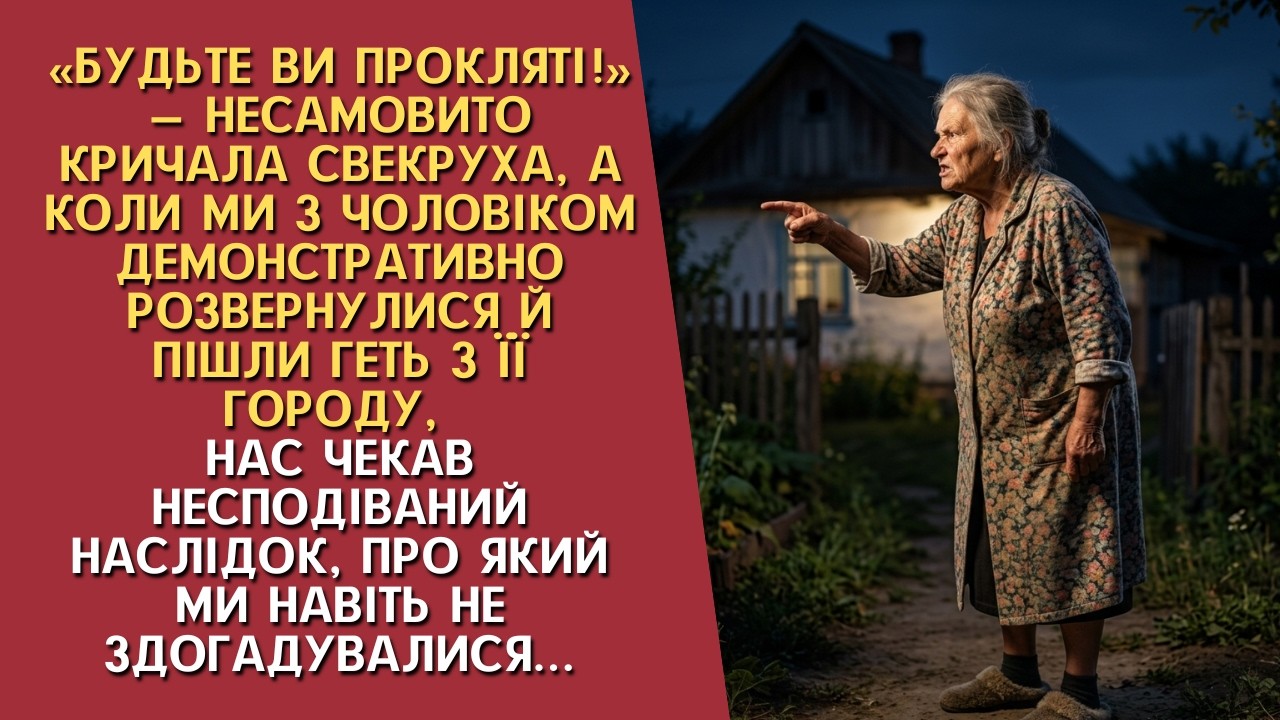
The old woman burst onto the porch in her thin robe, voice shredding the village quiet. Dogs erupted across the street. “Be cursed! May your children treat you the same way!
May you crawl on your knees, Varka, with your arthritis! ”
Vlod started the engine. The headlights cut through the dark yard. As the car swung through the gate, Varya looked in the mirror and saw the small bent figure screaming into the empty night.
Tears she hadn’t expected rolled down her cheeks. Not from hurt, but from the dull certainty that nothing could ever be fixed with a woman who refused to understand. They drove for half an hour in silence. The old Škoda hummed over the ruined asphalt.
Outside the window, trees bent in the dark like memory. Near a twenty-four-hour roadside café, Vlod pulled over. He came back with two paper cups of bitter coffee. “How are you holding up?
” he asked quietly. “Bad. My soul feels heavy. ” Varya wrapped her hands around the warm cup.
“But better than I expected. Like a stone fell off my chest. We did the right thing, Vlod. She would have driven us into our graves over those cucumbers.
”
He took a sip and grimaced. “Do you know what she used to tell me when she was angry? ‘I gave you life. I can take it away.
’ When I was a kid, I thought it was just words. Now I understand she was serious. She really wants to destroy us with her ego. ”
“From now on, we only come when we want to,” Varya said.
“If she starts a scene, we turn around and leave. ”
“And no garden. Ever. Let it rot to the roof.
”
They reached home late. Varya peeled off the pain patch, swallowed double doses of pills, and fell asleep as soon as she touched the mattress. Vlod sat on the dark kitchen, watching his phone. He expected another blow, but nothing came.
His mother stayed silent all night. At ten in the morning, the phone finally rang. “Son! ” Her voice was cheerful and ordinary, as if the curse had never happened.
“Sorry I got a bit hot yesterday. My pressure spiked. So, when will you come to hill the potatoes? The soil is drying out.
”
Vlod looked at Varya, who was pouring tea and listening. He pressed the loudspeaker button. “Mama, I said everything yesterday. There is no garden.
If you want to see us, we’ll come in three weeks. Without shovels. ”
Silence. Ten full seconds.
Then his mother’s voice turned icy and sweet. “Suit yourself. But remember one thing. When I die, don’t expect the house.
I’ll leave it to Pazka the neighbor. At least she respects me. ”
“Go ahead,” Vlod said flatly. “Leave it to whoever you like.
I don’t want anything from you. I wish you health and peace. Goodbye. ”
He pressed end and went to the garage.
Varya finished washing the dishes and turned on her favorite series. And for the first time in over twenty years, she realized she felt no dread. The fear of the hoe, of the endless rows of potatoes, of the burning sun and the new aches waiting in her bones—gone. What replaced it was not joy, exactly.
Not relief, exactly. But a stillness that felt like freedom. They visited Sosnivka two weeks later. The old woman met them with perfect ice-cold silence.
She switched off the television and swept into her bedroom, slamming the door hard enough to rattle the walls. They left bags of groceries on the kitchen table. Milk. Fresh bread.
Cheese. Sausage. Fruit. And then they left.
The garden stood abandoned and wild, choked in weeds taller than a man’s knee. Varya felt the old pull, that hidden reflex telling her to grab a hoe and fix it. She cut it off instantly. One concession would restart everything: the scandal, the blackmail, the broken backs, the empty wallet, the slow dying by degrees.
On the drive home, Vlod turned on the radio. A song came through about letting go of the past. Neither of them spoke. Three months passed.
The old woman called almost every day, but Vlod had his rules now. Calls lasted ten minutes max. The moment she raised her voice or threatened her own death, he hung up. Once, a neighbor told them, she’d tried to work the garden anyway, crawling between the rows on her knees.
But the harvest would most likely rot in the ground, because there was no one left to water it. He offered to hire workers twice. She refused every time with a hiss. “I won’t let strangers into my yard.
”
To each his own poison. They would fight again, certainly. She might truly write her house to the neighbor. None of it mattered anymore.
That invisible line, the one nobody could ever cross, was gone. It had been crossed on a hot night when a television remote shattered against a wall and curses chased a car into the dark. There was no road back.
And on that quiet highway, with the radio playing and the road rolling away behind them like the past itself, they drove home.