On my sixtieth birthday, my son grabbed my shoulder so hard it hurt and forced me to sign over my home while my grandchildren cheered. “Come on, Grandpa. ” Leo, eight years old, laughed and clapped his hands. “Dad says we’re getting a bigger house now.
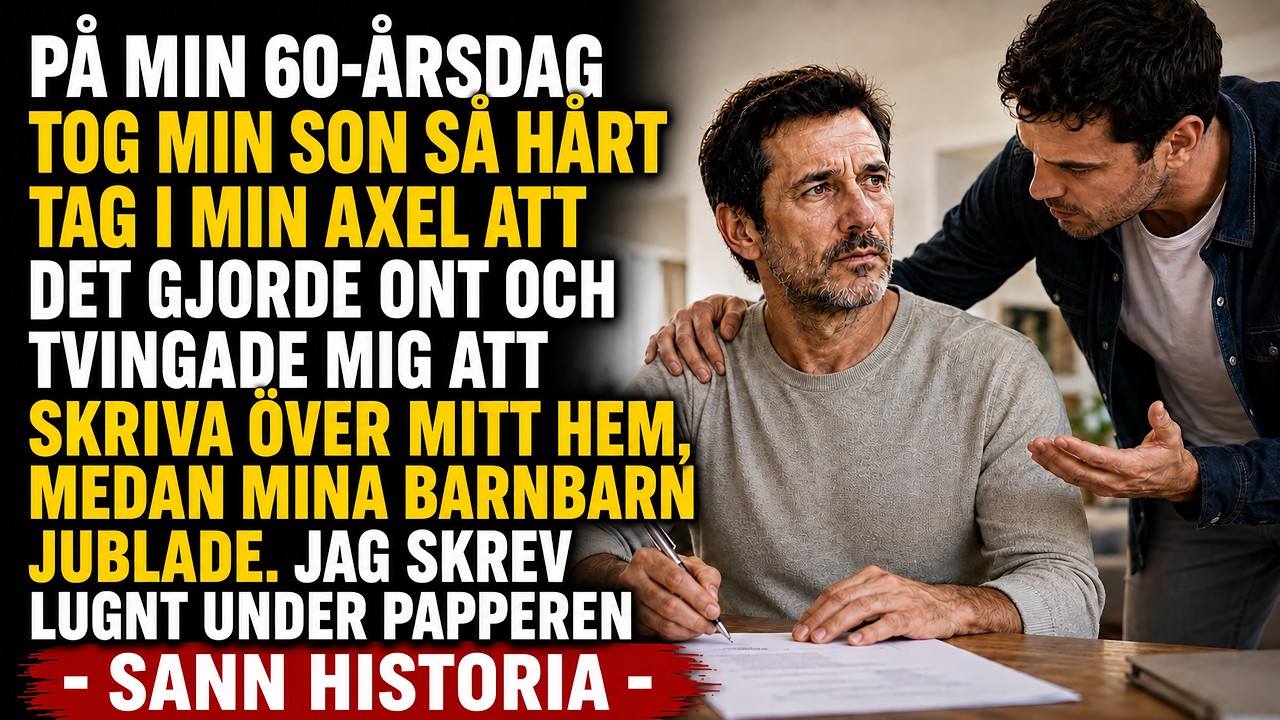
”
I stared at the legal papers scattered across the oak dining table—the same table my late wife and I had saved six months to buy. The birthday cake sat untouched. Sixty candles had melted into small pools of wax. Blue balloons.
A banner that read Happy 60th, Dad. Everything carefully planned. Just not the way I’d thought. “Sign it,” Oscar said between clenched teeth.
His fingers dug into my shoulder. “It doesn’t have to get ugly. ”
Malin pushed a pen toward me. “The lawyer already explained everything.
”
My grandchildren were smiling because they thought this was part of the celebration. None of them understood that their grandfather was being thrown out of the only home he’d ever known. I reached for the pen. No protests.
No questions. Oscar looked surprised. “So you’re actually signing. ”
I nodded.
“I am. ”
I signed every page slowly and neatly, then slid the papers back. No one said a word. I walked to the front door where a brown suitcase waited—packed, closed, ready.
Malin hadn’t forgotten anything. Even my blood pressure medication was tucked into the side pocket. She’d planned this for days. Maybe weeks.
I lifted the suitcase, turned around, and took one last look at the house my wife and I had built together nearly thirty years earlier. The kitchen where she taught our son to bake cinnamon buns. The hallway where pencil marks still tracked his height through every school year. The living room where we’d spent countless Christmas Eves opening cheap presents from discount stores because that was all we could afford.
I looked straight into my son’s eyes. “You have no idea what you just did. ”
His confident smile didn’t move. “Goodbye, Dad.
”
I nodded once. Then I walked out the front door. My name is Sven Holmberg. Until recently, I thought I’d done everything right.
I wasn’t rich, never had been. I spent thirty-eight years as an electrician outside Västerås—long days, cold winters, scorching summers, crawling through basements and construction sites until my knees reminded me every morning that I’d earned every krona the hard way. I retired three months before my sixtieth birthday, not because I wanted to but because my body finally voted against me. The company arranged a small send-off.
Coffee, buns, a gold watch, a framed photo signed by the men I’d worked beside for decades. When I walked through my front door afterward, I expected my family to be waiting. Instead, the house was empty. They’d forgotten.
Oscar sent a message later that evening. *Sorry, Dad, totally crazy day. * I told him not to worry. Parents get used to disappointment long before their children understand they’re causing it.
Oscar hadn’t always been like that. As a little boy, he followed me everywhere. He carried my toolbox even though it was nearly as big as he was. His mother Ingrid died of breast cancer when he was nineteen.
Everything changed after that. I buried my wife, then buried my own grief because my son still needed a father. I worked overtime, skipped vacations, delayed retirement, and sold Ingrid’s jewelry to help pay for Oscar’s studies. I never told him.
He thought the money came from savings. After graduation, I helped him buy his first work truck. When he wanted to start a landscaping business, I drained a large portion of my pension savings for the start-up capital. He cried and promised to pay back every krona.
I laughed and hugged him. “Just build a good life. That’s enough for me. ”
Years later, he married Malin.
Beautiful, smart, confident. I wanted to like her. In the beginning, I thought she liked me too. But slowly, very slowly, small comments started slipping out.
“This area is getting old. ” “You really should renovate the kitchen. ” “People your age don’t need such a big house. ” Nothing openly cruel—just little seeds.
Oscar began repeating them without noticing. “Dad, it must be hard to maintain a house this size. ” “Think about selling while the market is hot. ”
I always smiled.
“I’ll think about it. ”
The truth was, I never planned to leave. Ingrid’s favorite birch tree stood in the backyard. I’d planted it the day Oscar was born.
After my retirement, Oscar and Malin started visiting more often. The grandchildren came too—Alva, eleven, and Leo, eight. I convinced myself everything was finally getting better. Then one afternoon, I heard Malin talking on the phone in my kitchen: “If he could just let go of the house.
” She stopped the moment she saw me, smiled, and asked if I wanted more coffee. I pretended not to notice. Sometimes it’s easier to pretend than to accept the truth. A week later, Oscar invited me to dinner.
“We’ve been thinking about this all year. We want to celebrate your sixtieth at your house. ” Malin nodded enthusiastically. “The kids are already planning decorations.
” Alva bounced with excitement. “It’s going to be the best birthday ever, Grandpa. ”
I looked around the table. For the first time in months, it felt like my family wanted me.
I smiled. “I’d love that. ”
I had no idea they were planning something entirely different. The following weeks were dangerous because they felt genuine.
Oscar called almost every other day. “Dad, need anything from the store? ” Malin showed up with homemade lasagna. In fifteen years of marriage, she had never once shown up with dinner.
Yet there she was, smiling like the daughter I never had. I wanted to believe it. God help me, I really wanted to believe it. One afternoon, Oscar helped me clean out the garage.
We found his old football jersey buried under a shelf. He laughed. “I remember this. You slept with it next to your bed for a month after your first match.
” For just a second, I saw my little boy again. Not the forty-year-old business owner. Just Oscar. That memory made me ignore the small things.
The strange questions. The unusual phone calls. One evening, Oscar asked, “Dad, where do you keep all your important papers? ” I laughed.
“Planning my funeral already? ” He laughed too quickly. “No, no. Just thinking I should know if something happens.
”
About a week later, my neighbor Lennart stopped me while I was getting the mail. Lennart and I had lived next to each other for nearly twenty-five years. “I’ve seen Oscar here a lot lately,” he said. “They’ve been measuring things.
The garden, the garage, the fence. ” I told him they were probably planning the birthday party. Lennart didn’t answer. Then he asked, “Do you trust them?
” The question caught me off guard. “They’re my family. ” “But do you trust them? ” I changed the subject.
Before he left, he said, “If you ever need anything, anything at all, call me. ” I thought he was just being a good neighbor. Now I know he was trying to warn me. A few days later, a registered letter arrived.
I found the yellow notice in my mailbox and picked it up the next morning. The envelope came from a law firm in the city center. I tossed it on the passenger seat and forgot about it. It sat unopened on my kitchen counter for almost two weeks.
One of the biggest mistakes of my life. Meanwhile, Oscar’s landscaping business seemed to be thriving. He drove a newer truck. Malin had recently bought an expensive Volvo.
They posted vacation photos online—weekend trips, wine tastings. They looked successful, happy, comfortable. What I didn’t know was that almost everything I saw had been paid for with borrowed money. Oscar’s company had won several large commercial contracts the year before.
He expanded too fast, bought more equipment, hired more people, took out loans. Then two major clients went bankrupt. Hundreds of thousands of kronor vanished almost overnight. Bills kept coming.
Credit cards maxed out. Suppliers demanded cash. Payroll became a nightmare every week. And the only thing valuable enough to secure a miracle was my house.
An entirely debt-free home worth nearly five million kronor. Of course, I knew none of this. Every time Oscar visited, he smiled. Every time Malin hugged me, I hugged her back.
Every time my grandchildren laughed, I laughed too. The Friday before my birthday, I drove to the cemetery. Ingrid had been gone for nearly twenty years. Sometimes it still felt like yesterday.
I sat beside her grave with fresh daisies, her favorite flowers. “I think things are finally getting better,” I told her. “The kids have been here a lot. I think you’d be proud of Oscar.
” Before I left, I laid my hand on the cold stone. “I wish you were here. ” Because if Ingrid had been alive, none of what followed would have happened. She would have seen through every fake smile, every rehearsed excuse, every lie.
She always could. The evening before my birthday, Malin called. “We’ll come early tomorrow. Around nine.
Don’t make breakfast. We have everything arranged. You just relax. ”
After we hung up, I looked around the silent house.
Every room carried a memory. Oscar learning to ride a bike on the driveway. Ingrid singing while she made pancakes. The pencil marks on the inside of the hall closet showing Oscar’s height from preschool to high school.
I ran my fingers over the faded lines. He had once been so small. That night, before bed, I noticed the unopened envelope from the law firm still sitting on the kitchen counter. I picked it up, turned it over, and put it back.
“It can wait until Monday,” I murmured. I fell asleep believing the next day would be one of my happiest birthdays. Instead, it was the day I lost my home. The rain had stopped by the time I reached the end of the street.
I pulled my old Volvo to the side, turned off the engine, and put both hands on the wheel. For the first time since I’d walked out my own front door, I let myself cry. Not because I’d lost the house. Not because I’d been humiliated.
Because my son had looked me in the eyes while destroying everything his mother and I had spent thirty years building—and felt absolutely nothing. I cried for about five minutes. Then I wiped my face with an old rag from the console. Crying doesn’t help, Ingrid.
But I think you already knew I’d need those five minutes. Most people probably imagined I spent the night sleeping in my car or checking into some cheap motel. Instead, I drove east to a quiet apartment hotel near Enköping. Nothing fancy—just clean, safe, private.
The next morning, I woke before sunrise. Old habits never die. After making coffee, I opened my old leather notebook. Phone numbers I’d collected over the years.
People I trusted. I picked up the phone. The first call went to Henrik Lindqvist, my lawyer. He answered on the second ring.
“Sven, good morning. You don’t usually call before eight. ” “I need to see you. ” A pause.
“Has something happened? ” “Yes. Today. The earlier the better.
” His voice changed at once. “Come at ten. I’ll clear my calendar. ”
Henrik had handled nearly every important legal matter in my adult life.
Ingrid’s will. Our estate planning. The property deeds. When I walked into his office that morning with a suitcase in hand, he didn’t ask many questions.
He just looked at my face and stood up. “What happened? ” “My son took the house. ” Henrik stared.
“Explain. ” So I did. Every detail. The birthday party.
The papers. The suitcase waiting by the door. The children cheering. When I finished, Henrik took off his glasses.
“I’ve worked as a lawyer for thirty-four years. I’ve seen families fight over millions. But this—” he shook his head slowly. “This is among the cruelest things I’ve ever heard.
”
Then he asked the question I’d been expecting. “Did you really sign? ” “Yes. ” “Did you sign voluntarily?
” “I signed. ” “That’s not what I asked. ” I looked out his office window. “My son had his hand on my shoulder.
” Henrik nodded. “I understand. ” He opened a filing cabinet, pulled out several folders, and smiled a very small smile. “Good.
”
“Why is that good? ”
“Because you remembered Ingrid. ”
I frowned. “What?
”
“Twelve years ago, you came here together. ” And then it came back. Ingrid had insisted we go through everything after a friend lost nearly everything in a messy inheritance dispute. She’d looked at Henrik and said, “I don’t care how much paperwork it takes.
I want Sven to be protected. Even from family. Especially from family. ” I’d laughed at the time.
“Oscar would never do something like that. ” Ingrid had hugged me. “I hope you’re right. ”
Henrik placed a thick blue folder on the desk.
“You listened to her. ” He opened it. “There are documents here your son has never seen. ”
Twelve years earlier, Ingrid had convinced me to create a Swedish family foundation and asset structure.
Most of our savings, several investment accounts, insurance payouts, and other assets had gradually been placed there. Not to hide money, not to avoid taxes, but to make things simpler and safer. Henrik slid another document across the desk. “The house isn’t the only thing you own.
” Over the years, I’d become so emotionally attached to the house that I’d almost forgotten the rest. Pension investments, dividend stocks, municipal bonds, locked savings accounts, and a modest rental property with two apartments that Ingrid had inherited from her aunt. Henrik calculated the estimated value. The number surprised even me.
“See? ” Henrik said. “You’re not a victim. You just don’t know what you have yet.
”
My second meeting that afternoon was with my financial advisor, Anna Berg. She’d managed my pension portfolio since shortly after Ingrid died. She noticed the suitcase beside my chair and the smile disappeared. After hearing what happened, she opened my account statements.
“First of all,” she said, turning the screen toward me, “you don’t need to worry about money. ” She explained my monthly income—state pension, occupational pension, investment dividends, rental income. It was more than enough for one person to live comfortably. I hadn’t lost my future.
I’d only lost an address. That evening, I returned to the hotel, made a simple sandwich, and sat by the window watching a duck glide across the pond. For the first time in two days, I felt calm. Not happy.
Not relieved. Just calm. My phone vibrated. Oscar.
I let it ring. A voicemail came a moment later. “Hey, Dad. Just wanted to check you found somewhere to stay.
” No apology. No real concern. Just curiosity. I deleted the message.
The next morning, Henrik called. “Sven, I’ve gone through everything. Are you ready? ”
I looked out over the still water.
For the first time since my birthday, I smiled. When people think of revenge, they imagine screaming, courtrooms, police cars, someone being dragged away in handcuffs. Life rarely works that way. Consequences usually arrive silently, like a crack in a foundation.
At first no one notices. Then one morning, the whole house is tilting. Two days after my meetings with Henrik and Anna, I rented a small furnished apartment overlooking Mälaren. One bedroom, a tiny kitchen, a balcony just big enough for two folding chairs.
Meanwhile, Oscar believed life had finally gone his way. Lennart kept me updated. Not because I asked, but because news travels fast on a quiet residential street. “They’ve already started ripping out the kitchen,” he told me over lunch one afternoon.
Oscar posted photos online almost every day. Malin stood proudly in what used to be Ingrid’s kitchen. *New start. * Another photo showed expensive hardwood flooring stacked in what used to be my garage.
Designer cabinets. New appliances. About three weeks later, the first crack appeared. Oscar called.
“Dad. ” “Yes. ” “I just have a quick question. Do you happen to have copies of the original land survey and subdivision documents?
” “Why? ” A pause. “The bank needs supplementary documents. ” “Which bank?
” “Our lender. ” “I thought you owned the house now. ” “We do. It’s just a refinancing.
” I smiled to myself. “No, Oscar. ” “What? ” “No, it’s not.
” Silence. “I’ll figure it out myself. ” He hung up. That afternoon, Henrik called.
“I wondered when he’d make his first move. ” Henrik explained that the transfer had given Oscar ownership, but it didn’t magically solve his money problems. Banks don’t approve loans based purely on property. They examine income, existing debts, company results, cash flow, credit history.
The house wasn’t enough. Not even close. A week later, Lennart called again. “Are you sitting down?
” “I am now. ” “The enforcement service was at your old house. ” My stomach tightened. “What happened?
” “Nothing dramatic. They served documents. Malin looked furious. ” Henrik filled in the gaps.
Several equipment suppliers had filed civil claims against Oscar’s company. A subcontractor claimed he’d never been paid. Another accused him of breach of contract. Then came the tax problems—employer contributions, late declarations, interest, penalties.
I hadn’t known any of it. Because they’d worked very hard to make sure I didn’t. The following Friday, I drove past my old neighborhood for the first time. Not to spy—just to say goodbye.
I parked across the street. The birch tree Ingrid and I had planted still stood proudly in the backyard. New kitchen cabinets were visible through the front window. Several work trucks sat in the driveway.
And then I noticed something else. Oscar and Malin were screaming at each other on the porch. “You said this would fix everything! ” she shouted.
“It would have,” Oscar shouted back. “What do you want me to do? ” “You said the bank already approved! ” “They changed their minds!
” The voices echoed across the quiet street. The children stood just inside the front door, watching. Exactly the way children always watch. Learning exactly the way children always learn.
I drove away before anyone saw me. That evening, Alva called. Not Oscar. Not Malin.
Alva. She sounded nervous. “Grandpa. ” “Hi, sweetheart.
” “Mom says we’re not allowed to visit you. ” “I know. ” “I miss you. ” My throat tightened.
“I miss you too. ” She hesitated. “Are you mad at us? ” “No.
I promise. ” Another long silence. Then she whispered, “I didn’t know they made you leave. I thought it was your idea.
” Children believe what adults tell them, until life teaches them otherwise. “I love you, Alva. ” “I love you too. ” Before she hung up, she asked quietly, “Are birthdays supposed to make people cry?
” I closed my eyes. “No, sweetheart. They’re supposed to remind us who’s grateful we’re still here. ”
The next Monday morning, Henrik invited me back to his office.
He placed a large envelope on the desk. “What’s that? ” “The beginning. ” Inside were copies of financial documents, property registrations, court notices, and corporate credit records.
None of it belonged to me. All of it belonged to Oscar. “He never told you because he couldn’t,” Henrik said. “Because if you’d known the truth, you never would have signed anything voluntarily.
”
Henrik slid one final document across the desk. “What’s this? ” “A letter. ” “From who?
” “From me. Addressed to your son. ” “What does it say? ” “Nothing threatening.
Nothing emotional. Just facts. ” He leaned back in his chair. “When he reads it, he’ll finally understand what happened the moment you smiled and walked out your front door.
”
Three days after Henrik sent the letter, Oscar called. I watched the phone vibrate across the kitchen counter. Once. Twice.
Three times. I didn’t answer. Then a text: *We need to talk. * I put down the phone and went back to making breakfast.
That afternoon, Henrik called. “He got the letter. ” “I gathered that from the phone calls I ignored. ” Henrik chuckled.
“He came to my office demanding answers. I told him exactly what I told you. The ownership of your former house didn’t give him ownership of anything else. The family foundation protects the investments.
The rental property is protected. The pension funds are still yours. The charity fund Ingrid wanted is fully funded. ”
Even after all those years, Ingrid was still protecting me.
Henrik continued. “I also informed him that none of those assets were ever promised to him. ” “I never promised him anything. ” “I know.
But he assumed. ”
Assumed. Oscar had assumed the house was everything. He’d assumed I was just an old retired electrician living on a pension.
He’d assumed that when he owned my home, he owned my future. He’d never asked. He’d never listened. He’d just decided.
Two evenings later, Lennart came by my apartment with a fishing rod. “Busy? ” “Not at all. ” “Want to go down to the water?
” We sat on the dock for an hour without catching a single fish. Sometimes older men don’t need conversation—just company. Finally, Lennart broke the silence. “Oscar came by to see me.
” I looked up. “Did he? ” “Asked if I’d heard from you. ” “What did you say?
” “The truth. That if he wanted to find his father, he should’ve thought about that before throwing him away. ”
The following weekend, something unexpected happened. Alva knocked on my apartment door alone.
When I opened it, she threw her arms around me so hard I nearly lost my balance. “I’m sorry, Grandpa. ” “For what? ” “For clapping my hands.
” My heart broke. “I didn’t know. ” “I know. I thought everyone was happy.
” She pulled a folded piece of paper from her backpack. “I drew this. ” It was a picture of our old garden—the birch tree, the swing I’d built years earlier, me pushing Leo while Alva laughed. At the top she’d written: *I miss home.
Not I miss the house. I miss home. * “You can keep it,” she said. I folded the drawing carefully.
“I’ll treasure it. ”
She looked around my small apartment. “It’s smaller. ” “It is.
But it’s peaceful. ” She nodded thoughtfully, then asked a question only a child could ask. “If Dad says sorry, will you come back? ” I smiled sadly.
“Sometimes sorry fixes things. And sometimes a person has to become someone different before sorry means anything. ” She thought about that for a long time, then nodded. “I think Dad is trying.
” “I think so too. ”
The next morning, Oscar stood at my door. He looked older. Only two months had passed, but it seemed like ten years had settled onto his shoulders.
Unshaven. Dark circles under his eyes. His expensive clothes were wrinkled. For several seconds, neither of us spoke.
Finally he said, “I can come back later. ” “No. ” I stepped aside. “Come in.
”
He sat across from me at my small kitchen table. The same man who had once forced me out of my own home now seemed uncomfortable sitting in mine. “I’ve read everything. ” “I know.
” “I didn’t know. ” I nodded. “I know. ” “No—” his voice cracked.
“I really didn’t know. ” He pulled several papers from his backpack. Copies of old financial documents. Canceled checks.
Loan statements. Receipts. “I went through your old filing cabinet. I found everything.
Mom’s medical bills. The receipt showing you sold her wedding ring. ” He couldn’t continue for a moment. “You said the insurance covered it all.
” “It covered some. The rest came from us. ” Tears ran down his face. “You sold her ring so I could finish my education.
” “Yes. ” “Why didn’t you tell me? ” “Parents don’t put their burdens on their children. ”
He buried his face in his hands.
Then he said a sentence I’ll never forget. “I don’t recognize the man I became. ” “Neither did I. ”
He reached into his backpack again.
This time he pulled out an old photo album. Ingrid had put it together many years before her death. Every birthday. Every Christmas.
Every school play. Every fishing trip. On the last page, she’d written something in neat blue handwriting: *Take care of each other when I’m gone. Love is the only inheritance worth fighting for.
*
Oscar stared at the words for what felt like an eternity. “I’ve never seen this. ” “You weren’t ready to. ” He laughed bitterly.
“I wasn’t. ” “No. You weren’t. ”
Before he left, Oscar paused at the door.
“I don’t expect forgiveness. ” I looked at him carefully. “I know. ” “I just wanted you to know that I’m ashamed.
” I believed him. Not because he cried. Not because he apologized. But because for the first time in years, he hadn’t asked me for anything.
As he reached for the door handle, I said quietly, “Oscar. ” He turned around. “Your mother used to say something to me every time I made a mistake. ” “What?
” “Character isn’t measured by the worst thing you’ve done. It’s measured by what you choose to become afterward. ” He wiped his eyes. “I hope she was right.
” “So do I. ”
He left without another word. For the first time since my sixtieth birthday, I thought reconciliation might actually be possible. But forgiveness would still have to be earned.
Oscar didn’t come back the next day, or the day after that. For the first time in years, he stopped trying to fix everything overnight. Instead, he gave me something I hadn’t realized I needed. Time.
Sometimes time isn’t distance. Sometimes it’s respect. A week later, the phone rang. It was Alva.
“Grandpa. ” “Hi, sweetheart. ” “Dad wants to know if you can meet us at the cemetery. ” I looked at the photograph of Ingrid on my bookshelf.
“What day? ” “Saturday. ” “I’ll be there. ”
Saturday morning arrived with a clear blue sky.
Ingrid had always loved September. When I arrived at the cemetery, Oscar was already standing by her grave. Malin stood a few steps behind him. Alva and Leo held a bouquet of white lilies.
For several moments, no one spoke. The silence didn’t feel uncomfortable. It felt honest. Finally, Oscar cleared his throat.
“I’ve been here every Saturday since I left your apartment. ” I nodded. “I know. ” “I’ve finally started doing the things Mom would have done.
” He smiled sadly. “She would have dragged me here herself. ” “Probably. ”
Alva placed the lilies at Ingrid’s grave.
Leo knelt down and quietly pulled a few weeds growing around the stone. No one had asked him to. He just did it. Children notice more than we think.
Malin stepped forward. “I owe you an apology. ” I looked at her. “No apologies.
” “I spent years treating your house like a prize. I told myself we deserved it. I convinced Oscar everything would get better if we could just have one more thing. ” Tears filled her eyes.
“I forgot it wasn’t just a house. It was your life. It was Ingrid. It was your family.
I taught my children the wrong lesson. They watched me value property above people. ” She didn’t ask me to forgive her. She just told the truth.
That meant something. Oscar reached into his pocket and took out a small envelope. “I know this doesn’t fix anything. ” He handed it to me.
Inside were the deeds to my old house. “I’m giving it back. ” I looked at him. “You don’t have to.
” “I know. I want to. ” “I don’t deserve it. ” “No, you don’t.
” His eyes filled with tears again. “But maybe one day I’ll deserve to be your son again. ” I folded the documents and gave them back to him. “No,” I said.
He stared. “What? ” “I’m not taking the house back. ” “But it’s yours.
” “It was mine. There’s a difference. ” I glanced at Ingrid’s grave. “I spent thirty years believing my life lived in that house.
It didn’t. My life came with me when I walked out the front door. ”
A month later, I sold the house. Not to an investor—to a young couple with a three-year-old daughter who ran laughing through the garden during the viewing.
The little girl stopped under Ingrid’s birch tree and looked up. “It’s pretty. ” Her mother smiled. “We’ll take good care of it.
” When I signed the sale documents, I felt no sorrow. Only gratitude. The house had done its job. Now it was someone else’s turn to fill it with memories.
With the money from the sale, I bought a small cottage near Mälaren. One bedroom. A workshop in back. A veranda with a view of the water.
Henrik helped me update my estate plan. This time, I created an education fund for Alva and Leo—university, vocational school, an apprenticeship, or starting a small business. The money would always be there, but only if they took personal finance courses and did community service each year until they turned twenty-five. Henrik smiled when he read the final draft.
“Ingrid would have approved. ” “I hope so. ” “No. ” He laughed softly.
“I know so. ”
The months passed. Oscar didn’t ask for money. Not once.
Instead, he showed up every Saturday morning. Sometimes we fished. Sometimes we repaired old furniture in my workshop. Sometimes we just drank coffee without saying much.
Slowly, very slowly, trust began to return. Not because he wanted forgiveness, but because he stopped expecting it. Malin started volunteering at a local food bank. Not for attention.
She never posted photos online. She just went every Wednesday after work. Alva wrote me letters. Leo started learning carpentry with me.
One afternoon, he carefully sanded a small birdhouse and asked proudly, “Grandpa, do you think Grandma would have liked this? ” I smiled. “She would have loved it. ”
One evening, nearly a year after my sixtieth birthday, Oscar and I sat on my veranda watching the sun disappear over the water.
“I still think about that day,” he admitted. “So do I. ” “When you looked at me and said—” he swallowed hard. “You have no idea what you just did.
I remember. I thought you meant the money. ” I smiled. “You figured it out eventually.
” He nodded. “You weren’t talking about the house. ” “No. I was talking about us.
” I looked out over the water. “When you forced me to sign those papers, you didn’t just take a home. You destroyed the trust between a father and his son. ” He lowered his head.
“I know. ” “Rebuilding that takes much longer than destroying it. ” I placed a hand gently on his shoulder. For a long moment, neither of us spoke.
Then Oscar said quietly, “Thank you for giving me the chance. ” I smiled. “Thank your mother. She taught us both how.
”