“150 kronor, pappa. ”
That was my son’s final offer. His voice carried the satisfaction of a man who believed he was about to inherit a fortune worth nearly seven billion kronor. He wanted me at the reading of his mother’s will.
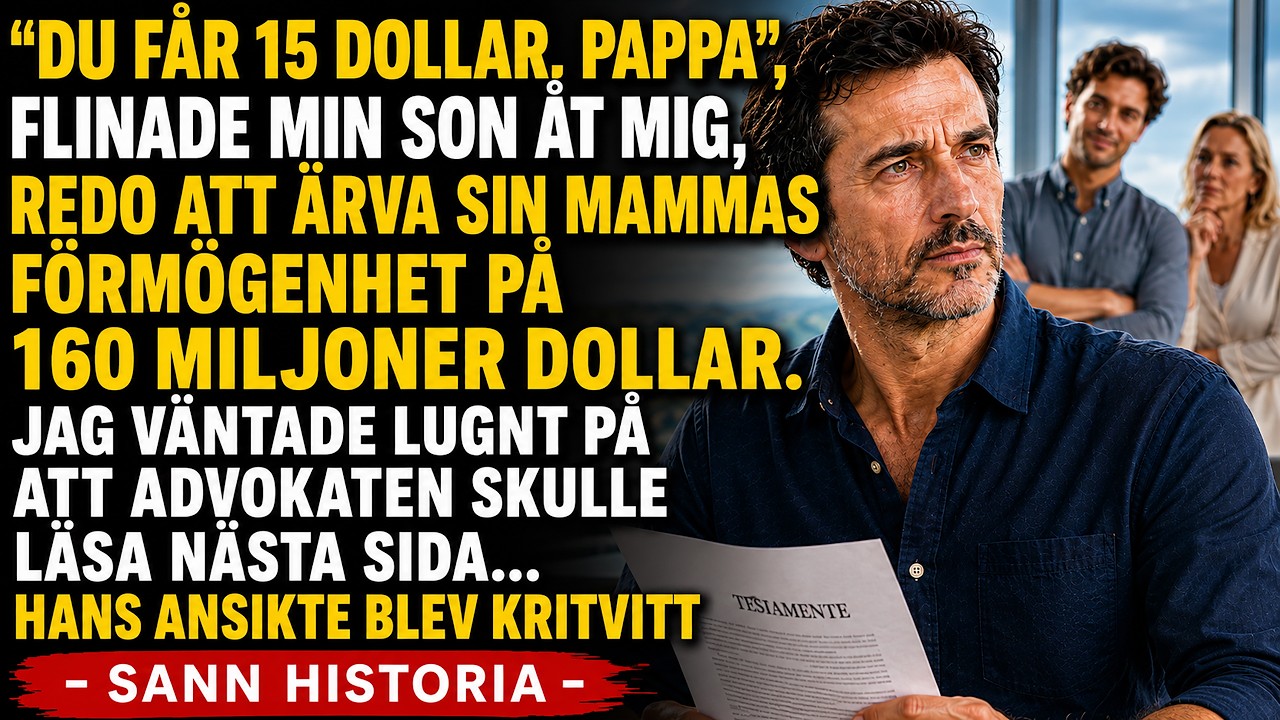
Not because he needed me there. Not because grief had softened him. He wanted an audience. He wanted me across from him when my complete worthlessness was entered into the legal record.
He hadn’t called me “pappa” in twenty years. I was Magnus, a name he used like a stain he was forced to mention. But the last line of the call, the little performance he’d rehearsed, ended with the word he’d saved as a weapon. “150 kronor, pappa.
” The price of a train ticket back to whatever little place I came from. What he didn’t know was that my ex-wife, even after death, had one last move. After twenty years of silence, I was at the center of it. For five years, the whine of my planer had been the rhythm of my days.
Birch shavings curled from the blade. In my little red workshop outside Eksjö, I wasn’t the disgraced architect the papers had once called reckless and corrupt. I was just a carpenter. Wood doesn’t flatter.
It has knots, cracks, memory. If you force it, it breaks. If you listen, it tells you where it wants to go. The call came three days before the reading.
Simon told me Ingrid was dead. Stroke. Quick. No grief in his voice, no hesitation.
“The funeral is over. You weren’t on the list. Her lawyer requires you at the reading of the will. Friday, ten o’clock.
Lindholm Partners, Stockholm. Don’t be late. ”
“I have no reason to be there,” I said. “Ingrid and I settled everything twenty years ago.
”
“Don’t flatter yourself. She hated you. But you’ll sit there in person and hear it. I want to see your face when her lawyer reads out loud how little you meant to this family.
”
There was pleasure in his cruelty, not anger. He wasn’t a wounded son. He was a victor dragging his defeated enemy through the square. “Are you done?
” I asked. “Almost. Don’t worry about getting back to Småland. I’ll give you 150 kronor for the train.
Consider it your inheritance. ”
He’d invited me to an execution. But he wanted a performance. Fine.
He’d get one. I wore my only suit, dark gray wool, pressed until the creases were sharp. The same suit I’d worn on the last day I saw Ingrid alive. Friday morning, the train from Nässjö carried me from one life into another.
Lindholm Partners occupied the upper floors of a stone building near Biblioteksgatan. The lobby smelled of polished wood, fresh flowers, and expensive silence. At five to ten, Simon arrived. Dark blue suit poured over him.
A blonde woman with a trophy bag and a man with a permanent tan followed. They weren’t mourners. They were investors collecting a dividend. Simon spoke to the receptionist, then turned and smiled.
“You actually came. I suppose you really do need those 150 kronor. ” He gestured at me. “This is my father.
” An apology for a biological inconvenience. I said nothing. It unsettled him. He’d expected anger, shame, pleading, something he could use.
I remembered him at ten, Christmas morning. A wooden corvette I’d spent weeks building, every tiny cannon carved by hand. He looked at it for three seconds and pushed it aside. “It’s not from a real shop.
” Ingrid produced a game console from behind the sofa and smiled when he lit up. She never understood that love bought that way becomes appetite. The man in front of me wasn’t a man. He was appetite in a tailored suit.
A heavy door opened. Erik Lindholm, tall, gray suit, no ornament, only authority. His eyes swept over Simon’s party like he was cataloguing them. Then they landed on me.
“Herr Wern,” he said, and walked to me first. “Thank you for coming. ”
A small courtesy. In that room, it felt like a hand on my shoulder.
Only then did he turn to my son. The conference room was long, cold, bright. Simon took the far end like a throne. I sat near the door.
Lindholm placed a leather folder on the table. Ingrid Maria Sjöberg’s last will and testament. He read the formal preamble. Simon sighed and checked his watch.
Then the smaller bequests. Five hundred thousand to the housekeeper who’d been loyal for twenty-seven years. A million to protect Swedish meadows. I remembered a meadow on Öland, blue butterflies, Ingrid laughing before the money changed everything.
Simon’s hand slammed the table. “For God’s sake, skip the charity. Read the main part. ”
Lindholm removed his glasses slowly.
“This is not a negotiation. It is the legal expression of a dead woman’s final will. You will sit there and listen. ”
We continued.
Fifty thousand to Simon’s financial adviser, with the suggestion he invest it in a course on professional ethics. To Felicia, Simon’s companion: the imitation handbag she’d tried to swap for Ingrid’s real Hermès. The room had shifted. The coronation had become a dismantling.
Lindholm turned the page. “To my son, Simon Wern, I give my apartment on Strandvägen and my complete collection of Patek Philippe and Vacheron Constantin watches. ”
Simon relaxed. Smiled.
Lindholm raised a finger. “The key to the watch safe has been entrusted to his father, Magnus Wern. ”
Silence. I was as stunned as he was.
I had no key. No idea what any of this meant. Simon laughed, hard. “I’ll have the safe opened before dinner.
Read the main inheritance. ”
Lindholm turned the page. “All remaining liquid assets, shares, properties, and the controlling interest in Sjöbergform AB — to my former husband, Magnus Wern. ”
Simon made a sound like he’d been struck.
“To my former husband, Magnus Wern, I give and bequeath the sum of 150 kronor, to be paid in cash, so that he may return to whatever little place he came from. ”
Simon burst out laughing. Deep, ugly, triumphant. “Oh, mother, you wonderful woman!
” He walked around the table, pulled out a two-hundred-kronor note, and threw it in front of me. “Here. Keep the change. ”
I looked at the note.
Then at him. I did nothing. I was watching Lindholm. He hadn’t moved.
He’d let Simon perform. This wasn’t the end. It was the pause. Simon turned toward the door.
“Come. We’re done. ”
“Herr Wern. Sit down.
I’m not finished. ”
Lindholm reached into his briefcase and lifted out a second folder, sealed with red wax. “This is a codicil, signed, witnessed, and certified three weeks before Mrs. Sjöberg’s stroke.
Its principal clause replaces all earlier provisions concerning the main estate. ”
Simon didn’t sit. He collapsed. Lindholm broke the seal.
“This contains a letter from a mother to her son, to be read aloud. ” He began to read. The words were Ingrid’s. “My son, I write this because I am finished being a coward.
For twenty years I let you believe a lie I helped create. The story of your criminal father who betrayed me out of greed is a construction. It is the opposite of the truth. ”
“Your father,” Simon whispered.
He lunged forward. “She was sick. We’ll contest it. ”
Lindholm raised another document.
“A medical evaluation by three independent physicians, seventy-two hours before the signing. Their unanimous conclusion: Mrs. Sjöberg was completely lucid and legally competent. ”
The truth came out in pieces.
Twenty years ago, Sjöbergform stood on the edge of collapse. Overextended on a development in Spain. Banks demanding repayment. Ingrid faced bankruptcy and possible prosecution.
Then an offer came, through Luxembourg and Dubai, a capital injection that looked like salvation. I read the terms and saw the trap. It was financial crime dressed as investment. I told Ingrid.
She broke down. “I can’t go to prison. I can’t become nothing. ”
So I chose.
“You’ll design. You’ll be the public face. I’ll be the wall between you and the fire. ” I signed what needed signing.
I attended meetings I should have walked out of. I became the name on the documents where hers never appeared. The money came. Sjöbergform survived.
Then the authorities investigated. They didn’t come after Ingrid. They saw my signatures. I could have pulled her into it and saved my license.
Instead I admitted what could be proven and refused to name her. I avoided prison. I lost my architect’s license forever. I lost my reputation.
“Magnus Wern — near-architect. ” That was the headline. Simon was twenty-two. He came to his mother with fury, not questions.
And Ingrid, ashamed and afraid of his judgment, let him believe the lie. She divorced me. She let me burn. “Your father didn’t destroy this family,” Lindholm read.
“I did. He saved my company, my name, my freedom, and your future. I rewarded him by letting you spit on him for twenty years. ”
Simon had gone gray.
He stared at the table like the polished surface had opened beneath him. “You have spent your adult life mocking the man who paid for your comfort with his own name. You have never built anything. You have consumed.
You have worn your righteousness like a crown. ”
Simon made a small sound. “No. She loved me.
”
“She did. And one of her greatest failures was loving you badly. ”
Then the final provision: all remaining property, shares, liquid assets, art, real estate, and the full controlling interest in Sjöbergform AB, an estate valued at approximately seven billion kronor, to her former husband, Magnus Wern. “I leave this not as charity, but as compensation for the career I let be destroyed and the honor I let be stolen.
”
“And to my Simon, who has already received a lifetime of money and sacrifices he never acknowledged, I leave exactly what he publicly offered his father. ”
A bank check slid across the table. 150 kronor. “For your journey home.
”
The adviser left first, silent. Then Felicia. “You’re pathetic. ” The door closed.
Simon sat frozen. Then he exploded. Glasses shattered against the wall. He screamed that he would sue, that his mother was sick, that I’d manipulated her.
Then he came for me. Lindholm pressed a button. Two guards appeared, caught Simon before he reached me, and dragged him toward the door while he fought like a trapped animal. “I’ll kill you!
You hear me? I’ll kill you! ”
The door slammed. Only two of us remained.
I looked at the broken glass, the overturned chair, the two-hundred-kronor note still on the floor. “The key,” I said. “The watches. Why did she drag me into it?
”
For the first time, Lindholm’s face softened. “It was Mrs. Sjöberg’s final test of her son. She wanted to see if he could humble himself enough to ask for something.
He failed. ”
He slid a small brass key across the table. “The safe in the apartment contains empty boxes. This key opens another safe, hidden behind a painting in her private office.
”
“What’s in it? ”
“The original evidence. The files from the years you protected her. Her letters to you.
The whole truth. She wanted you to decide what becomes public. The inheritance is her apology. This key is her way of giving you back your name.
”
The brass was cold in my palm. Seven billion kronor felt like a burden. The key felt like freedom. The next morning, Lindholm met me at Ingrid’s apartment on Strandvägen.
I’d seen photographs of it in magazines. Everyone in Sweden had. But I’d never been invited in. For twenty years, strangers had walked through those rooms while I, the man who once held Ingrid while she wept on a kitchen floor, didn’t know which windows faced the water.
Her office lay behind sliding oak doors. The painting was easy to find, hanging where the light never quite reached, too perfect in its placement. I lifted it down. My hand shook as I turned the brass key in the steel lock.
Inside: three archive boxes, two hard drives, and a sealed envelope with my name on it. Magnus. Not “Herr. ” Not “my former husband.
” Magnus. Her letter was short. “Magnus, I don’t ask for forgiveness. I have no right.
I kept these documents because I knew I committed a wrong every day I let you carry my shame. I told myself I was protecting Simon. The truth is I was protecting myself. I gave him comfort instead of character, and I punished you for my weakness.
Use these files as you see fit. Burn them, publish them, hand them to the authorities. The story belongs to you now. ”
I read it three times.
There was no satisfaction in it. Just a grief so old it almost felt familiar. I didn’t destroy the company. Too many honest people worked there.
But I separated Sjöbergform from the myth of its founder. The evidence went to the authorities. A statement went out. The papers called me a tragic hero, which felt almost as false as calling me a criminal.
Simon threatened to contest the will. Lindholm answered that if he did, every document would be filed in open court. Simon didn’t sue. A week later, a letter arrived at my workshop.
No return address, but I recognized the handwriting from the birthday cards he’d sent as a child. “Pappa. I don’t know what I believe yet. I don’t know who I am if what she wrote is true.
I’m angry at you, at her, at myself. I remember things I’ve said to you and I feel sick. I’m not asking for money. Maybe that’s all I ever wanted.
I don’t know anymore. I just wanted to say I heard it. I’m not ready to apologize, but I heard it. ”
I folded the letter and put it in the top drawer of my workbench, next to the small wooden boat he’d made with me when he was six.
Crooked, glue showing along the seams, one side heavier than the other. He’d been proud of it then. I didn’t call him. Some wounds have to close from both sides.
I’d spent twenty years trying to heal alone. In the months that followed, I didn’t move into the apartment. I didn’t buy a new car. I went back to Småland.
With Lindholm’s help, I created a foundation to fund scholarships in architecture, carpentry, restoration, and ethical business. The company lived on, smaller, quieter, less arrogant. We sold the apartment. We kept the workshops and the people who actually made things.
The professional board didn’t erase the past. Institutions seldom admit they were used by a lie. But they changed the record. They restored my right to be called architect in an honorary capacity.
The first time I saw my name in print without “near-architect” beside it, I closed the paper and cried in my workshop. Not loudly. Just an old man putting down a weight he’d carried so long it had become part of his posture. That winter, I finished the rocking chair.
Oak armrests, birch spindles, hand-rubbed linseed oil. I placed it by the window facing the fields. Snow drew over Småland in long white strokes. Somewhere in Stockholm, my son was learning what silence feels like when no fortune fills it.
A lie can rule a family for decades if people protect it with silence. But the truth has its own patience. It waits in locked safes, in old letters, in the memory of those who sacrificed without applause. Honor is built in the choices no one sees.
And when the truth finally rises, it doesn’t just change an inheritance. It changes the meaning of a life. I sat in the chair and felt it hold my weight. The wood was honest.
After twenty years, so was everything around me. If you had been in my place, with the key in your hand and seven billion kronor on your shoulders, what would you have done?