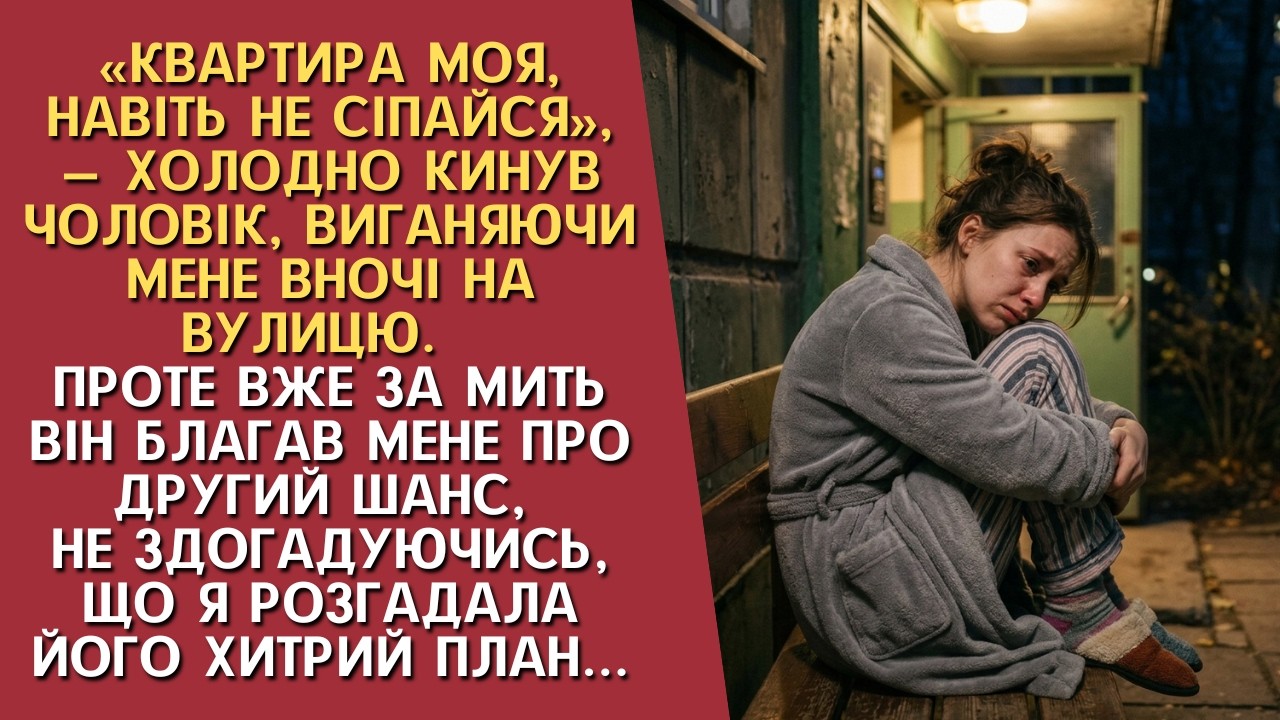
The summer heat in Mukachevo didn’t break even at midnight, but Taisia felt only cold. Her husband had just thrown her out of their apartment. She stood by the entrance of the old five-story building in a thin robe and house slippers, clutching a hastily packed bag to her chest. Phone, passport, a few crumpled bills.
Everything she’d managed to grab in her panic. On the third floor, in the yellow streetlight, stood Boris. Her husband of ten years. His face, once so familiar, was a stone mask.
“The apartment is mine. Don’t even try,” he’d said, shoving her out the door. She touched her right shoulder. His fingers had gripped it hard enough to leave a bruise.
In ten years of marriage, he’d never once raised a hand to her. She sank onto the wooden bench by the entrance, shaking. It had all started so ordinarily. She made his favorite Zakarpattia kruchenyky with porcini mushrooms.
After dinner, she picked up his phone by mistake — they had the same model, different cases. The screen lit up. “Darling, I booked us the chalet in Bukovel for August. The five-star one you liked.
”
Sender: Ilona. Below it, a dozen playful photos. A young, polished girl with perfect nails and endless gym selfies. At three in the morning, Taisia had two thousand hryvnias and a handful of change.
Her salary card, still on the dresser in the hallway, was gone. Payday was a week away. She opened the bank app. Their joint savings — half her modest teacher’s salary put aside every month for a new car — had been methodically drained.
Twelve thousand, one hundred eighty hryvnias remained. Her phone buzzed. “Taisia, are you alright? I heard screams.
” It was Stefania, the elderly neighbor from the floor below. Five minutes later, Taisia sat in Stefania’s tiny, cozy kitchen with flowery curtains and a wall of colorful fridge magnets, warming her hands on a mug of chamomile tea. “Child, I’ve been through this hell too,” Stefania said quietly. “Twenty years ago my husband did the same.
I was left with two small children. But I survived. You will too. You’ll stay with me.
”
Taisia lay on the lumpy couch in Stefania’s living room, staring at her phone. Boris didn’t call. He didn’t write. Tomorrow, she told herself, a lawyer.
The apartment had been bought in marriage. Half of it was legally hers. The next two weeks passed in a strange, quiet rhythm. Stefania brewed strong coffee with a pinch of cinnamon every morning.
In the evenings they watched serials and talked. Stefania told stories about her years working at the library, fighting indifferent officials to keep the children’s section open. Taisia taught her to order groceries online and use Telegram to video-call her grandchildren. When Taisia found a small room in a dormitory and started packing, Stefania put her foot down.
“Sit and eat your borscht. Don’t even think about leaving. Do you think I don’t understand how hard it is to make ends meet alone? ”
She wouldn’t take a kopeck for food.
Taisia left money on the nightstand anyway; Stefania silently left it there. At school, a mountain of paperwork waited. Her normally loud second-grade class somehow sensed her state and went quiet, even the resident troublemaker behaved. The hardest part was walking past her old building.
Behind those doors sat her whole happy past: her collection of ceramic elephants, her worn books, the huge ficus she and Boris had bought with their first joint salary. Several times she ran into him. He was unrecognizable — expensive suits, polished shoes, a barbershop haircut, a leather briefcase. He pretended not to see her.
The lawyer confirmed what she knew. Half the apartment was hers. But she didn’t file. Maybe fear of the final point.
Maybe a naive hope the nightmare would end. One hot evening, as Stefania dozed in her armchair, the doorbell rang. Taisia opened the door. Boris.
“Taisia,” he said hoarsely. “We need to talk. I destroyed everything. Please forgive me.
”
Stefania tactfully vanished into her room. “Destroyed it? ” Taisia’s voice was cold. “You threw me out at midnight in my slippers after ten years of marriage.
What am I to you? A stray cat? ”
“I was wrong. Catastrophically wrong.
” He ran a shaking hand through his hair. “These two weeks I’ve been out of my mind. Ilona was a fatal mistake. A nightmare.
I cut all ties with her. I blocked her everywhere. ”
She stared at him. That familiar wrinkle between his brows.
The small scar above his lip. Inside, everything trembled, but she didn’t move. “And your precious words? ‘The apartment is mine.
‘ And the bruise on my shoulder? ”
“Taisia, I don’t recognize myself. In ten years I never touched you. I panicked.
I was terrified you’d found out and would leave. Instead of stopping, I snapped. ”
He stepped closer. “I love you.
I’ve always loved you. These days without you have been pure emptiness. I come home and you’re not there. Only bare walls and your scent on the pillow.
”
Her heart pounded. She turned away to hide the hot tears. “How can I trust you? ”
“Give me one chance.
Just one. ” His voice cracked. “I’ll prove I’m worthy of you. Remember the notes I left you every morning in our first year of marriage?
I’ll start over. Everything. ”
They talked until midnight. He confessed it all — the stupid chance meeting in a bar during his Odessa trip, Ilona’s pressure, his own weakness.
When they finally packed Taisia’s things, Stefania looked at Boris with hard eyes. “Take care of her. Women like her are rare. My door is always open for her.
”
Coming back to their apartment felt like a strange dream. Boris had set a beautiful table, lit tall candles, opened a bottle of red wine. He served baked trout with rosemary. They sat on the balcony and talked until sunrise — about themselves, about the future, about almost losing what mattered most.
They laughed, remembering their clumsy first dates and silly fights. Morning met Taisia with the smell of fresh coffee. Boris was already in his pressed suit, ready for an important meeting with investors. “Buy something tasty for dinner?
” he asked, kissing her temple exactly as he used to. Everything felt so perfect, as if those two black weeks had never happened. She was humming while getting ready for school — her second-graders had their final math quiz that day. She reached for her favorite blouse.
Then a sharp call from an unknown number shattered the morning. “Taisiia Volodymyrivna? ” A dry, official voice. “I’m a private notary.
I’m calling about an inheritance. ”
“Inheritance? ” Taisia sat down hard on the edge of the bed. “You must have the wrong number.
All my relatives are alive and well. ”
“No mistake. Your name is listed as the sole heiress. ”
She almost refused the meeting.
But something in the notary’s tone made her agree. At two o’clock she sat in a bright office. The notary, a woman of about forty in a strict suit, opened a thick folder. “Your grandfather on your father’s side, Mykola Petrovych Tereshchenko, died a month ago.
He left a will entirely in your name. ”
“But I never knew my father or my grandfather. ” Taisia’s voice trembled. “My mother only said my father left before I was born.
”
“He knew about you. He watched your life from afar for years. He was a wealthy man, and you are his only granddaughter. ” The notary turned a page.
“According to the will, you receive a spacious apartment in the center of Lviv and a bank deposit of three million hryvnias. ”
The room spun. Taisia reached for her phone. “I need to call my husband—”
“Wait.
” The notary gently covered her hand. “Now I’ll speak to you not as a lawyer but as a woman. And I apologize in advance for interfering in your family affairs. ”
She took off her glasses.
“I’m the wife of Serhiy, your Boris’s colleague. Two days ago I was waiting for my husband in a coffee shop near their office. Boris sat at the next table. He didn’t see me behind the tall partition.
”
Taisia’s heart clenched. “Forgive my brutal directness, but your husband has another woman. Ilona. I heard every word of their conversation.
Boris cynically bragged that he needed to play the perfect repentance for you. His words: ‘A sentimental fool who’ll run back on her own. ‘ They’ve already planned how to spend your money. They’ve even picked out a new apartment in Kyiv.
”
Silence fell in the office. “Perhaps I should have stayed silent for ethics’ sake,” the notary said quietly. “But if it were me… Please be careful.
Don’t sign any documents with him without an independent lawyer. And above all — don’t tell him you were here. ”
Taisia walked out into the blazing street in a fog. She lowered herself onto a bench in the shade of chestnut trees and pulled out her phone with trembling fingers.
Three missed calls from Boris. Messages. “Darling, how are you? Let’s have lunch in the center?
”
“Bought your favorite pistachio pastries. ”
Yesterday, such attention would have made her heart soar. Now she saw only disgusting, undisguised falseness in every letter. The scattered pieces clicked into place.
His sudden dramatic repentance. The candlelit dinner. The coffee in bed. He was buying time, waiting for her to officially receive the inheritance.
He had prepared the ground methodically and cynically. “Prove I’m worthy of you,” he’d said. Now she understood what he thought he was worthy of. Not her love.
Her grandfather’s money. Tears streamed down her face, but they weren’t tears of despair. They were release. She wiped her cheeks, straightened her shoulders.
There was no going back. She didn’t go home. She went to a quiet café across from the notary’s office, ordered a double espresso, and — for the first time in five years — called in sick to work. Then she called Stefania.
“Child, come immediately,” the neighbor commanded firmly after listening. “We’ll sort out your things later. The main thing is that you’re safe. ”
Boris called every half hour.
She rejected each call, then turned off her phone. In the evening, knowing he was still at his meeting, she slipped into their apartment. She worked quickly and mechanically. Documents.
Her work laptop. Her ceramic elephants. A few summer dresses. None of the shared property mattered.
Before leaving, she let her eyes rest on their wedding photo. Silently, she turned the frame face down. That night, sitting safely in Stefania’s kitchen, she switched on her phone and sent one message:
“I know everything. About Ilona, about the inheritance, about the fact that you knew.
Divorce papers will come through the court. Don’t try to contact me. ”
The screen exploded with calls and pleading messages. She deleted everything without reading and blocked his number forever.
A week later, a courier delivered a thick envelope from the notary. Her grandfather had left her more than property. He’d left a deeply personal letter. He confessed that her father had died in a car accident before her birth, and that he’d never dared to intrude into her mother’s life.
“Forgive me for my weakness. I hope this inheritance helps you spread your wings. ”
Boris appeared a month later. He’d been living on illusions, spending all the money he’d stolen from their family budget, even taking out wild microloans for the down payment on the dream Kyiv apartment for Ilona, certain Taisia’s millions would cover it.
When the debt collectors started calling and Ilona realized no big money was coming, she disappeared. He waited for Taisia under Stefania’s door. He intercepted her at the school gates. He fell to his knees, theatrically begged for forgiveness, and when she refused, turned to threats.
The divorce was quick. Taisia didn’t claim their shared apartment. Gossips later said Boris, fleeing his debts, shamefully left the country to work abroad. Taisia sold the Lviv apartment.
With the money, she bought a bright, beautiful apartment in the center of her native Mukachevo and opened a modern development school for young children. Now she had twenty curious students who adored her math lessons. One autumn day, Stefania asked if she regretted everything that had happened. Taisia genuinely laughed and said no.
Because now she knew what real love was: Stefania’s selfless care, the warm lines of her grandfather’s letter, and the sunny smiles of her small students. Life went on. And it was absolutely beautiful.