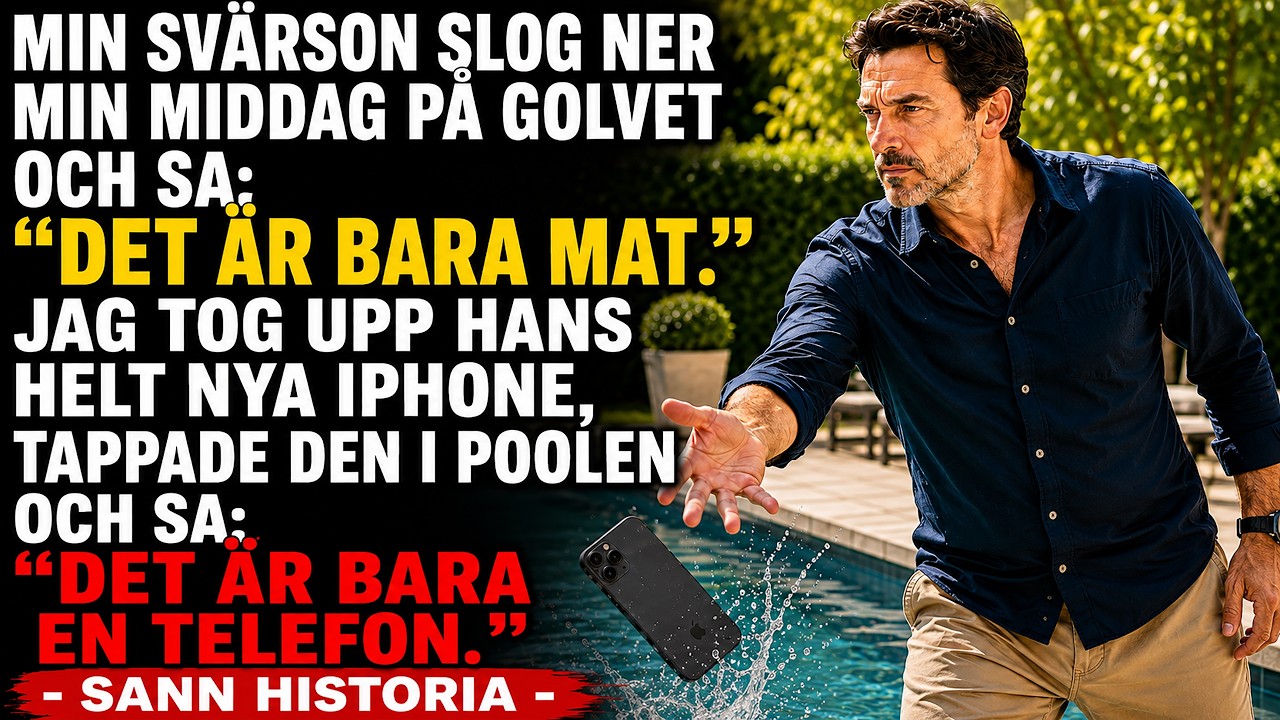
The first thing I heard wasn’t Hanna’s scream. It was the sharp crack of my plate hitting the stone patio. Then Oscar laughed. “It’s just food.
”
Nobody moved. The scent of grilled entrecôte still hung in the warm June air while my steak slid across the flagstones, leaving a trail of juices and cracked pepper. A fork spun slowly before landing flat. Without a word, I bent down and picked up the brand-new iPhone Oscar had left beside his glass.
I walked to the edge of my pool and let it slip from my hand. One clean splash. “It’s just a phone. ”
That was when Hanna completely lost it.
If you’d asked me ten years earlier whether I’d ever throw someone’s phone in a pool, I would have laughed. That wasn’t me. I was the man who fixed broken things, not the man who destroyed them. My name is Lars Holmgren.
I’m 61. I spent 38 years keeping PostNord’s delivery trucks running across Stockholm. I live in Täby, in the same brick house my wife and I bought decades ago. She planted the maple in the garden.
I built the patio myself. The pool came later, after eighteen months of Saturday side jobs. When Ingrid died of pancreatic cancer four years ago, the Sunday grills became my way of holding onto what was left of our family. Every Sunday around four.
Same garden, same grill, same folding table I’d sanded and varnished three times. I still use her spice rub — garlic, black pepper, smoked paprika, a pinch of brown sugar, written on an old index card in fading blue ink. Hanna almost never missed a Sunday. She’s 34, a pediatric nurse.
Smart, warm, kind. At least she used to be. Somewhere along the way she got tired of standing between her husband and me. Oscar Lind, 36, exclusive real estate agent.
Perfect smile, designer glasses even in overcast weather. Always talking about investments, networking, high-value people. He drove a leased BMW that probably cost more per month than my first mortgage payment. I didn’t care about any of that.
What bothered me was how he looked at people who had less, especially older people. He never insulted me outright. He didn’t need to. He preferred small comments.
“Lars, still using that old button phone? ”
“You know they make hearing aids with Bluetooth now? ”
“That old Volvo belongs in a museum. ”
Everyone laughed politely.
Hanna would squeeze my arm afterward. “Dad, he’s just joking. ”
Maybe. But jokes stop being funny when they always point the same direction.
I let it pass because I loved my daughter, and because I’d promised Ingrid during her final weeks that I would never let bitterness tear the family apart. Looking back, I kept that promise longer than I should have. That Sunday had started beautifully. Summer had finally arrived.
I had four entrecôtes resting under foil while the baked potatoes finished on the grill. Hanna brought potato salad with dill. Oscar arrived twenty minutes late carrying nothing but an expensive bottle of mineral water for himself. He glanced at the meat.
“Still buying premium cuts? That’s an expensive habit for a retiree. ”
I smiled. “Some things are worth the money.
”
He laughed. I let it go. We sat down. Hanna talked about one of her young patients who’d finally gone home after months in the hospital.
It reminded me of the woman she’d been before life got so complicated. Then Oscar looked at my plate. “That’s a pretty big steak. ”
“I earned it.
”
He reached across the table. I thought he was going for the barbecue sauce. Instead his forearm swept straight across my plate. Steak, potatoes, corn — everything hit the flagstones.
He looked down for half a second, then shrugged. “At your age, skipping a steak isn’t the worst thing. ”
Nobody laughed. Not this time.
Even his parents looked uncomfortable. I pushed my chair back slowly. For one strange second I actually considered apologizing. Isn’t that ridiculous?
Someone humiliated me, and my first instinct was to make everyone else comfortable. That’s what years of keeping the peace will do to a man. Then I saw Oscar set his phone next to his glass while reaching for a burger. New iPhone.
Worth over twelve thousand kronor. I walked over and picked it up. He frowned. “What are you doing?
”
I didn’t answer. I took six slow steps toward the pool. Hanna finally understood. “Dad—”
Splash.
The phone disappeared into the water. I turned around. “It’s just a phone. ”
Silence.
Then Hanna exploded. I looked at my ruined dinner on the flagstones. Then I looked at her. Not once had she asked if I was okay.
Not after Oscar humiliated me. Not after years of small insults. The only thing she cared about was the phone. That hurt more than losing my temper.
I took my keys from the kitchen counter. Nobody tried to stop me. As I backed my old Volvo down the driveway, I caught a last glimpse in the rearview mirror: Oscar pacing around the pool, crying. I should have felt guilt.
Instead I just felt tired. The kind of tired that has nothing to do with age. Twenty minutes later, my phone rang through the car speakers. Hanna.
I let it go to voicemail. Her voice was shaking. “Dad, you have no idea what you’ve just started. ”
For two days, nobody came by.
Nobody checked on me. Nobody asked if I’d eaten dinner after mine ended up on the flagstones. I got three texts from Hanna. All about Oscar’s phone.
Not one contained the words “Are you okay? ”
The first: “You need to replace his phone. ”
The second: “Dad, this is embarrassing. His parents saw everything.
”
The third: “Oscar says if you apologize and pay for the damage, we can move past this. ”
Move past this. On Tuesday, a cousin posted something on Facebook about old people who can’t control their temper. Oscar’s mother shared a quote about forgiveness and maturity.
One of Hanna’s friends commented: “Some people just get mean when they get old. ”
I stared at that comment longer than the others. Mean? Was I mean?
I didn’t like the question, so I did what old mechanics do when emotions get messy. I found something to fix. The lock on the garage cabinet had been sticking for months. Around three, my neighbor Bengt Holmqvist knocked on the open garage door.
He’d been at the dinner because I always invite him. He’s 70, retired from Vattenfall, walks his beagle twice a day whether the dog wants to or not. “I’ve been thinking about Sunday,” he said. “Haven’t we all?
”
“That wasn’t an accident, Lars. ”
I stopped turning the screwdriver. “I know. ”
“No.
I mean I saw it clearly. Oscar looked straight at your plate before he knocked it off. ”
Something cold moved through my chest. It was one thing to suspect it.
Another to hear someone say it out loud. Bengt hesitated. “There’s more. ”
I put down the screwdriver.
“A few months ago, I was walking past your house with Buster. Oscar stood out there with two younger men — real estate types, I assume. They were laughing about something. I didn’t hear everything.
”
“What did you hear? ”
“He said, ‘When the old man ends up in a nursing home, that house will pay for my summer place by Mälaren. ‘”
I laughed once. Not because it was funny, but because my body didn’t know what else to do.
Bengt’s face didn’t change. He didn’t need to say anything. I looked past him at the maple Ingrid had planted the year Hanna was born. My house.
The one we’d paid for with overtime, coupons, used furniture, and postponed vacations. The house where Hanna learned to ride a bike. The house where Ingrid took her last breath while I held her hand. Oscar had already turned it into a future transaction.
I didn’t sleep much that night. I sat at the dining table with an old photo album open in front of me. Hanna at six, missing two front teeth, holding a Father’s Day card covered in glitter. Hanna at sixteen, rolling her eyes before her graduation dance.
Hanna at twenty-four, standing next to Ingrid in the garden, both laughing at something I couldn’t remember. Then the newer photos. Hanna and Oscar at Christmas. Hanna and Oscar at midsummer.
And there I was, usually at the edge. Sometimes partially cropped out. Sometimes behind the camera. Had I been so afraid of losing Hanna that I’d let myself become smaller and smaller in my own family?
I thought about calling her. I even picked up the phone. Then I remembered her voice, shaking: “You have no idea what you’ve just started. ”
She was right.
I didn’t. But I was beginning to understand. So I put the phone down, closed the album, and for the first time in years made a decision that wasn’t about keeping everyone else comfortable. I wasn’t going to shout.
I wasn’t going to beg. I was going to pay attention. Quietly. Carefully.
Because if Oscar thought age made a man harmless, he had mistaken my silence for weakness. After that conversation with Bengt, I stopped seeing Oscar the same way. I didn’t confront him. I returned to my normal life.
At least that’s how it looked from the outside. The first thing I noticed was how often Hanna suddenly wanted to talk about my future. Not our future. Mine.
She came by one Thursday evening after work, holding two coffees. “I thought you could use some company. ”
For almost half an hour we talked like we used to. One of her patients had finally been discharged.
I showed her the tomatoes behind the garage. We laughed at the squirrel stealing birdseed. Then she asked: “Have you thought about moving somewhere smaller? ”
“I mean, this house is a lot for one person.
”
“It keeps me busy. ”
“You have stairs to the basement, and your knees have been bad for twenty years. ” She stirred her coffee without looking at me. “I’m just worried.
”
A few minutes later, she left. I stood on the porch and watched her car disappear around the corner. The following Sunday, Oscar came over with a bottle of wine and couldn’t have been friendlier. He praised the meat, asked about my Volvo, even offered to mow the lawn.
But I caught the look he exchanged with Hanna. Quick, subtle. The kind married people share when a conversation isn’t going the way they’d planned. A week later he showed up while I was changing the oil.
“Still doing that yourself? You know, if you ever wanted to simplify your life, selling this place wouldn’t be a bad idea. ”
“I’ve lived here for 37 years. If I decide I don’t want it anymore, I’ll let you know.
”
His smile stiffened. “Fair enough. ”
He left five minutes later. That conversation stayed with me, not because it was threatening, but because it felt rehearsed.
The following Tuesday I had an appointment with my lawyer, Gunnar Sjögren. He handled Ingrid’s estate. He helped us refinance the mortgage in the nineties. I’d come to update a power of attorney on one of my pension accounts.
Gunnar went through the documents, pushed the folder toward me, and leaned back. “Lars, I’ve been wondering whether I should tell you something. ”
“What is it? ”
“Your son-in-law called my office a few months ago.
”
“About what? ”
“He asked general questions. About how guardianship and conservatorship work. What happens when an older homeowner is no longer considered able to manage their finances.
Whether moving to a care facility changes ownership of a house. ”
I felt my jaw tighten. “What did you tell him? ”
“Nothing.
I explained I couldn’t discuss anything involving a current client. ” He paused. “But he didn’t need to mention you by name. ”
I drove home much slower than usual.
Every kilometer seemed to erase another excuse I’d made for Oscar over the years. Maybe he didn’t mean it. Maybe he was joking. Maybe I was oversensitive.
Those maybes disappeared. The next morning I called Gunnar before eight. “I want to make some changes. ”
“What kind of changes?
”
“The kind that make sure nobody mistakes kindness for permission. ”
Over the next three weeks we went through everything: the house, the pension accounts, the Volvo, even the old fishing boat. Gunnar never asked if I wanted revenge. He asked a better question: “What outcome would let you sleep at night?
”
“I don’t want to punish anyone. I just never want anyone to think they can plan my life without asking me. ”
So we created a Swedish holding and foundation-like structure. Appointed an independent professional manager.
Updated my care directives. Made it crystal clear that no one could step in and make decisions just because they thought they knew what was best for me. It was all legal, simple, quiet. Strangely, once the papers were signed, I stopped thinking about Oscar every day.
One Saturday, Bengt talked me into a vintage car meet in Norrtälje. Guys my age stood around drinking coffee and talking about carburetors like they were discussing world politics. Nobody cared what phone you owned. Nobody cared how expensive your watch was.
I realized on the way home that I’d laughed more in four hours than in the previous four months. The next week I started volunteering at a nonprofit garage repairing donated cars for veterans trying to get back on their feet. Mostly brakes, oil changes, alternators. I came home dirty every Thursday and happier than I’d been in years.
A month after the barbecue, Hanna called. “You’ve been hard to reach. ”
“I’ve been busy. Fishing, volunteering.
”
“You never told me. ”
“You never asked. ”
Silence. Then, low: “I came by on Sunday.
I left some cookies at the door. ”
“I know. They were good. ”
“I thought maybe we could have dinner.
”
“I already had plans. ”
“You never have plans on Sundays. ”
“I do now. ”
For years I’d organized my life around everyone else’s schedules.
Now they had to fit into mine. Hanna wasn’t used to it. Neither was I. A few days later, Bengt came over while I washed the Volvo.
“Your son-in-law is telling people you’re acting strange. And he’s organizing some kind of family meeting. ”
“Why? ”
“To clear the air.
”
I shook my head slowly. Neither of us believed that. Two evenings later, Hanna called. “Oscar wants everyone to meet next Saturday.
He says we need to sort everything out. ”
“I’ll come,” I said calmly. When we hung up, I called Gunnar. “I think it’s time.
”
“I’ll meet you there. ”
Saturday afternoon arrived warm and clear. I drove toward my daughter’s house with my lawyer following in his silver sedan. I wasn’t nervous.
A month earlier I’d have rehearsed arguments. Now I had nothing left to prove. Hanna and Oscar lived in a large two-story house in western Täby. Oscar loved calling it his dream house.
What he usually forgot was that the bank technically owned most of it. Everyone was already there. Hanna, Oscar, his parents, my sister, my nephew, and Bengt, who’d been invited after Oscar learned he’d witnessed what happened at the barbecue. The room went quiet.
Oscar noticed Gunnar immediately. “You seriously brought a lawyer? ”
“I brought someone who’s very good with paperwork. ”
Hanna looked confused.
“Dad, what’s going on? ”
“I think Oscar wanted to clear the air. ”
“I do. ” Oscar stood near the fireplace with his hands in his pockets, like he was running a business meeting.
“I think Lars owes everyone an apology. ”
Lars. Not Dad. Not Mr.
Holmgren. Lars. Gunnar glanced at me. I gave him a small nod.
He opened his briefcase. “Mr. Holmgren asked me to be here because several misunderstandings have arisen around his future legal and financial plans. In recent weeks we’ve completed a comprehensive Swedish plan for future power of attorney, succession, and asset protection.
”
Gunnar placed a folder on the coffee table. “A Swedish holding and foundation-like structure has been established. Care directives have been updated. Future powers of attorney have been revised.
And an independent professional manager has been appointed. ”
The room went very quiet. Oscar crossed his arms. “And why are we talking about this?
”
Gunnar looked straight at him. “I think you know. Several months ago, someone contacted my office and asked questions about guardianship and conservatorship. About how older homeowners lose financial control.
About what happens when they move into a care facility. ”
Oscar spoke quickly. “That was hypothetical. ”
“I’m sure it was.
”
Hanna turned to her husband. “You called my dad’s lawyer? ”
Oscar hesitated. “I didn’t ask about your dad specifically.
”
Gunnar spoke mildly. “You didn’t need to. ”
The room felt smaller with every second. Oscar’s father stared at the floor.
His mother clasped her hands tightly in her lap. Hanna stared at her husband as if she’d never seen him before. Finally she whispered, “Why? ”
Oscar threw up his hands.
“I was trying to plan ahead. ”
“For what? Our future. My father’s future is not your financial plan.
”
Nobody breathed. Oscar looked around the room, searching for support. He found none. Bengt cleared his throat.
“I saw what happened with the steak. It wasn’t an accident. You looked straight at his plate before you knocked it off. And I heard what you said in March: ‘When the old man ends up in a nursing home, that house will pay for my summer place by Mälaren.
‘”
Oscar’s face lost color. Nobody moved. Hanna turned slowly back to him. “You said that was a joke.
”
Her voice was barely more than a whisper. “It wasn’t. ”
Oscar tried one last time. “Everyone’s blowing this out of proportion.
”
I stood up. Not because I was angry, but because I wanted everyone to hear me clearly. “I didn’t come here to embarrass you. ” My voice stayed calm.
“I came because I spent almost forty years building a home with my wife. I wanted my retirement to be about fishing, old cars, and dinners with my daughter. Instead, I started wondering if I needed to protect my own front door. ”
Nobody interrupted.
“I never cared about the phone. I cared that you thought it was funny to humiliate me. And I cared even more that I’d started to believe peace meant accepting disrespect. I was wrong.
”
Gunnar closed his briefcase. “I believe our work here is done. ”
Nobody tried to stop us as we walked toward the front door. Just before I reached it, Hanna spoke.
“Dad. ”
I turned around. She looked like she wanted to say a hundred different things. None came out.
She just started to cry. I gave her a small, sad smile. Then Gunnar and I walked out. When I climbed into the Volvo, he looked at me.
“How does it feel? ”
I started the engine. “Lighter. ”
I drove home with the windows down for the first time in a long time.
I wasn’t driving away from my family. I was driving back to myself. Life didn’t become magically peaceful after that meeting. The next morning I still woke at six.
My knees still hurt. The coffee still tasted better from the old mug Ingrid had bought me at a roadside café twenty years ago. And when I looked toward the kitchen, her chair was still empty. Three days passed before Hanna called.
I let it go to voicemail. Her message was short: “Dad, can we talk? ”
I listened twice. Then I went out and mowed the lawn.
About a week later, she knocked on my door. She looked exhausted — dark circles, hair pulled back, no makeup. She reminded me of the little girl who used to come home after losing a softball game and try very hard not to cry. “Can I come in?
”
“Of course. ”
She sat down in Ingrid’s chair before she realized what she’d done. “Sorry. ”
“It’s okay.
”
Neither of us touched our coffee for five minutes. Finally: “I didn’t know. ”
“I believe you. But I also know that’s not the whole story.
” I waited. She stared into her coffee. “I saw him make jokes. I heard the little comments.
I kept telling myself they didn’t matter. ”
“They didn’t. Not individually. But together, they became something else.
”
Tears filled her eyes. “I should have stopped him years ago. ”
I reached across the table and put my hand over hers. “You loved your husband.
”
“I still do. ”
“I know. And I love you. ”
“I know that too.
”
She cried quietly. The kind of crying that comes after holding something in for too long. When she left, she hugged me harder than she had in years. Two weeks later she came back, angry this time.
Not at me — at the situation. “Oscar says everyone turned against him. He says Bengt exaggerated. He says your lawyer humiliated him.
” Then she asked the question she’d really come to ask: “Can’t we just move past this? ”
I went to the desk in the living room, opened the top drawer, and took out the envelope I’d written weeks earlier. “I wrote this to you. ”
She reached for it.
I gently pulled it back. “Not yet. ”
“Dad—”
“I don’t think you’re ready. I think you’re still trying to fix everyone’s pain except your own.
”
Silence. “I’ll always love you, Hanna. But I’m not going to pretend everything is okay just because pretending feels easier. ”
She wiped her eyes.
“I don’t know what to do. ”
“You don’t have to figure it out today. ”
Another month passed. Summer drifted toward autumn.
The maple started turning red at the edges. Thursday mornings still belonged to the veteran garage. Saturday afternoons meant coffee with Bengt or a car meet somewhere around Stockholm. For the first time since Ingrid died, I wasn’t just passing time.
I was living again. Then, on a cool September afternoon, Hanna knocked for the third time. She was alone. She looked different — calmer, older in some way.
She sat down without saying a word. After almost a minute, she whispered: “I moved out. ”
I didn’t ask for details. “I finally asked him a question.
Whether he would have treated you the same way if Mom were still alive. ” She smiled sadly. “He couldn’t answer. ”
She took a deep breath.
“I spent years telling myself I was keeping the peace. But all I was really doing was asking you to carry all the pain. ”
Then she stood up, walked into the kitchen, opened the refrigerator, and took out two steaks. “I stopped at the butcher on the way here.
”
I laughed. “Planning dinner? ”
“If you let me help. ”
For the first time since Ingrid died, someone stood next to me at the grill instead of waiting to be served.
Fat dripped onto the coals. The familiar smell filled the garden. Hanna reached for the spice rub. “Garlic first, right?
”
I nodded. “Your mother would be proud. ”
She laughed through tears. “I finally understand why these Sundays mattered so much.
”
“So do I. ”
When the food was ready, she carried my plate to the table herself. She set it down gently, looked me in the eye, and smiled. “Don’t let yours get cold, Dad.
”
Months earlier, someone had knocked my dinner onto the ground. Now my daughter was making sure I had a warm meal in front of me. No speeches. No big gestures.
Just respect. Sometimes that’s enough. Oscar and Hanna divorced quietly the following spring. No dramatic court battle.
No celebration. Honestly, I felt more sadness than satisfaction. No father dreams of watching his daughter’s marriage end. But a marriage can’t survive if respect only travels in one direction.
These days the Sunday dinners still happen. The guest list is smaller. Sometimes it’s just Hanna and me. Sometimes Bengt comes.
The table isn’t as full as it used to be, but the conversations are better. The laughter is real. Nobody walks on eggshells anymore. Sometimes I catch myself looking toward the deep end of the pool.
The phone has been gone for months. What stayed wasn’t that moment. It was everything that came after. I used to think protecting my family meant accepting whatever they gave me.
I don’t believe that anymore. Getting older doesn’t mean becoming less valuable. It just means you’ve lived long enough to know the difference between love and obligation.
And once you know that difference, life gets a lot lighter.


