My rich son-in-law accused me of stealing a silver spoon. “Get out, thief! ” he screamed in front of all his guests. Everyone laughed.
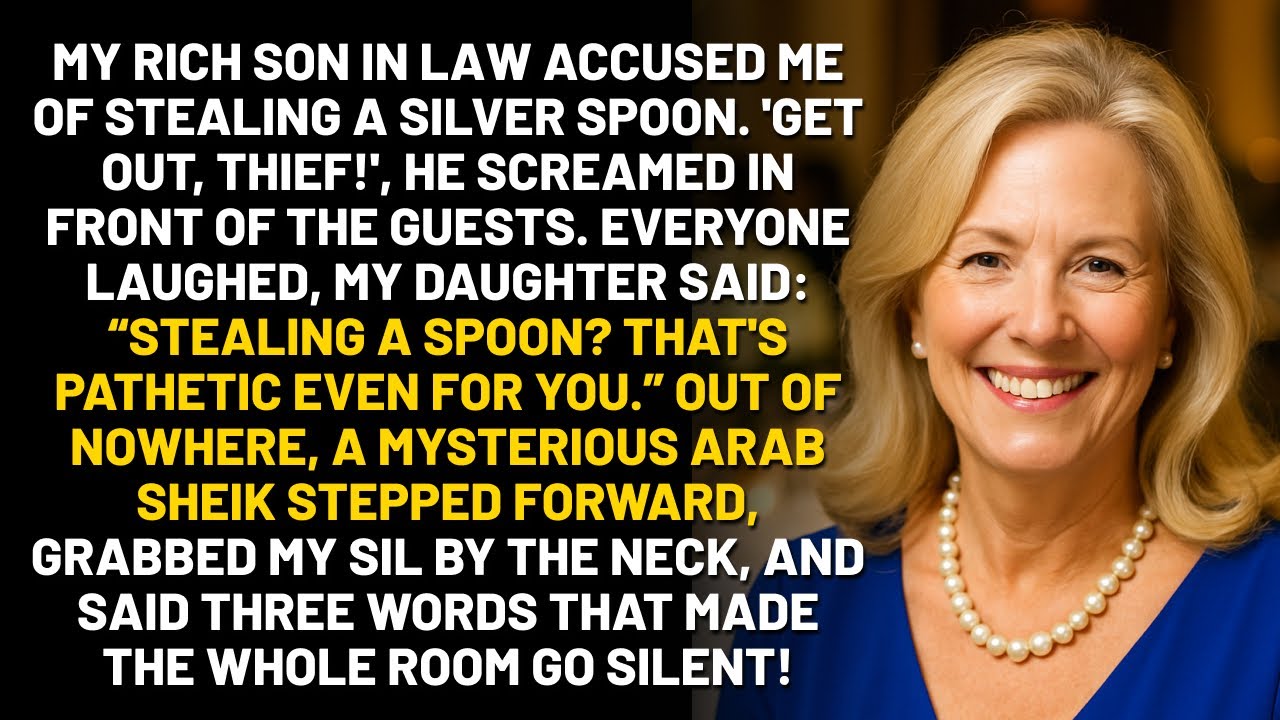
My daughter said, “Stealing a spoon? That’s pathetic, even for you. ”
Then a mysterious Arab man stepped forward, grabbed my son-in-law by the neck, and whispered three words that made the whole room go silent. My name is Ada.
At 61, I thought I’d experienced every kind of heartbreak life could offer. I was wrong. The invitation came on a Tuesday, handwritten on cream-colored paper that probably cost more than my weekly grocery budget. “Mother,” it read in Emory’s perfect script.
“Eli and I would be delighted if you joined us for dinner this Saturday, 7:00 sharp. Please dress appropriately. ”
The last line stung. My daughter hadn’t invited me to their Beacon Hill mansion in over eight months.
Not since Easter, when I’d accidentally used the wrong fork for the salad course and Eli had made such a scene about proper etiquette that I’d excused myself early. I spent Thursday afternoon at Goodwill, searching for something that might pass for appropriate in Eli’s world. A navy blue dress with pearl buttons. My size.
One tiny stain near the hem, but my old black cardigan would cover it. $12. 50. Saturday evening arrived with an October chill.
The house loomed three stories of red brick and pristine white trim, windows glowing like golden eyes. Through the glass, I could see elegant silhouettes already gathering. The butler took my worn coat with a neutral expression. “They’re expecting you in the dining room.
”
Emory glided toward me in an emerald dress that cost more than my monthly rent. “Mother! You made it. And you look… nice.
” The pause before “nice” lasted just long enough to sting. Eli appeared beside her. “Ada,” he said, giving me a once-over that clearly found me wanting. “How modest of you to join us.
”
The room was filled with their usual crowd. Wealthy couples from the country club, business associates, people whose names I could never remember but whose judgmental stares I recognized immediately. I was seated at the far end of the table next to Mrs. Whitmore, who spent most of dinner discussing her poodle’s grooming schedule.
The meal was exquisite. Multiple courses arrived in perfect succession. I followed Emory’s subtle cues about which utensil to use, remembering the Easter disaster all too clearly. By the time dessert arrived, I was beginning to relax.
That’s when it happened. Eli stood up, his chair scraping against the hardwood floor. The entire table fell silent. “Stop right there,” he commanded.
All eyes followed his pointing finger directly to me. “Check her purse,” Eli said, his voice deadly calm. “Check it now. ”
“Eli, what are you talking about?
” Emory asked. But I could hear the uncertainty creeping into her voice. “Your mother has stolen one of our antique silver spoons. I saw her slip it into her purse when she thought no one was looking.
”
The room erupted in gasps. My face burned as every pair of eyes turned to stare at me. “That’s not true,” I whispered. “I would never.
”
“Open your purse,” Eli demanded, moving toward me like a predator stalking its prey. My hands shook as I fumbled with the clasp. I knew there was nothing in there except my wallet, keys, and a small pack of tissues. The silver spoon tumbled out onto my lap with a soft clink that sounded like a gunshot in the silence.
“Get out, thief! ” Eli roared. “Get out of my house this instant. ”
The laughter started small, then grew until the entire room was filled with the sound of people enjoying my humiliation.
Mrs. Whitmore actually clapped her hands in delight. But it was Emory’s voice that shattered what was left of my heart. “That’s pathetic, even for you, Mother.
”
“Emory, please,” I pleaded, standing on shaking legs. “You have to believe me. I didn’t—”
“Don’t make this worse than it already is,” she said, turning away from me as if she couldn’t bear to look. “Just go.
”
Eli advanced on me, his hand raised as if he might physically remove me himself. Then a voice cut through the chaos like steel through silk. “That will be quite enough. ”
The accent was foreign.
Cultured and commanding in a way that made everyone freeze mid-laugh. A man I hadn’t noticed before rose from the shadows at the far end of the table. Tall and distinguished, with silver threading through dark hair and eyes like polished onyx. He wore an expensive suit that made Eli’s look cheap by comparison.
He moved through the room with fluid grace, the dinner guests parting before him like he was royalty. His dark eyes never left Eli’s face as he approached, and I watched my son-in-law’s arrogant expression slowly transform into something that looked remarkably like fear. The stranger stopped directly in front of Eli, so close they were almost touching. He leaned in and whispered three words, so quietly only Eli could hear them.
The effect was immediate. All the color drained from Eli’s face. His hands trembled. He stumbled backward.
“I… I…” Eli stammered, but no complete words came out. The mysterious man straightened and turned to me with an expression I couldn’t read. There was recognition there, though I was certain I’d never seen him before in my life. “Mrs.
Patterson,” he said, his voice gentle now. “Perhaps you would allow me to escort you home. ”
I looked around the room one more time. Emory stood frozen by the window, pale with confusion.
Eli stared at the stranger as if he’d seen a ghost. The dinner guests whispered among themselves, sensing that something significant had just happened. I nodded and accepted his arm. His presence was oddly comforting, like shelter in a storm I hadn’t realized I was caught in.
As we walked toward the door, I heard Eli’s voice behind us, weak and shaky. “Sir, please. I didn’t know. I didn’t realize who she was.
”
The stranger didn’t acknowledge him. He simply guided me through the marble hallway, past the crystal chandeliers, and out into the October night where a sleek black car waited at the curb. Inside, the leather seats were softer than anything I’d ever touched. The silence felt like a protective cocoon after the nightmare I’d just escaped.
“I didn’t steal that spoon,” I whispered, needing someone to believe me, even if it was a complete stranger. “I know,” he said simply, as if it were the most obvious thing in the world. “How can you know that? You don’t even know me.
”
A small smile played at the corners of his mouth. “On the contrary, Mrs. Patterson. I know you better than you might think.
”
Something about the way he said my name made my skin prickle. “Who are you? ”
“My name is Rashid al-Mansuri,” he said, inclining his head slightly. “And you, Mrs.
Patterson, are someone I have been searching for for a very long time. ”
“Searching for me? Why? I’m nobody special.
Just a widow living on a pension of $800 a month. ”
“You are far from nobody,” he said gently. “Though I suspect you do not remember why. ”
Remember?
What was he talking about? “Mrs. Patterson, may I ask you something? Do you ever have dreams about sand, desert winds, the sound of helicopters overhead?
”
My hand froze on the door handle. How could he possibly know about the dreams? Fragmented images of endless sand dunes, the acrid smell of smoke, voices shouting in languages I didn’t understand. They’d been coming for years.
I’d always dismissed them as nonsense. “How did you—? ”
“There is much about your past that you do not remember,” Rashid said softly. “A past that connects you to my family in ways that run deeper than gratitude, deeper than obligation.
You saved something precious to me once, though I suspect the memory is lost to you now. ”
“I’ve never been anywhere but Boston and the small town in Maine where I grew up. You must have me confused with someone else. ”
But even as I said the words, something nagged at me.
There were gaps in my memory, periods from my early 20s that felt fuzzy and indistinct. Rashid reached into his jacket pocket and pulled out an old photograph, its edges yellowed with age. The image was grainy, clearly taken in some kind of emergency situation. It showed a young woman in nurse’s scrubs, her blonde hair pulled back in a messy ponytail, crouched beside a hospital bed.
She was holding the hand of a small boy, maybe seven or eight years old, whose head was wrapped in bandages. The woman in the photo looked exactly like I had at 21. “That’s not…,” I whispered, but my voice trailed off. “The boy is my nephew, Omar,” Rashid said quietly.
“This photograph was taken in 1982 in a field hospital in Lebanon. The woman who saved his life was an American nurse who volunteered with a medical relief organization. ”
1982. The year that was mostly blank in my memory.
The year I supposedly spent finding myself after college, though I could never quite remember what that had involved. “You have a scar on your left hand near the thumb,” Rashid said. “Small, crescent-shaped. You probably tell people it came from a kitchen accident.
”
I felt the familiar ridge of scar tissue under my cardigan. I did tell people that. It was the story that felt right, even though I couldn’t actually remember how it happened. “Because you got it protecting Omar from falling glass when the hospital was bombed,” Rashid said.
“You threw yourself over his bed and a shard cut your hand. The doctor said you probably saved his life. ”
I felt dizzy, disoriented, as if the world had tilted on its axis. You don’t just forget saving a child’s life in a war zone.
“I need to go inside,” I said abruptly. “This is all very confusing. ”
“Of course,” Rashid said. “But there is one more thing.
The reason your son-in-law became so frightened when I spoke to him. ”
I paused. “What did you say to him? ”
“I told him who you are.
Your real name before you lost your memory and started over as Ada Patterson. ” He paused. “Your name is Amira Zara. And you are a woman my family has been searching for across three continents for over 40 years.
A woman who disappeared after saving my nephew’s life, who was reported killed in the bombing that destroyed the hospital. ”
Amira Zara. Even hearing it made something deep in my chest ache with recognition. “That’s impossible,” I managed.
But the dreams flooded back suddenly. The weight of a small child’s hand in mine. The acrid smoke that burned my throat. Voices calling a name that might have been Amira.
Might have been mine. He left me the photograph. I stumbled up the three flights of stairs to my apartment and sank onto the couch, staring at it. The more I looked at the young woman, the more familiar she became, until it felt like looking into a mirror that reflected not just my image, but my soul.
I didn’t sleep that night. Every time I closed my eyes, fragments of memories that might have been dreams flooded my mind. The knock came at exactly 9:00 a. m.
Rashid stood in my dingy hallway looking completely out of place, holding a leather briefcase. He spread documents across my coffee table. More photographs. Official papers.
And a hospital identification badge, yellowed with age, showing the same young woman smiling under a nurse’s cap. The name read: “A. Zara, RN, Emergency Relief Corps. ”
“Your full name was Amira Louise Zara,” Rashid said.
“You went by your middle name when you returned to America. Louise became Ada over time. But you kept the initial A. ”
He told me the story.
August 1982. I’d been working with the emergency relief corps for eight months, treating civilians caught in the Lebanese civil war. Omar was brought in after a bombing near his school. Seven years old.
Critical head injuries. The doctors said there was nothing they could do, but I refused to accept that. “You worked on him for 14 hours straight,” Rashid said. “You refused to leave his side.
And when the shelling started again and everyone was evacuating, you stayed. You covered his body with your own when the windows exploded. ”
My left hand began to throb. I looked down at the crescent-shaped scar, and suddenly I could feel it happening.
The sharp bite of glass, the warm wetness of blood, the weight of a child beneath me as the world exploded around us. “Oh my God,” I breathed. “Omar. His name was Omar.
”
Tears spilled down my cheeks. “He had a toy truck. Blue and red. He clutched it even when he was unconscious.
I promised him he’d get it back when he woke up. ”
“He did wake up,” Rashid said softly. “Thanks to you. But by then you were gone.
”
The explosion had thrown me clear of the building. I was found three days later by American forces, unconscious with severe head trauma and no identification. Listed as Jane Doe and evacuated to a military hospital in Germany. The amnesia was real.
When I recovered enough to travel, they flew me back to the United States and placed me with a social services program. That’s how I became Ada Patterson. Ada from my middle name, Patterson from the social worker who helped me start over. Then Rashid opened another folder.
“There is something else you need to know, Amira. ”
A bank statement from an institution I’d never heard of. The account read: “Zara Memorial Fund. ” The balance made me dizzy.
$15,200,000. “When we thought you had died, my family established a fund in your honor. Every year we added to it. Money that should have been yours.
”
I stared at the number. All those years of struggling, counting pennies, worrying about medical bills. And somewhere in the world, a fortune sat waiting for me. “But there’s more,” Rashid said, his voice growing harder.
“Three months ago, someone contacted our family’s legal representatives claiming to have information about Amira Zara. They demanded a finder fee of $50,000. ”
My blood ran cold. “Eli.
”
“Someone has known who you are for quite some time, Mrs. Patterson. Someone who chose to use that information not to help you reclaim your identity, but to profit from keeping you in the dark. ”
The betrayal cut deeper than the humiliation at dinner.
Eli hadn’t just stumbled across my past. He’d been hiding it from me. “The three words I whispered to him last night were, ‘We know everything. ’ I wanted him to understand that his game was over.
”
“He set me up last night, didn’t he? The spoon in my purse. ”
“I believe so. Though proving it would be difficult.
”
The next day, I sat in the most expensive law office I’d ever seen. Floor-to-ceiling windows offered a panoramic view of Boston Harbor. The mahogany conference table was larger than my entire living room. The evidence against Eli was damning.
Recorded phone calls where he called me “the old lady” and suggested I might be “happier in a nice facility. ” Emails hiring a private investigator to research gaps in my employment history. A draft legal petition to have me declared mentally incompetent due to “advancing dementia. ”
He’d fabricated incidents of me being confused, getting lost, forgetting to pay bills.
He’d claimed I’d left the stove on and nearly caused a fire. None of it was true. And his motivation was clear: Eli owed $800,000 to creditors. His business ventures were failing.
He desperately needed money and saw my hidden fortune as his solution. “What about Emory? ” I asked, dreading the answer. “Does she know?
”
“We don’t believe so,” Rashid said. “The evidence suggests she’s as much a victim of his manipulation as you are. He’s been very careful to control information, to make her see you through his lens rather than her own experience. ”
That almost made it worse.
My daughter hadn’t rejected me out of cruelty, but because her husband had spent years poisoning her perception of me. “What do you want to do? ” Margaret, the lead attorney, asked. I stared out the window at the harbor.
For 40 years, I’d lived a quiet life, avoiding conflict, accepting whatever treatment came my way. But I wasn’t that powerless woman anymore. I was Amira Zara. I had saved lives.
I had faced bombs and chaos and survived. “I want him to confess,” I said. “I want Emory to hear the truth from his own mouth. And then I want him gone from our lives permanently.
”
Margaret smiled. “That can be arranged. ”
The plan was elegant. We would use Eli’s own greed against him.
The call came at exactly 6:00 on Thursday evening. Eli’s voice was full of forced warmth. “Ada, I’ve been thinking about what happened at dinner. I owe you an apology.
There might have been a misunderstanding about the spoon situation. ”
A misunderstanding. As if the antique silver spoon had leaped into my purse of its own accord. “I have some wonderful news I’d like to share with you in person,” he said.
“Will you come over for dinner tomorrow? Just the three of us. ”
“I’d like that,” I said, keeping my voice elderly and neutral. Friday afternoon, I went to a boutique in Back Bay.
The sales associate looked surprised when I walked in wearing my usual thrift store cardigan. “I need a dress,” I told her. “Something that says I’m not the same woman I was last week. ”
An hour later, I left wearing a navy blue dress that actually fit properly, a matching jacket, and hair styled to emphasize my cheekbones.
I looked like the successful woman I was about to become. Emory answered the door and blinked in surprise. “Mother, you look different. ”
“I feel different,” I said, stepping into the marble foyer that had intimidated me just a week ago.
Tonight, it felt like any other room. Eli appeared, clearly expecting the same dowdy widow. When he saw me, his smile faltered for just a moment. Dinner was elaborate, much more formal than he’d promised.
He was trying to butter me up. I wore the recording device Margaret had given me under my dress. “As you know,” Eli said, “I have contacts in the financial world. One of them reached out with some very interesting information about your background.
It seems you might be entitled to some kind of inheritance from your work as a young woman. ”
“I never worked overseas,” I said, playing my part. “I’ve never even left the country. ”
“That’s where it gets interesting.
My contact thinks you might have forgotten some things due to, well, your age. Memory issues. But if we can establish your identity properly, there could be significant money involved. ”
“Mother doesn’t have memory issues,” Emory said.
But Eli was too focused on his prize to notice her defensive tone. “Oh, sweetheart, she’s had some confusion lately. Remember when she forgot about dinner last month? ”
I watched my daughter’s face as he spoke, seeing the doubt creep into her eyes.
He’d been doing this for months, planting seeds of concern about my mental state. “The point is,” Eli continued, “we’ll need to set up some kind of trust or guardianship arrangement to handle the money properly. For her own protection, of course. I’d be happy to manage it.
”
“How much money are we talking about? ” Emory asked. “My contact estimates it could be anywhere from 5 to 15 million. Maybe more.
”
Then the doorbell rang. James appeared with a confused expression. “Sir, there’s a gentleman here who insists on speaking with Mrs. Patterson.
He says it relates to legal documents. ”
“Show him in,” I said calmly before Eli could object. Rashid entered the dining room carrying a leather briefcase. He nodded politely to Emory and completely ignored Eli.
“Mrs. Patterson, I apologize for interrupting your dinner, but there are documents that require your immediate attention. ”
“What documents? ” Eli demanded, his voice tight with panic.
Rashid finally looked at him. “I am Rasheed al-Mansuri, representing the al-Mansuri family trust. We’ve been in communication with your legal representatives regarding Mrs. Patterson’s inheritance.
”
The silence that followed was deafening. “Your mother, Mrs. Richardson, is not who she appears to be,” Rashid said, spreading photographs across the table. “Her real name is Amira Zara.
And 42 years ago, she saved the life of my nephew in a field hospital in Lebanon. She suffered severe amnesia after a bombing and lost all memory of her previous life. We’ve been searching for her for four decades. ”
Emory stared at the photos.
“That’s you,” she whispered. “But you’ve never been to Lebanon. ”
Eli found his voice. “How did you find her?
”
Rashid’s smile was cold. “Someone contacted our investigators claiming to have information about Amira Zara’s whereabouts. Someone who demanded $50,000 for that information and suggested that Mrs. Patterson might need a guardian to manage any inheritance.
”
The color drained from Eli’s face. “Perhaps Mr. Richardson would like to explain how he discovered your mother’s true identity and why he chose to keep it secret while planning to have her declared mentally incompetent,” Rashid said. “We have recordings.
We have emails. We have evidence of your attempts to establish guardianship based on fabricated claims of dementia. Would you like me to play them for your wife? ”
Emory stood up so quickly her chair nearly toppled.
“You knew. You knew about this inheritance and you didn’t tell us. ”
“It’s not what you think,” Eli said desperately. “I was trying to protect her.
Ada’s been showing signs of confusion and I was worried. ”
“Stop lying,” I said, my voice cutting through his excuses like a blade. “There are no signs of confusion, Eli. There never were.
You made them up because you needed money and you thought you could steal mine. ”
I stood up, feeling the power of my true identity flowing through me. “You planted that spoon in my purse to make me look unstable. You’ve spent months telling my daughter I was deteriorating mentally.
You hired private investigators to research my background so you could claim my inheritance through guardianship fraud. ”
Emory sank back into her chair, staring at her husband as if she’d never seen him before. “The spoon? You put the spoon in her purse?
”
Eli’s shoulders slumped in defeat. “I needed the money. The business is failing. We owe hundreds of thousands in debts.
When I found out about her past, it seemed like the answer to everything. ”
“By stealing from my mother? ” Emory’s voice was barely controlled fury. “I wasn’t stealing.
I was going to take care of her, make sure she was comfortable. She would never have known the difference. ”
The casual cruelty of that statement hung in the air like smoke. Rashid closed his briefcase with a sharp snap.
“Mrs. Patterson, your inheritance has been confirmed and transferred to accounts under your control. $15,200,000 plus accumulated interest over the past 40 years. ”
“You’re going to leave,” I told Eli, my voice steady.
“You’re going to pack your things and go tonight. You’ll file for divorce and give Emory whatever she wants. And if you ever try to contact me or manipulate my daughter again, I will use my considerable resources to destroy you completely. ”
Eli opened his mouth to argue, but one look at Rashid’s face stopped him cold.
“The recordings of your conversations will remain confidential as long as you cooperate fully,” Rashid added. “If you force us to take legal action, everything becomes public record. ”
Eli turned to Emory with desperate eyes. “Emory, please.
”
“Get out,” she said quietly. “Just get out. ”
Three months later, I stood in the garden of my new house in Cambridge, watching the morning sun filter through the maple trees. The house wasn’t a mansion.
I’d chosen something comfortable rather than ostentatious. But it was mine in a way my little apartment had never been. Every Saturday morning, Emory came for coffee. The divorce was final.
Eli had moved back to New York, his reputation in Boston irreparable. Slowly, carefully, we were rebuilding something that might actually be stronger than what we’d had before. “How do you feel? ” I asked her one morning.
She was quiet for a long moment. “Free,” she said finally. “For the first time in years, I can think clearly. I keep remembering things.
Conversations where Eli would make little comments about your mental state. Times when he’d discourage me from inviting you over. I was so blind. ”
“You weren’t blind,” I said firmly.
“You trusted someone you loved. That’s not a character flaw. The only person responsible for Eli’s actions is Eli. ”
Tears filled her eyes.
“I just wish I could make up for it somehow. All those years of being cold, of keeping you at arm’s length. ”
“You already are,” I said. “Every Saturday morning when you come here.
Every time you call just to talk. Every time you look at me like you’re proud to be my daughter. You’re making up for it. ”
That afternoon, I found myself in my study looking at a framed photograph.
It was a new print of that old hospital picture, but now it was displayed alongside others. Photos of me with Omar and his family. Pictures of Emory and me at the housewarming party she’d thrown. One of Rashid and me at the restaurant where he’d celebrated the finalization of my inheritance.
The money had changed my circumstances, but it hadn’t changed who I was. I still preferred quiet evenings at home. I still found joy in simple things. But now I had choices, and that made all the difference.
I’d started volunteering at the Refugee Assistance Center downtown, using my own experience with memory loss and starting over to help others navigate similar challenges. There was a woman there who reminded me of myself. Elderly, traumatized, unable to remember her own name. I sat with her and told her my story.
“You really forgot who you were? ” she asked. “For 40 years. But I built a new life.
And when my memories came back, I didn’t lose what I’d built. I just added to it. ”
Back in my own kitchen that night, I made myself a simple pasta dinner with herbs from my garden. Outside, the first snow of winter was beginning to fall.
Inside, I was warm and safe and home. Not just in the building, but in my own skin. In my own story. For most of my adult life, I’d felt like I was waiting for something.
For Robert to come home from work. For Emory to call. For some sign that my life had meaning beyond just getting through each day. I’d measured my worth by other people’s approval, other people’s definitions of success.
But sitting in my own kitchen, in my own house, surrounded by evidence of choices I’d made freely and relationships I’d built authentically, I realized I wasn’t waiting for anything anymore. The woman I’d been at 21 had saved a child’s life in a war zone and lost herself in the process. The woman I’d become at 61 had found herself again and was using that strength to help others. Both women were me.
Both stories were true. I’d spent so many years thinking I wasn’t enough. Not a good enough mother. Not an important enough person.
Not worthy of love or respect. But I was enough. I’d always been enough. It had just taken me 61 years, and a journey halfway around the world, to remember it.
As I turned off the lights and headed upstairs, I caught my reflection in the hallway mirror. The woman looking back at me had silver hair and lines around her eyes, but she stood straight and smiled easily. She looked like someone who’d lived fully, who’d faced challenges and survived them, who’d found her way home after a very long journey. She looked like Amira Zara.
She looked like me.