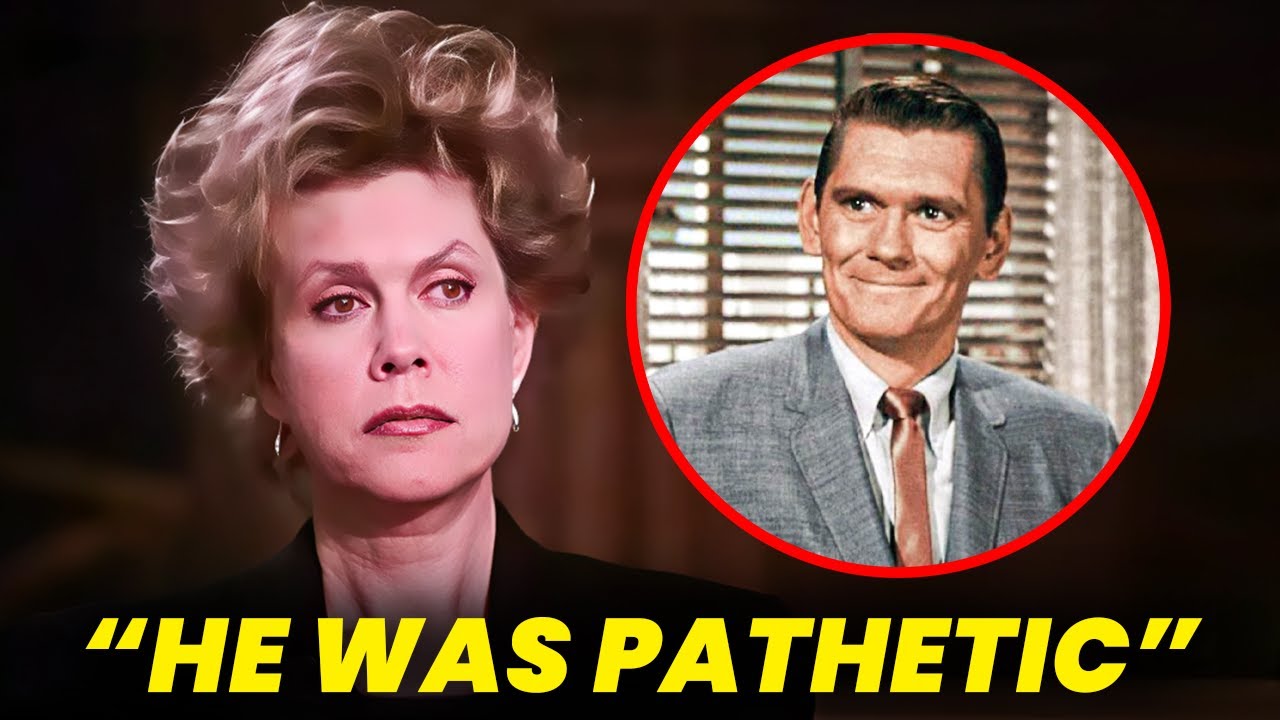
The silence between Elizabeth Montgomery and Dick York lasted more than two decades, and it ended exactly the way it began, with no words, no reconciliation, and no explanation. For years, fans of the classic television series Bewitched have wondered why Montgomery, who played Samantha Stevens with such warmth and charm, refused to ever work with Dick York again after he left the show in 1969. Now, newly uncovered details from behind-the-scenes accounts, personal letters, and interviews with those closest to the production have finally revealed the heartbreaking truth.
Dick York did not leave Bewitched by choice. He was forced out, pushed aside by a production team that no longer had patience for his deteriorating health, and abandoned by a co-star who never spoke to him again. The story begins long before the cameras started rolling on the iconic sitcom, in a single moment on a film set in 1959 that would change everything for York.
 During the filming of the western drama They Came to Cordura, York was involved in a physically demanding scene that required him and several other actors to operate a handcar on railroad tracks. When a crew member lost his grip, the heavy metal handle snapped back with brutal force, slamming directly into York’s spine. He later described the sensation as an explosion inside his back, and the damage was immediate and permanent.
Rather than seek long-term treatment or take time to recover, York pushed through the pain. In those days, chronic pain was something actors were expected to endure silently, and York did exactly that. He entered a cycle of painkillers, chiropractic treatments, and sheer willpower, managing his condition in secret while continuing to work.
When he was cast as Darren Stevens on Bewitched in 1964, he was already living in a delicate balance, constantly managing his agony behind a cheerful smile.
At first, the production team was accommodating. York had an extraordinary ability to appear quick-witted and energetic on screen, even when his back was screaming in agony. Between takes, he would collapse into a chair, drenched in sweat, while stage hands kept folding cots nearby so he could lie down.
Scripts were rewritten to minimize his physical movement, and directors carefully angled cameras to hide the fact that York was often bracing himself against furniture for support.
But the demands of a hit television show are relentless, and patience wears thin under pressure. York’s missed days began to pile up. Sometimes he was simply too sick to come in, other times he arrived but could not make it through a full scene.
Through it all, he never lost his warmth, remaining kind to everyone on set and avoiding complaints even when the pain became unbearable.
Elizabeth Montgomery, however, reportedly began to change. At first, she sympathized with York’s condition, but by the fourth season, her tone had shifted. According to multiple accounts from crew members, she began keeping her distance from him.
The once playful energy between them turned cool. Some say she was frustrated by the constant schedule changes, while others believe she felt York’s condition was drawing too much attention away from the rest of the cast.
The influence of William Asher, Montgomery’s husband and the show’s executive producer, cannot be overlooked. Known for his no-nonsense attitude, Asher reportedly clashed with York on multiple occasions. He was focused on keeping the show tight, efficient, and profitable, and York’s unpredictable health was beginning to interfere with that goal.
 One former crew member recalled an instance where York, visibly exhausted and wincing in pain, asked for a short break before filming a complicated scene. Asher allegedly rolled his eyes and walked off set.
The moment that changed everything came during the filming of season five in 1969. York had been hanging on by a thread for months, dragging himself to the set even when he could barely walk. On one particular day, his body finally gave out in front of the entire cast and crew.
They were filming a simple scene in the kitchen set when York suddenly turned pale, started swaying, and dropped to the floor without warning.
Production stopped immediately, and the studio went completely silent. York was rushed to the hospital, and he never returned to the set of Bewitched again. Official statements were vague, citing health concerns, but the real story was far more complicated.
According to York himself, he begged the producers for a few weeks off to recover, promising he could finish the season. That call never came.
Instead, just days later, the studio announced that Dick Sargent would be stepping in to play Darren Stevens, a jarringly different version of the character that many fans never fully accepted. There was no on-screen explanation for the change, no farewell episode, no acknowledgment of York’s contributions. He simply disappeared from the series as if he had never existed.
What hurt even more than the sudden replacement was the silence from Elizabeth Montgomery. She never reached out to York after his departure, no visit, no letter, no message. After five years of working side by side, their partnership ended without a single word.
Some believed it was William Asher’s decision to replace York, a clean break that would allow the show to move forward, but others saw something deeper in Montgomery’s silence.
York later said that he never received a phone call, never heard a kind word, and never got so much as a note from her. He tried to stay optimistic, speaking of Montgomery with respect and admiration in interviews years later. He described her as talented, charming, and professional, never criticizing her publicly.
 When asked about how their relationship ended, he chose his words carefully, simply saying she went her way and I went mine.
Privately, it was a different story. York confided in close friends that he had tried reaching out, sending letters hoping to clear the air. He never heard back.
According to those closest to him, the lack of response cut deeper than anything else. For all the hours they had spent together on set, for all the laughter and banter in the early seasons, there was no interest on her part in making peace.
The reasons behind Montgomery’s silence remain unclear even now. Some speculate it was out of loyalty to her then husband, who had reportedly grown tired of accommodating York’s health issues. Others believe she may have resented the disruption York’s condition brought to the show’s momentum, that perhaps in her mind he had become more trouble than he was worth.
Still, others wonder if the issue was more personal, with rumors suggesting York may have developed real feelings for Montgomery during the early years of filming.
Whatever the cause, the result was undeniable. York never worked with her again, never spoke to her again, and never received any acknowledgment of his departure or his pain. And yet, remarkably, he never expressed bitterness.
Until the end of his life, he continued to speak of Montgomery with dignity.
After Bewitched, York never landed another role of that scale. Hollywood had a way of forgetting actors who could no longer keep pace, especially those dealing with long-term health issues. By the mid-1970s, he was all but retired from acting.
The physical pain had become too great, and the offers had stopped coming. He lived in relative obscurity with his wife Joan, who remained by his side through every struggle, sometimes literally carrying him when he was unable to walk.
 The financial strain hit hard. At one point, York and his wife were living on the edge of poverty, relying on minimal residuals and disability support. There were times when they had to choose between medical care and groceries.
He described those years as humbling, but he never expressed resentment toward Hollywood, toward Bewitched, or toward Elizabeth Montgomery.
In the final chapter of his life, York’s legacy took a remarkable turn. Though confined to his bed for much of the 1980s and early 1990s, he used the little energy he had to make a difference. He founded Acting for Life, a charity organization dedicated to helping the homeless.
From his small home in Michigan, he made phone calls, coordinated donations, and inspired others to join the cause.
Friends say that even in his weakest moments, he remained warm, optimistic, and full of compassion. His voice, still recognizable to fans of Bewitched, had grown softer but no less sincere. He never gave up hope that someday the rift between him and Montgomery might heal, that maybe they could reconnect before it was too late.
Time ran out on February 20, 1992, when Dick York passed away from complications related to emphysema. He was 63 years old. He died in his wife’s arms, far from the bright lights of Hollywood, far from the fame he once knew, and still estranged from the woman who had shared his most iconic role.
Elizabeth Montgomery’s career continued to flourish after York’s departure, but something about her demeanor changed. She remained a household name, still enchanting on screen, yet when it came to the topic of Bewitched, she grew increasingly guarded. For years, she gave interviews about her time on the show, but she never once mentioned York by name, not in passing, not in reflection, not even when directly prompted.
When Montgomery herself became ill in the mid-1990s, many wondered if she would finally break that silence, perhaps offer some reflection or a tribute to the man who had helped launch the magic of Bewitched alongside her. She never did. On May 18, 1995, Elizabeth Montgomery passed away from colon cancer at the age of 62.
In her final interviews, there was no mention of Dick York, no reconciliation, no final words, just the same measured silence that had followed her since his exit from the show.
The silence between them lasted more than two decades, and it ended exactly the way it began, with no words, no reconciliation, and no explanation. What remains is not just the absence of what was never said, but the weight of a partnership that once brought joy to millions, only to crumble under the pressures of pain, pride, and the unforgiving machinery of Hollywood.