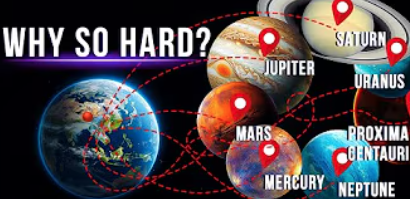
Humanity has sent spacecraft to almost every corner of our Solar System. We have landed on the Moon, explored Mars with robotic vehicles, flown past distant planets, and even reached the edge of interstellar space. Yet some worlds remain incredibly difficult to visit—not because they are the farthest away, but because the laws of physics themselves make the journey almost impossible.
Among all planets and celestial bodies, Mercury, Mars, Jupiter, Saturn, Uranus, Neptune, Pluto, and even our closest neighboring star system represent some of the greatest challenges ever faced by space exploration.
The reasons are surprising. Extreme temperatures, powerful gravity, enormous distances, radiation, fuel limitations, and communication delays all create obstacles that engineers must overcome before a spacecraft can safely reach its destination.
Mercury: The Planet That Is Close But Nearly Impossible to Reach
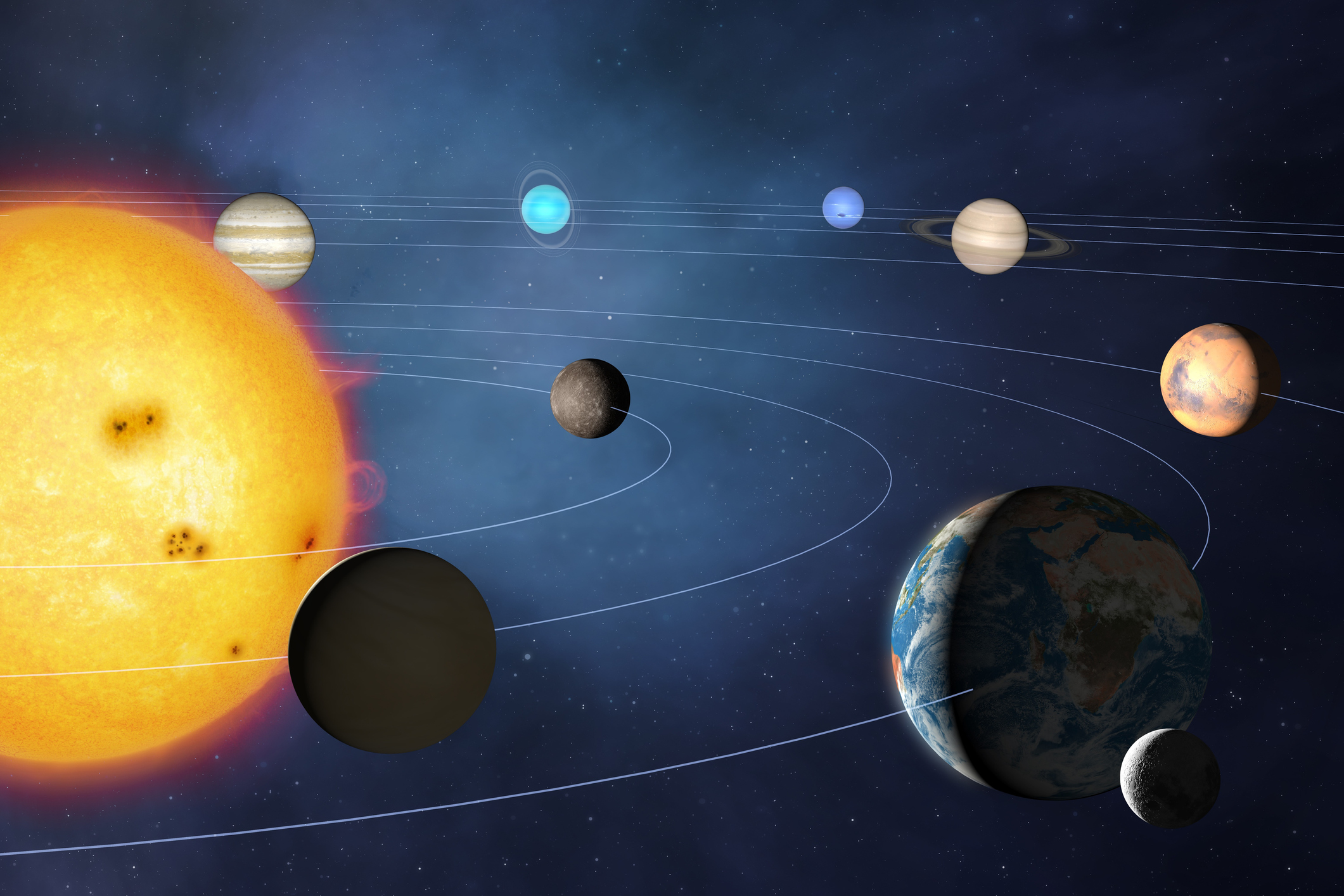
Mercury is often considered an easy target because it is one of the closest planets to Earth. However, reaching Mercury is far more difficult than traveling to planets much farther away.
Although Venus is actually Earth’s closest planet on average, Mercury is still relatively nearby compared with the outer planets. Despite this, humanity waited decades before sending a successful mission there.
The problem is not distance—it is the Sun.
Mercury orbits extremely close to our star, where sunlight is about seven times stronger than what Earth receives. The intense heat can damage spacecraft electronics, forcing missions to carry special heat shields and protective systems.
However, the greatest challenge is gravity.
As a spacecraft approaches the Sun, it accelerates dramatically because of the Sun’s enormous gravitational pull. A probe traveling directly toward Mercury would become too fast to enter orbit. Slowing down requires enormous amounts of fuel, something small robotic spacecraft cannot carry.
The solution came through orbital mechanics. Instead of flying directly to Mercury, NASA’s Messenger spacecraft followed a complicated route using gravitational assistance from Earth, Venus, and Mercury itself. After traveling nearly 5 billion miles over seven years, Messenger finally entered Mercury’s orbit in 2011.
The mission revealed fascinating secrets, including evidence suggesting that frozen water may exist inside permanently shadowed regions near Mercury’s poles.
Mars: The Planet Humanity Wants to Reach But Cannot Yet
Mars is often called the next frontier for human exploration. Unlike Mercury, Mars is not difficult because of extreme heat or gravity. The biggest obstacle is simply distance.
Traveling to the International Space Station means staying only a few hundred kilometers above Earth. Even the Moon, which seems far away, is only about 380,000 kilometers from Earth.
Mars is completely different.
The distance between Earth and Mars changes constantly, but even at their closest approach, they are tens of millions of kilometers apart. A journey to Mars would require astronauts to survive months in deep space, exposed to radiation and weightlessness.
A Mars mission would also require enormous amounts of supplies, spare parts, fuel, and life-support systems. Unlike astronauts on the International Space Station, a crew traveling to Mars cannot simply return home if something breaks.
Another major challenge is fuel. A spacecraft must not only reach Mars but also slow down, land, survive on the planet, and eventually launch back toward Earth.
Scientists estimate that a human Mars mission could require hundreds of tons of fuel and multiple rocket launches. The Apollo missions proved humans could reach another world, but Mars represents a completely different level of difficulty.
Jupiter: The Giant Planet Without a Surface
Jupiter is one of the most visited planets in the Solar System, yet it remains one of the most mysterious.
The problem begins with its size. Jupiter is so massive that its gravity creates both an advantage and a challenge. Spacecraft can use its gravity to gain speed, but entering orbit around Jupiter requires carefully reducing velocity.
Unlike Earth or Mars, Jupiter has no solid surface. A spacecraft descending into the planet would eventually be crushed by extreme pressure and destroyed by intense temperatures.
Radiation is another serious danger. Jupiter has one of the strongest magnetic fields in the Solar System, creating powerful radiation belts that can damage spacecraft electronics.
NASA’s Galileo mission was the first spacecraft to send a probe deep into Jupiter’s atmosphere. The probe survived only minutes before being destroyed by pressure and heat, but it provided valuable information about the planet’s composition and atmosphere.
Saturn and Its Mysterious Rings
Saturn is famous for its spectacular rings, but reaching this distant world requires advanced technology.
Because Saturn receives much less sunlight than Earth, spacecraft cannot rely on traditional solar panels. Instead, missions require nuclear power systems, which add weight and increase costs.
NASA’s Cassini-Huygens mission became the greatest exploration mission to Saturn. It discovered new moons, studied Saturn’s atmosphere, and revealed incredible details about Titan, Saturn’s largest moon.
The Huygens probe landed on Titan in 2005 and discovered a world with lakes, rivers, and weather systems—but instead of water, the liquid was methane.
Cassini also discovered evidence that Enceladus, another Saturnian moon, contains a hidden ocean beneath its icy surface, making it one of the most promising places to search for extraterrestrial life.
Uranus and Neptune: The Forgotten Ice Giants

Uranus and Neptune are among the least explored planets in our Solar System.
Uranus is especially strange because it rotates almost sideways. One pole can experience decades of sunlight while the opposite pole remains in darkness for more than 40 years.
Only Voyager 2 has visited Uranus, making a brief flyby in 1986.
The challenge is distance. Uranus is nearly 3 billion kilometers from the Sun, meaning spacecraft require nuclear power sources and extremely advanced communication systems.
Neptune is even farther away. Voyager 2 reached it in 1989 after more than a decade of travel. The spacecraft discovered incredibly powerful storms with winds exceeding 2,000 kilometers per hour.
Neptune’s largest moon, Triton, became one of the most fascinating discoveries. Scientists believe it may contain a hidden ocean beneath its icy surface and could potentially support conditions suitable for life.
Pluto: The Lonely World at the Edge of the Solar System
For decades, Pluto was considered the ninth planet. But visiting this tiny distant world required one of the most ambitious missions ever created.
NASA’s New Horizons spacecraft finally reached Pluto in 2015 after traveling billions of kilometers.
The spacecraft revealed that Pluto was not a frozen, inactive rock, but a surprisingly dynamic world with mountains, glaciers, and possible underground water.
However, New Horizons did not enter orbit. It moved past Pluto at incredible speed, collecting data during a brief encounter before continuing toward the outer Solar System.
Beyond the Solar System: The Impossible Journey to Proxima Centauri
The greatest challenge of all is not another planet—it is another star.
Proxima Centauri is the closest star system to Earth, located 4.24 light-years away. With today’s technology, reaching it would take thousands of years.
The Voyager 1 spacecraft, the fastest human-made object leaving the Solar System, would need approximately 76,000 years to reach Proxima Centauri.
Future concepts such as laser-powered sails and the Breakthrough Starshot project aim to send tiny spacecraft traveling at a significant fraction of the speed of light. If successful, such a mission could reach the nearest star within a few decades.
But sending humans remains far beyond our current abilities.
The Future of Space Exploration
Every difficult mission teaches humanity something new. Mercury showed us how to navigate extreme gravity. Mars challenges us to solve the problems of human survival. The outer planets reveal worlds unlike anything on Earth. And distant stars remind us how small we are compared with the universe.
Space exploration is not limited by curiosity—it is limited by physics, technology, and time.
The greatest discoveries may still be waiting beyond our reach. The question is not whether humanity will explore these worlds, but when we will finally develop the technology to get there.