The echo of a single gunshot in a Santa Barbara mansion on the morning of May 9, 1914, did more than end the life of cereal magnate Charles William Post; it detonated a seismic shift in the American social and economic landscape. The shot, which claimed the 60-year-old founder of the Postum Cereal Company, catapulted his 27-year-old daughter, Marjorie Merriweather Post, into a position of unprecedented power. She inherited a fortune valued at $20 million—a sum with the purchasing power of over half a billion dollars today—and control of a burgeoning food empire.
Yet, as history would record, the inheritance was merely the starting point. The young widow, already a mother of two, would not simply preserve her father’s legacy; she would multiply it exponentially, transforming a breakfast food company into the General Foods Corporation and using her vast wealth to build palaces, collect imperial treasures, and navigate the highest echelons of global power.
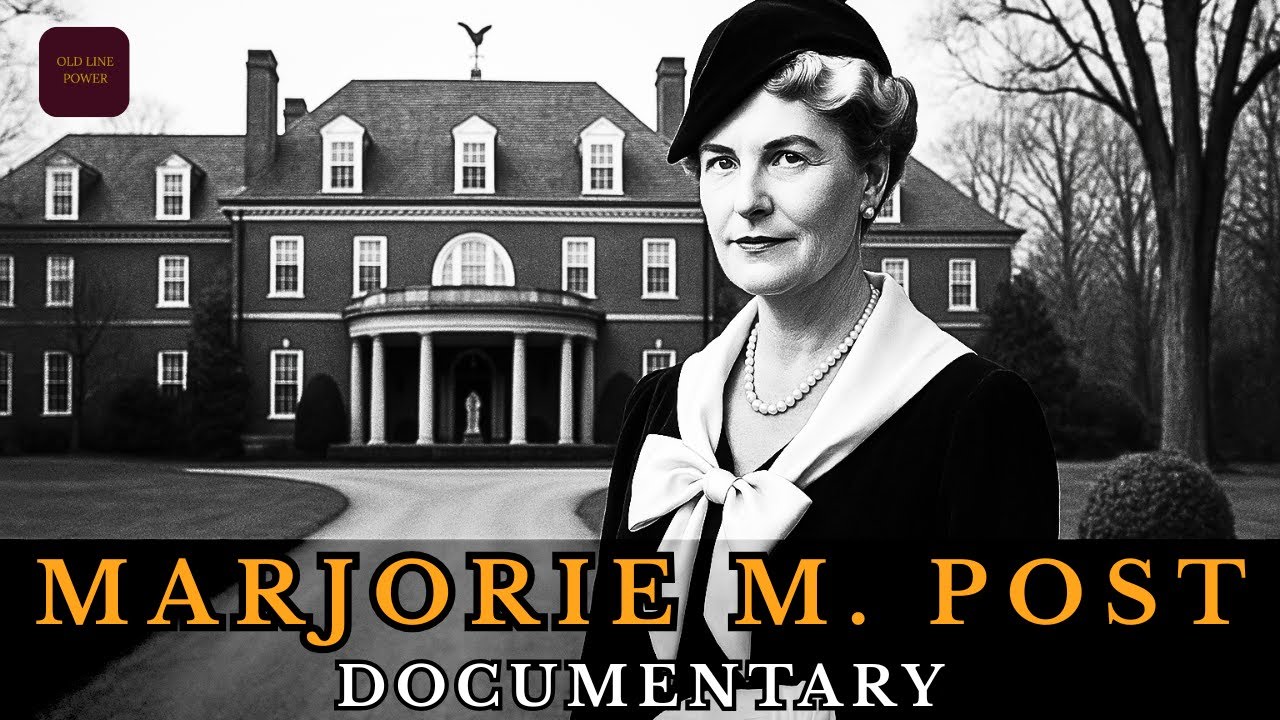 Marjorie’s ascension was not an accident of birth alone; it was the culmination of a deliberate and rigorous apprenticeship. Charles Post, a self-made titan who had revolutionized American breakfast habits with Grape-Nuts and Post Toasties, had no son. Instead, he groomed his only daughter with an intensity reserved for a successor.
From the age of ten, Marjorie was brought into board meetings, a silent observer in a world of cigar smoke and ledgers. She toured the factory floors in Battle Creek, Michigan, learning the intricacies of production and logistics. Her father explained the reasoning behind contracts and advertising campaigns during carriage rides, turning the family barn where she once glued labels onto boxes into the first classroom of a business education that would rival any formal institution.
By the time she was a teenager, she understood the vocabulary of margins, inventory, and market share—concepts alien to most women of her era, who were expected to master only the social graces.
The death of her father, however, was a crucible. The tragedy was compounded by the fact that her first marriage, to lawyer Edward Bennett Close, had already begun to sour. The union, which had provided social legitimacy for the nouveau riche Post family, had devolved into a hollow arrangement.
But the outbreak of World War I provided Marjorie with a new focus and a new identity. While her husband served in France, earning a battlefield promotion and the French Médaille d’Or, Marjorie threw herself into humanitarian work. She personally funded and organized Base Hospital No.
15 in Savenay, France, a 2,460-bed facility that treated thousands of wounded American soldiers. Walking the wards of her hospital, she witnessed the brutal cost of conflict and discovered a capability for organization and leadership that the confines of domestic life had never demanded. The experience was transformative, and upon her husband’s return, the chasm between them had become unbridgeable.
The marriage ended in divorce in 1919, leaving Marjorie a single mother, but a woman who had proven she could command a massive enterprise on her own.
The 1920s heralded a new era defined by a formidable partnership. In 1920, Marjorie married Edward Francis Hutton, a Wall Street titan who had built one of the nation’s largest brokerage firms. Unlike her first husband, Hutton was a financial equal who understood the language of capital and expansion.
 Together, they formed a corporate juggernaut. Hutton took Postum public in 1922 and became chairman of the board, while Marjorie, with her inherited acumen, drove the strategic vision. The decade became a relentless acquisition spree.
They purchased Jell-O, Baker’s Chocolate, Maxwell House coffee, Hellmann’s mayonnaise, and Log Cabin syrup, folding these iconic American brands into a growing conglomerate. In 1929, the company was renamed General Foods, reflecting its new status as the largest food corporation in the nation. This period of aggressive growth was mirrored by an equally aggressive expansion of their personal universe, culminating in the construction of Mar-a-Lago, a 126-room mansion in Palm Beach, Florida, designed by Marion Sims Wyeth and Joseph Urban, which cost an estimated $7 million and was intended to rival the great estates of European royalty.
Yet, the glittering facade of the 1920s concealed a personal unraveling. The stock market crash of 1929 and the subsequent Great Depression tested the marriage in unexpected ways. While Edward Hutton remained focused on his financial concerns, Marjorie was moved to action by the suffering around her.
In a gesture that shocked her social circle, she canceled the insurance policy on her vast jewelry collection—which included pieces owned by Marie Antoinette and Empress Marie Louise—and used the savings to fund the Marjorie Post Hutton Canteen in Hell’s Kitchen, Manhattan. She did not merely write a check; she personally supervised the operation, ensuring that a thousand hungry people a day received meals with dignity. She even stood on a street corner ringing a Salvation Army bell during the Christmas season, a spectacle of humility that baffled her peers.
This divergence in priorities, coupled with Hutton’s infidelity with her own maid—which Marjorie meticulously documented using bells, silk threads, and talcum powder to catch him in the act—sealed the fate of the marriage. They divorced in 1935.
Within three months, Marjorie married Joseph E. Davies, a prominent Washington lawyer and diplomat. This third marriage would prove to be her most consequential.
In 1936, President Franklin D. Roosevelt appointed Davies as the U. S.
 Ambassador to the Soviet Union. Marjorie, now 50, stepped into the role of ambassadress in one of the most dangerous and opaque capitals on Earth. She transformed Spaso House, the ambassador’s residence, into an oasis of American elegance, paying for renovations out of her own pocket and hosting lavish dinners for Soviet officials, all while navigating the constant surveillance of the secret police.
It was during this period that she began her most significant collecting endeavor. As Stalin’s purges decimated the old order, the Soviet state was liquidating the treasures of the Romanovs to fund industrialization. Marjorie, with her keen eye and hard currency, began rescuing imperial eggs, chalices, porcelain, and icons from dusty commission shops and state storerooms.
She was not just acquiring art; she was preserving fragments of a civilization that was being deliberately dismantled.
The Davies ambassadorship was controversial, particularly Joseph’s acceptance of the Moscow show trials as genuine, a stance he documented in his book Mission to Moscow. Marjorie, however, remained focused on her role as a cultural salvager. The collection she assembled in Moscow formed the foundation of what would become the most important assemblage of Imperial Russian art outside of Russia.
Her marriage to Davies, however, did not survive the return to American life. They divorced in 1955, with Marjorie citing his “funny lack of basic straight thinking.” She was 68 years old, and her fourth and final marriage, to Herbert May, a Pittsburgh industrialist, ended in 1964 under a cloud of 𝒔𝒄𝒂𝓃𝒹𝒶𝓁 involving photographs of May at the Mar-a-Lago pool with other men.
The humiliation was profound, and after the divorce, Marjorie reclaimed her maiden name, declaring that she would be known as Marjorie Merriweather Post for the rest of her life.
In the final decades of her life, Marjorie focused on cementing her legacy. She purchased a 25-acre estate in Washington, D. C.
 , which she named Hillwood, and transformed it into a showcase for her Russian and French decorative arts collections. Recognizing that her treasures were meant for the public, she bequeathed the estate to the Smithsonian Institution, with a $10 million endowment for its maintenance. She made similar arrangements for other properties, intending Mar-a-Lago to serve as a presidential retreat and Camp Topridge in the Adirondacks for educational purposes.
She died of cardiac failure on September 12, 1973, at the age of 86, just days after the tragic drowning of her grandson, David. At the time of her death, her fortune had grown to an estimated $250 million, a testament to her business acumen and the power of the General Foods empire she had helped build.
The legacy of Marjorie Merriweather Post is a complex tapestry of immense wealth, profound philanthropy, and relentless ambition. She was a business pioneer in an era when women could not vote, a fact that makes her control of a major corporation all the more remarkable. Her foresight in recognizing the potential of frozen food, leading to the acquisition of Birdseye, revolutionized the American diet.
Her humanitarian efforts during the Great Depression provided tangible relief to thousands. And her preservation of Russian imperial art saved a cultural heritage that might otherwise have been lost to history. While the Smithsonian ultimately returned Hillwood to the Post Foundation due to insufficient endowment income, the estate was opened to the public in 1977 by her daughter, Adelaide, and continues to operate as a museum, exactly as Marjorie had arranged it.
The Mar-a-Lago estate, after being deemed too costly for the federal government to maintain, was sold to Donald Trump in 1985, becoming a symbol of a different kind of American wealth.
Today, Hillwood stands as a testament to her vision, a time capsule of a life lived on a scale that seems almost mythical. Visitors walk through rooms where Fabergé eggs gleam under glass and chandeliers from the Catherine Palace hang overhead, guided by docents who tell the story of the woman who believed that magnificence was not a sin but a responsibility. Her life was a narrative of contradictions: a woman who lived like an empress but stood on street corners for charity; a capitalist who dined with the architects of communism; a collector who saved the treasures of a murdered dynasty.
She navigated four marriages, each reflecting a different stage of her personal evolution, and she transformed a $20 million inheritance into a $250 million empire. The gunshot that echoed through Santa Barbara in 1914 did not just end a life; it unleashed a force of nature. Marjorie Merriweather Post took the raw materials of her inheritance—the money, the company, the lessons from her father—and built a legacy that continues to shape American cultural institutions today, proving that the Gilded Age heiress was, in fact, the architect of her own enduring monument.