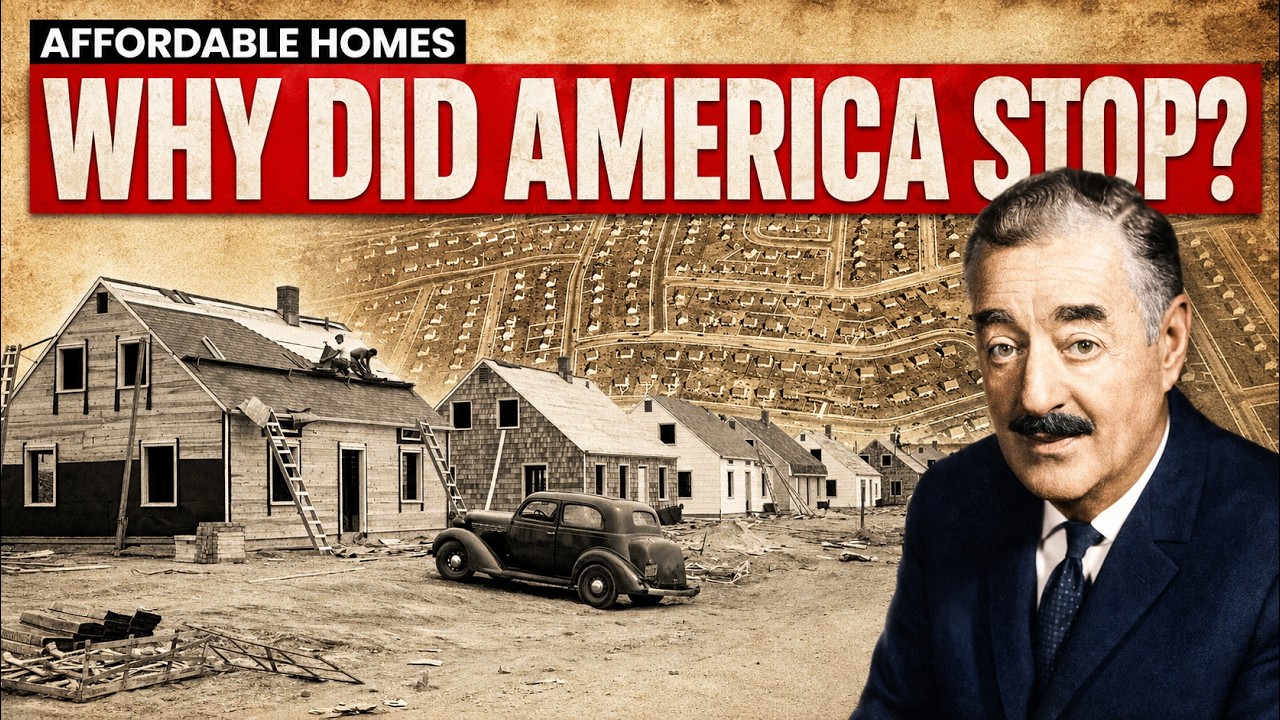
In 1949, a young veteran could drive onto a former potato field on Long Island—
and buy a brand-new house.
No wealthy parents.
No six-figure salary.
In many cases, almost no down payment.
The house had two bedrooms.
A refrigerator.
A stove.
A washing machine.
A small yard.
A driveway.
And the mortgage payment could be lower than rent.
Behind him, construction crews were building another house.
Then another.
Then another.

At peak production—
one new home could be completed roughly every sixteen minutes.
Sixteen minutes.
America had figured out how to mass-produce the middle-class dream.
Now jump forward.
A teacher finishes work in a city she cannot afford to live in.
A firefighter drives an hour home because houses near the station cost too much.
A thirty-year-old couple with two incomes saves for years—
then watches prices rise faster than their down payment.
A renter receives another notice:
Rent increased.
Again.
And somewhere outside town sits empty land where thousands of homes could theoretically be built.
Except they aren’t.
Maybe zoning forbids apartments.
Maybe the lots are required to be enormous.
Maybe parking rules make the project too expensive.
Maybe neighbors show up at a hearing and say:
“We support housing.
Just not here.”
Maybe the builder cannot find enough workers.
Maybe financing collapses.
Maybe permitting takes years.
Maybe everyone agrees America needs more homes—
and everyone has a reason why this particular home should not be built.
That is how a country that once built housing at industrial speed ended up short millions of homes.
And the strangest part is this:
America already solved this problem once.
After the Great Depression and World War II, the federal government helped create a housing machine powerful enough to turn millions of ordinary workers into homeowners.
Then, over decades, America slowly dismantled parts of that machine—
while making it harder and harder to build anything new.
The result is the housing crisis we live in now.
But to understand how the ladder disappeared—
you first have to see how deliberately America built it.
The housing system was collapsing.
Banks were failing.
Construction had stopped.
Families were losing homes.
Unemployment was catastrophic.
A mortgage in those days looked nothing like the one most Americans know now.
A buyer might need thirty—
forty—
even fifty percent down.
The loan might last only five years.
Maybe ten.
And then—
the balloon payment.
The entire remaining balance came due.
Imagine making payments for years—
then reaching the end and discovering you still owe almost the whole loan.
If the bank refinanced you—
you survived.
If it didn’t—
you could lose the house.
During the Great Depression, refinancing disappeared.
Banks were terrified.
Credit froze.
Foreclosures exploded.
The American housing market was dying.
Franklin Roosevelt’s administration reached a conclusion that would permanently reshape the country:
Housing was too important to leave completely exposed to financial panic.
So in 1934—
the federal government created the Federal Housing Administration.
FHA.
The government wouldn’t build every house.
It wouldn’t personally issue every mortgage.
Instead—
it would reduce the lender’s risk.
If qualifying borrowers defaulted, federal insurance protected the lender.
Banks suddenly had a reason to lend again.
And the mortgage itself began changing.
Longer terms.
Lower down payments.
Fixed payments.
Amortization.
Every payment could reduce the principal.
Instead of reaching the end of five years and facing financial execution—
families could pay gradually.
Predictably.
For decades.
The thirty-year mortgage would emerge fully over time rather than instantly in 1934.
But the essential revolution had begun.
Time became the tool that made houses affordable.
Then came another problem.
If a bank makes a long-term mortgage—
its money is trapped inside that loan.
How does it keep lending?
Washington created another answer.
Fannie Mae.
The Federal National Mortgage Association.
Fannie Mae.
A local bank could make a mortgage—
then sell it.
That returned money to the bank.
Now the bank could lend again.
And again.
And again.
Mortgage capital no longer had to remain trapped inside one local institution for decades.
A national housing-finance system began taking shape.
Government insurance reduced risk.
The secondary market recycled capital.
Long-term mortgages reduced monthly payments.
America had created the financial machinery.
Then World War II ended—
and millions of young families arrived at exactly the moment that machinery was ready.
Sixteen million Americans served during World War II.
When the war ended, millions came home wanting the same thing.
Normal life.
Marriage.
Children.
A job.
A house.
But there weren’t enough houses.
The Depression had suppressed construction.
The war had redirected building materials toward military production.
Young couples doubled up with parents.
Some veterans lived in converted military structures and temporary housing.
Demand was enormous.
Then came the GI Bill.
Among its benefits were government-backed home loans for eligible veterans.
Low interest.
Extremely favorable financing.
Often little or no down payment.
Compare that with the old world.

Before:
Save half the price of the house.
After:
Serve your country—
and the government helps stand behind your mortgage.
That single difference created millions of potential buyers.
Now America needed millions of houses.
Enter William Levitt.
Long Island.
Potato fields.
Thousands of acres.
Levitt looked at traditional homebuilding and saw inefficiency.
A house was built almost like a custom object.
One team moved through many different tasks.
Slow.
Expensive.
He had seen military construction during the war.
Standardization.
Specialized crews.
Repeatable processes.
So he asked a revolutionary question:
Why not build houses like automobiles?
Instead of the house moving down an assembly line—
the workers would move.
One crew pours foundations.
Next crew frames.
Next crew installs plumbing.
Next crew paints.
Next crew installs appliances.
Then move to the next house.
Same task.
Again.
Again.
Again.
Materials bought in bulk.
Lumber pre-cut.
Components standardized.
Waste reduced.
Speed increased.
At peak production—
a new house could be completed roughly every sixteen minutes.
Think about that image.
A young family visits an empty field.
Weeks later—
an entire neighborhood exists.
House after house.
Street after street.
Driveways.
Lawns.
Children.
A community appearing almost as quickly as a factory could produce automobiles.
The early Levittown houses were small.
Simple.
Nearly identical.
But they were affordable.
And affordability mattered more than architectural individuality.
For a generation raised through Depression and war—
a modest house with a yard felt luxurious.
It was theirs.
That idea spread across America.
Developers copied the formula.
Suburbs exploded.
Millions of houses were built.
And homeownership surged.
America had created one of the greatest middle-class wealth engines in history.
You buy a house.
Pay the mortgage.
Build equity.
Property appreciates.
Years later, that equity can finance retirement.
College.
Another home.
Inheritance.
The house becomes more than shelter.
It becomes family wealth.
But there was a terrible condition hidden inside this prosperity.
Not everyone was allowed onto the ladder.
Imagine two soldiers coming home from the same war.
Same uniform.
Same battlefield.
Same country.
One is white.
One is Black.
The white veteran walks into a suburban development.
He qualifies for favorable financing.
Buys a house.
Moves in.
Raises children.
The neighborhood appreciates.
Thirty years later, the mortgage is gone.
The family owns an asset worth far more than the original purchase price.
Now the Black veteran tries to do the same.
And the answer is:
No.
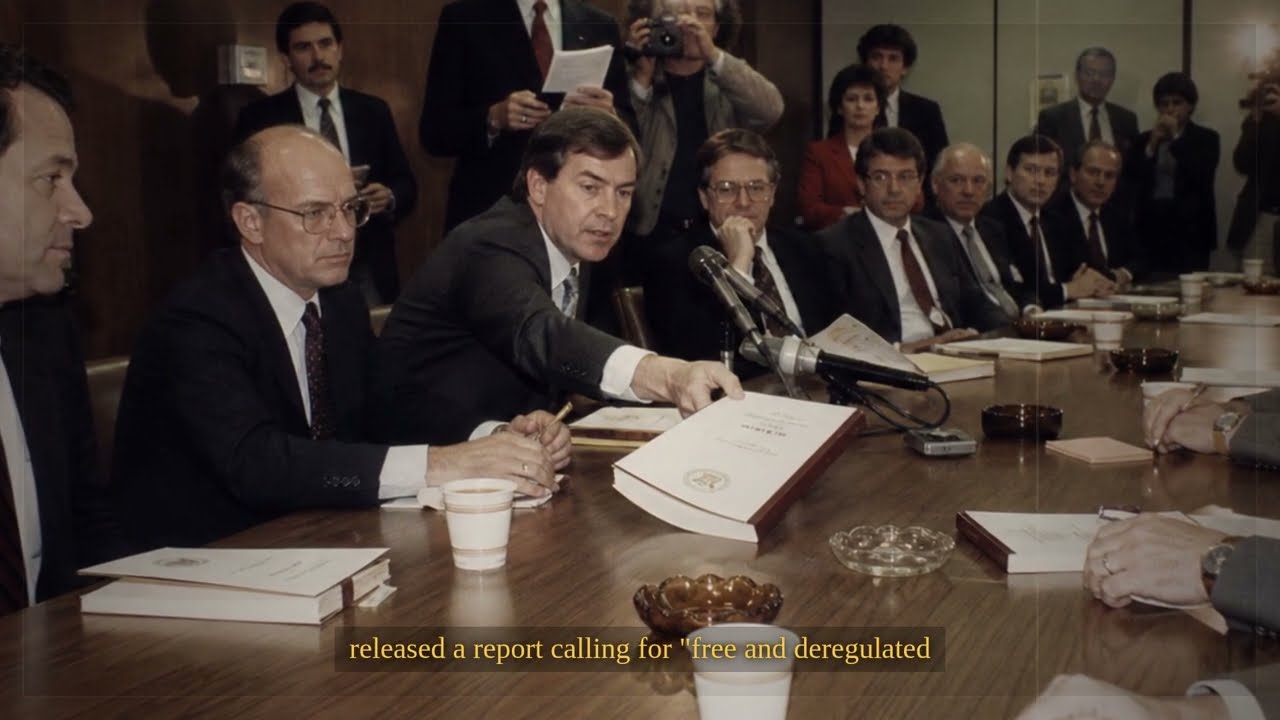
Not necessarily written in the law of the GI Bill itself—
but embedded in local implementation, mortgage underwriting, restrictive covenants, lender behavior and federal housing policy.
Redlining helped classify minority neighborhoods as risky.
The FHA promoted underwriting practices that reinforced racial segregation.
Developers such as Levitt initially refused to sell to Black families.
The same government-backed housing revolution that expanded white middle-class wealth—
systematically denied many Black families equal access.
That difference did not disappear when the discriminatory rule disappeared.
Because wealth compounds.
If one family bought a house in 1949—
their children inherited equity.
Their grandchildren received help with down payments.
Another family denied that opportunity had no equivalent asset to pass forward.
Housing policy wrote inequality into geography.
And many of those geographic patterns remain visible.
But another idea from that same era would eventually become one of the biggest obstacles to building housing today.
Zoning.
At first, zoning sounds harmless.
Keep factories away from homes.
Don’t let a slaughterhouse open beside a school.
Separate dangerous industrial uses from residential life.
Reasonable.
But zoning could also control something else.
Who was economically capable of entering a neighborhood.
Suppose explicitly racial zoning is prohibited.
A town can no longer say:
“Black families cannot live here.”
But it can say:
Only detached houses.
Minimum lot:
half an acre.
No apartment buildings.
No duplexes.
No small lots.
Large setbacks.
Minimum parking requirements.
Now the rule doesn’t mention race.
Or class.
But ask a simple question:
Who can afford the only type of house legally allowed?
Exclusion becomes financial.
And over decades, these rules hardened.
Single-family-only zoning spread.
Neighborhoods that had once been created as affordable developments became places where building the next generation of affordable housing was effectively illegal.
This is one of the great ironies of American housing.
The first families climb the ladder.
Then zoning removes the lower rungs.
A small starter house might have been perfectly acceptable in 1950.
Try building an equally modest home in the same region decades later—
and local rules may require more land.
More parking.
More setbacks.
More approval.
More cost.
The house becomes expensive before anyone lays the first brick.
And while zoning tightened locally—
the federal government’s approach to affordable housing was changing too.
HUD was created.
The federal government continued supporting public and subsidized housing.
Section 8 emerged during the following decade.
For a time, Washington helped finance substantial numbers of affordable units.
Then the political philosophy shifted.
1980s.
Ronald Reagan.
Federal housing budgets were cut sharply.
The idea gaining power was straightforward:
Government should play a smaller role.
Markets should provide.
Private developers should build.
But private markets respond to profit.
If a luxury apartment earns more—
build luxury.
If large expensive houses produce stronger returns—
build large expensive houses.
A developer does not build a low-rent apartment simply because society desperately needs one.
The numbers have to work.
When direct federal support weakened—
the market did not automatically replace the missing affordable supply.
Instead, programs increasingly used vouchers, tax credits and complicated partnerships to subsidize housing.
One of the biggest tools became the Low-Income Housing Tax Credit.
Private developers could receive tax benefits for producing income-restricted housing.
The program created large numbers of units.
But affordable-housing finance became extraordinarily complicated.
Tax credits.
Private equity.
Local subsidies.
State money.
Federal money.
Soft loans.
Multiple approvals.
A project can be legally approved—
financially desirable—
socially necessary—
and still sit unbuilt because one funding layer is missing.
America didn’t stop knowing how to build.
It learned how to surround building with complexity.
Then came 2008.
And housing construction fell off a cliff.
The housing bubble burst.
Subprime mortgages imploded.
Financial institutions failed.
Home prices collapsed.
Foreclosures surged.
Builders suddenly found themselves surrounded by unsold homes.
So they stopped.
Projects were canceled.
Construction companies failed.
Workers lost jobs.
Young people stopped entering the trades.
Experienced workers moved into other industries.
Housing starts collapsed dramatically.
At the time, that made sense.
America had overbuilt in some markets.
Prices were crashing.
Why build more?
But here’s the problem.
The crash ended.
Population kept growing.
Households kept forming.
Demand returned.
Construction did not fully return at the old pace.
The 2010s became a historically weak decade for homebuilding relative to earlier eras.
Years of underbuilding accumulated.
One missing house.
Then another.
Then another.
Eventually millions.
The housing shortage of the 2020s did not begin during the pandemic.
It had been quietly building for years.
And 2008 damaged more than developers.
It damaged the construction workforce itself.
Carpenters.
Electricians.
Plumbers.
Framers.
Roofers.
People left.
Many never returned.
Now imagine a builder today.
He has land.
Financing.
Demand.
But not enough workers.
Labor becomes more expensive.
Materials become more expensive.
Land becomes more expensive.
Permitting takes longer.
Interest costs accumulate while waiting.
Every month of delay adds cost.
Every regulation may individually seem small.
Parking spaces.
Setbacks.
Height limits.
Design requirements.
Environmental reviews.
Impact fees.
Traffic studies.
Public hearings.
Add them together—
and the cheap house disappears before construction begins.
But even after clearing all of that—
there is still one more obstacle.
The neighbor.
Public hearing.
Tuesday night.
A developer proposes apartments.
Maybe townhouses.
Maybe several hundred units near transit.
Someone stands up.
“We absolutely support affordable housing.”
Pause.
“But this project is too dense.”
Next speaker.
“Traffic.”
Next.
“Parking.”
Next.
“Neighborhood character.”
Next.
“Property values.”
Next.
“Schools are already crowded.”
The meeting continues.
Everyone agrees housing is expensive.
Almost nobody wants more housing beside them.
This is NIMBYism.
Not In My Backyard.
And economically—
it is completely understandable.
For many American homeowners, the house is their largest asset.
Scarcity protects its value.
More supply could moderate prices.
So the person who already owns has a financial incentive to restrict what the person who doesn’t own desperately needs.
That creates a vicious loop.
Block housing.
Supply stays low.
Prices rise.
Existing homeowners become wealthier.
Their political influence rises.
They fight the next project.
Supply gets tighter.
Prices rise again.
The winners become more capable of protecting the system that made them winners.
Meanwhile, the renter pays more every year.
And something else is quietly increasing demand.
America needs more homes even when population does not explode.
Why?
Households are smaller.
One person lives alone.
Divorced couples need two homes instead of one.
Older adults remain independent longer.
Young adults form separate households.
The same population can require more housing units.
So demand keeps climbing—
while communities keep saying no.
Then the pandemic hits.
People suddenly care about space.
Home offices.
Backyards.
More rooms.
Remote work allows high-income workers to leave expensive coastal cities and move somewhere cheaper.
Bozeman.
Austin.
Phoenix.
Miami.
Mountain towns.
Sunbelt metros.
Local residents watch outsiders arrive with salaries anchored to much richer markets.
Offers climb.
Homes sell above asking.
Rents surge.
Construction materials become volatile.
Mortgage rates eventually rise.
Suddenly a house that felt affordable three years earlier—
is unreachable.
And this is where the housing crisis becomes almost absurd.
America is not short of land.
It is not short of engineering talent.
It is not short of money.
It is not short of demand.
It is short of permission—
labor—
financing—
and political willingness to absorb change.
Some estimates place the national housing shortage in the millions of units.
Different studies produce different numbers.
But they agree on the central fact.
America did not build enough homes for years.
And when demand exceeds supply—
prices rise.
That is not ideology.
It is arithmetic.
The question is why supply cannot respond.
The answer is the entire story you just heard.
Zoning.
Land.
Labor.
Regulation.
Financing.
Local opposition.
Federal retreat.
The scars of 2008.
And decades of treating houses simultaneously as shelter—
and investment assets whose value must keep rising.
Those two goals eventually collide.
If homes become dramatically more affordable—
someone’s home equity may grow more slowly.
If home values rise dramatically—
the next generation has a harder time buying.
You cannot permanently maximize affordability for buyers—
and permanently maximize appreciation for owners—
at the same time.
That conflict sits at the center of American housing politics.
And here’s what makes it so frustrating.
America knows how to build quickly.
It has done it before.
Levittown wasn’t magic.
It used standardized designs.
Large land assemblies.
Efficient crews.
Bulk purchasing.
Predictable approvals.
Government-backed financing.
Most importantly—
a political system that wanted housing built.
That doesn’t mean America should recreate Levittown exactly.
The original model had enormous flaws.
Segregation.
Car dependency.
Environmental consequences.
Sprawl.
Uniformity.
But the lesson wasn’t:
Build identical detached houses forever.
The lesson was:
When government, finance and industry align around expanding supply—
supply expands.
Today, some places are beginning to test that principle again.
Minneapolis eliminated single-family-only zoning citywide.
Oregon legalized more “middle housing” types in many residential areas.
California has passed laws intended to make lot splits and additional units easier.
Other states and cities are experimenting with accessory dwelling units, duplex legalization, transit-oriented housing and permitting reform.
The principle is simple.
If you legalize more housing—
some of it may actually get built.
But changing zoning alone won’t solve everything.
Workers are still needed.
Infrastructure is still needed.
Affordable housing still requires subsidies when market rents cannot support construction costs.
Interest rates matter.
Materials matter.
Land matters.
And politically—
existing homeowners still vote.
That may be the hardest obstacle of all.
Go back to Levittown.
A veteran signs paperwork.
His wife stands beside him.
They walk through the front door.
Small living room.
Tiny kitchen.
Two bedrooms.
Nothing luxurious.
But there is a key in his hand.
The house costs around what a modest working family can realistically finance.
His children will grow up there.
The mortgage will eventually disappear.
The value may rise.
The family will possess something they can pass forward.
That key is not merely opening a house.
It’s opening the middle class.
Now imagine his grandson.
Same country.
Good job.
Works full-time.
Maybe earns more money, adjusted for inflation, than his grandfather ever imagined.
He opens a real-estate app.
Three-bedroom starter home.
$485,000.
Another.
$540,000.
Another.
$625,000.
He laughs.
Not because it’s funny.
Because there is nothing else to do.
He closes the app.
Keeps renting.
The grandfather entered adulthood when America was desperately trying to make homes easier to buy.
The grandson entered adulthood inside a system where millions of homeowners are financially rewarded when homes become harder to buy.
That is the reversal.
And it did not happen in one law.
One election.
One recession.
It happened through thousands of decisions.
One suburb prohibits apartments.
One city requires more parking.
One affordable-housing budget disappears.
One construction worker leaves the industry.
One project gets sued.
One neighborhood meeting says no.
One builder goes bankrupt.
One recession wipes out a decade of production.
One investor buys another property.
One homeowner watches the value rise—
and votes to protect it.
Again.
Again.
Again.
Until the ladder that built the American middle class is still standing—
but the first rung is six feet off the ground.
America can build homes.
The country has built entire suburbs in years.
It has built interstate highways across a continent.
Skyscrapers.
Factories.
Airports.
Data centers.
Military bases.
Cities in deserts.
The engineering problem is solved.
The financial technology exists.
The land exists.
The labor can be trained.
The materials can be produced.
So the deepest question in the housing crisis is not:
Can America build enough homes?
It is:
Who benefits if it does?
Because scarcity has winners.
The homeowner whose property appreciated.
The landlord collecting higher rent.
The investor holding housing assets.
The local government dependent on expensive property.
The resident who likes the neighborhood exactly as it is.
And scarcity has losers.
The twenty-eight-year-old still living with parents.
The teacher commuting sixty miles.
The family spending half its income on rent.
The veteran sleeping in a car.
The child moving schools because the rent increased again.
The old American housing machine was designed around expansion.
Build.
Finance.
Move in.
Build again.
The modern system often behaves as if the goal is preservation.
Protect the neighborhood.
Protect the view.
Protect the property value.
Protect the zoning.
Protect what already exists.
And every protection has a price.
Someone else does not get a home.
That’s why this crisis feels impossible.
The people who already made it onto the ladder—
often control whether the ladder gets extended downward.
And until that changes—
America can keep building rockets to Mars—
while ordinary families stare at an empty lot across the street and wonder why building a simple home there has become harder than going to space.