“Don’t open the trunk.”
It was 2:40 in the morning.
Police had stopped a seventeen-year-old boy after neighbors thought he was stealing tires.
He wasn’t.
But what he was actually doing was far worse.
The teenager warned the officers that the objects inside his car were—
“radioactive.”
For a moment, police feared they had stumbled onto some kind of homemade atomic weapon.
Specialists were called.
Equipment came out.

Then the radiation detector reacted.
The reading near the material was reportedly around ONE THOUSAND TIMES normal background levels.
And suddenly this was no longer a suspicious teenager standing beside a Pontiac in suburban Michigan.
It was a radiological emergency.
But the police still did not know the most frightening part.
The radioactive material in that car had come from a small potting shed behind the boy’s mother’s house.
A shed surrounded by ordinary homes.
Children.
Gardens.
Families sleeping only a few doors away.
And by the time the teenager himself realized how dangerous his experiment had become—
he could detect elevated radiation several houses away.
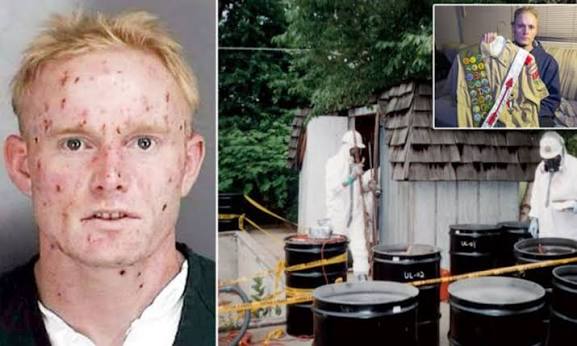
His name was David Hahn.
He would become known as the Radioactive Boy Scout.
And the strangest part of his story is not simply that a teenager tried to build a nuclear device in his mother’s backyard.
It is how many warning signs appeared—
how many adults crossed his path—
how many organizations unknowingly helped him—
and how long it took anyone to realize what was happening.
Because David did not begin with uranium.
He began with a book.
David Hahn was born near Detroit, Michigan, in 1976.
His parents divorced when he was young, and David divided his time between households.
Then, when he was around ten years old, his grandfather gave him a gift.
The Golden Book of Chemistry Experiments.
For another child, it might have been a book read once and forgotten on a shelf.
For David—
it became an obsession.
He started building a laboratory.
Not a child’s chemistry set with colored water.
Real glassware.
Beakers.
Test tubes.
Burners.
Chemistry books.
Encyclopedias.
Chemicals.
His bedroom slowly became something closer to a small experimental laboratory.
And David was not interested merely in reading about reactions.
He wanted to make them happen.
Again.
And again.
And again.
By his early teens, the experiments were already becoming dangerous.
According to accounts of his life, he produced nitroglycerin while still extraordinarily young.
He experimented with substances on himself.
On one Boy Scout trip, he reportedly arrived with his skin turned bright orange after taking canthaxanthin while experimenting with artificial tanning.
Then came magnesium.
David and other scouts ignited material he had brought for homemade fireworks.
The result damaged a tent.
This was becoming a pattern.
Experiment.
Explosion.
Warning.
Then another experiment.
His father and stepmother reportedly became accustomed to small blasts, chemical stains and damage inside the house.
Eventually, David’s laboratory was moved out of his bedroom.
Into the basement.
That might sound like an attempt to control the problem.
For David—
it meant more space.
More privacy.
And fewer eyes watching him.
He took jobs after school partly to finance his experiments.
Money came in.
Chemicals came home.
His knowledge increased.
So did the danger.
Then one experiment nearly blinded him.
David had obtained red phosphorus.
He placed it inside a glass container.
Then began striking or working it with a screwdriver.
The container exploded.
Glass tore into his hands and arms.
Fragments entered his eyes.
He required medical treatment.
He had not even been wearing proper eye protection.
If there was ever a moment when the experiments should have ended—
this was it.
Instead—
the laboratory moved again.
This time to his biological mother’s property.
A small potting shed in the backyard.
And that shed changed everything.
Because now David had something every obsessive teenage experimenter should probably never have.
Isolation.
His mother and her boyfriend apparently saw an intensely hardworking teenager disappearing into a shed for hours.
They did not fully understand what he was doing inside.
At one point, when asked about his obsession, David reportedly gave an answer that revealed just how enormous his ambition had become.
Someday—
the world was going to run out of oil.
David believed nuclear energy might be part of the answer.
Then the Boy Scouts gave that obsession a direction.
David’s father wanted him to channel his energy into becoming an Eagle Scout.
To earn that rank, scouts needed merit badges across multiple fields.
David chose one that almost no one around him apparently expected.
Atomic Energy.
For most teenagers, that badge would mean learning the basics.
Radiation.
Fission.
Nuclear power.
Safety.
Maybe building a harmless model.
David did all of that.
He created educational material.
Visited a hospital radiology department.
Built a model reactor using ordinary objects.
And in May 1991—
before his fifteenth birthday—
he earned the Atomic Energy merit badge.
For almost anyone else—
that would have been the end of the project.
Badge earned.
Move on.
David looked at his harmless model—
and apparently decided it was not enough.
He wanted something real.
His ambition evolved toward creating a breeder-type reactor experiment.
The idea behind breeder reactors fascinated him because, in simplified terms, they can produce fissile material while operating.
To a teenager already obsessed with solving future energy problems—
the concept must have seemed irresistible.
There was only one obvious obstacle.
David was a teenager in suburban Michigan.
He did not have access to a nuclear laboratory.
He did not have professional equipment.
He did not have trained nuclear engineers supervising him.
And he certainly should not have been able to obtain meaningful quantities of radioactive material.
That should have ended the story.
Instead—
David started making phone calls.
And people answered.
He reportedly presented himself as a student or researcher and contacted organizations connected with nuclear science and industry.
Among them was the Nuclear Regulatory Commission.
David asked questions.
Technical questions.
Where radioactive isotopes could be found.
How certain materials behaved.
What regulations applied.
The people answering apparently had no idea they were feeding information to a teenager working from a backyard shed.
David later summarized the situation with remarkable simplicity:
The information was available.
He only had to find the materials.
And this is where his story becomes truly disturbing.
Because some radioactive substances were already sitting inside ordinary consumer products.
Smoke detectors.
Old luminous clocks.
Camping lantern mantles.
Individually, these products were not backyard nuclear reactors.
The radioactive components were small and designed for particular uses.
But David was not interested in one.
He wanted quantity.
So he began collecting.
Smoke detectors became one target.
Some ionization smoke detectors contained tiny amounts of americium-241.
David reportedly contacted a manufacturer while presenting his request as connected to an educational project.
He obtained large numbers of detectors.
Then dismantled them.
One.
Another.
Another.
Extracting the radioactive sources.
Material deliberately distributed in tiny quantities for consumer safety was now being concentrated by a teenager in a shed.
But americium was only the beginning.
Old luminous clocks provided another source.
Radium had historically been used in luminous paint because it could make instrument faces glow.
By David’s era, the dangers of radium were well understood.
But old clocks still existed.
Antique stores still sold them.
David found them.
Camping lantern mantles offered another path.
Some older mantles contained thorium.
Again—
one mantle was not the issue.
David accumulated many.
He burned and processed material.
Concentrated it.
Experimented.
And the little backyard laboratory became increasingly contaminated.
He also obtained uranium-bearing material.
Piece by piece—
a teenager without formal nuclear training was assembling radioactive sources from a bizarre combination of consumer products, old technology and information obtained through correspondence.
And nobody around him understood the complete picture.
That is the key.
A smoke-detector company saw a request.
An antique seller saw a customer.
Hospital staff saw an interested young man.
Nuclear organizations saw questions.
His family saw an obsessive teenager working in a shed.
Each person saw one fragment.
Only David saw the entire project.
Then he started putting those fragments together.
His setup was crude.

Homemade.
Improvised.
And dangerous.
Radioactive sources were arranged with other materials in an attempt to create neutron activity and transform materials.
Foil.
Blocks.
Powders.
Tape.
Improvised shielding.
Nothing about it resembled the carefully controlled environment of a professional nuclear facility.
There were no specialized containment systems.
No professional radiation-safety program.
No trained team continuously monitoring exposure.
Just David.
A shed.
And radioactive material.
His project is frequently described sensationally as a “nuclear reactor.”
Technically, that description can be misleading.
David did not create a conventional self-sustaining power reactor like those used at nuclear plants.
He did, however, assemble and manipulate radioactive materials in an attempt to produce breeder-reactor-like nuclear reactions—
and created a serious contamination hazard in the process.
Eventually—
even David realized something was wrong.
He had radiation-detection equipment.
He began taking measurements farther from the shed.
The readings remained elevated.
He moved farther away.
Still detectable.
Eventually, according to the story, he could detect radiation several houses away.
Now the experiment was no longer merely threatening David.
His neighbors had never agreed to participate.
Children living nearby had never agreed.
Families sleeping in their homes had no idea radioactive material was being manipulated only doors away.
For perhaps the first time—
David became frightened by what he had built.
He decided to dismantle it.
But dismantling radioactive material creates another problem.
Where do you put it?
David’s answer was astonishing.
His car.
He began loading materials into the trunk of his Pontiac.
And that brings us back to 2:40 a.m.
August 31, 1994.
A neighbor saw suspicious activity.
Police were called.
Officers arrived believing they might be dealing with theft.
Then David gave them the warning.
Radioactive.
The situation changed instantly.
The car was searched.
Authorities initially feared the possibility of an explosive device.
Specialists examined the material.
Radiation readings were dramatically above background.
The federal radiological response machinery began moving.
Finally—
after years of explosions, chemical injuries, radioactive collecting, strange purchases and secret experiments—
adults had discovered what David was doing.
But the danger was not over.
Because the car was only where some of the material had gone.
The real contamination site remained behind his mother’s house.
And authorities did not immediately understand its full significance.
According to the account, months passed before the backyard laboratory received the full response it required.
Jurisdiction complicated matters.
The shed was not a licensed nuclear facility.
It was a teenager’s homemade laboratory.
Government systems designed to regulate nuclear plants and recognized radioactive sites were suddenly confronting something almost absurd:
What agency handles a Boy Scout’s radioactive backyard shed?
Meanwhile—
the shed was still there.
Wind existed.
Rain existed.
Fire was possible.
Contaminated material could move.
And then something happened that demonstrates how little David’s own family understood the danger.
His mother began throwing things away.
Ordinary household trash.
Except some of the material was not ordinary.
Objects from the shed could contain radioactive contamination.
Material requiring controlled handling was potentially entering normal waste streams.
The contamination was no longer confined to one backyard.
Months after the police encounter, the Environmental Protection Agency became deeply involved.
Its assessment was alarming.
The site represented an imminent and substantial threat to public health, welfare or the environment.
Nearby people could potentially be exposed.
Contamination could migrate.
The backyard experiment had officially become an environmental cleanup.
Then came the scene that makes the entire story almost impossible to believe.
Federal cleanup crews arrived at an ordinary suburban home—
because a teenager’s chemistry obsession had created radioactive waste serious enough to require government removal.
The shed was dismantled.
Contaminated materials were packaged.
Objects were loaded for transport.
What had begun with a chemistry book given to a ten-year-old—
ended with federal workers treating part of his mother’s backyard like a hazardous site.
The material was eventually transported to a licensed disposal facility in the western United States.
David’s laboratory was gone.
But one question remained impossible to answer cleanly.
How much radiation had everyone received?
David had spent enormous amounts of time close to the materials.
Handling them.
Processing them.
Carrying them.
Experimenting with them.
Often with crude protection.
His family had lived near the site.
Neighbors had lived nearby.
Objects may have entered ordinary trash.
The source behind this story makes extremely strong claims about tens of thousands of people being exposed to dangerous radiation.
That specific interpretation should be treated cautiously.
Potential exposure across a surrounding population is not the same thing as proving that tens of thousands received dangerous doses.
But David unquestionably created a contamination problem serious enough to trigger federal intervention and cleanup.
And David himself had been closer to the sources than almost anyone.
In 1995, authorities reportedly arranged an opportunity for him to undergo extensive medical testing.
David refused.
Accounts suggest he feared what doctors might discover.
Imagine carrying that uncertainty.
Every headache.
Every strange pain.
Every illness.
Is this normal?
Or is this what I did to myself when I was seventeen?
David’s life after the incident did not become the triumphant career in nuclear science someone might expect from the sensational headlines.
He served in the U.S. Navy.
Later served in the Marines.
He struggled personally.
Years later, police again encountered him in circumstances involving smoke detectors, reviving public fascination with the Radioactive Boy Scout story.
Then in 2016—
David Hahn died at thirty-nine.
His death was attributed to accidental intoxication involving alcohol, not to a documented case of radiation poisoning.
And that distinction matters.
The easy ending would be:
Boy builds radioactive experiment.
Radiation kills him.
But history did not give us that neat ending.
Instead, David’s story leaves something more uncomfortable.
A trail of questions.
How did a teenager repeatedly injure himself with chemistry experiments without the experiments being stopped?
How did he acquire so many unusual materials without anyone assembling the pieces?
How did organizations answer his nuclear questions without realizing who he really was?
How could consumer products containing individually small radioactive sources be accumulated and processed into something much more dangerous?
Why did authorities struggle to respond quickly once the site was discovered?
And perhaps most importantly—
how many disasters begin exactly this way?
Not because nobody saw anything.
But because everyone saw only one piece.
His father saw chemistry.
The Boy Scouts saw a merit badge.
Companies saw purchases.
Officials heard technical questions.
Antique dealers saw old clocks.
His mother saw a hardworking teenager in the shed.
Police initially saw a possible tire thief.
Nobody saw the whole thing—
until a radiation detector screamed.
That is what makes David Hahn’s story more disturbing than the headline “Teenager Builds Nuclear Reactor.”
The reactor is the spectacle.
The system around him is the story.
For years, David kept crossing boundaries that should have triggered intervention.
Explosion.
Injury.
Radioactive materials.
False identities.
Unusual purchases.
Contamination.
Each boundary produced another opportunity for somebody to stop and ask:
What exactly is this kid doing?
Almost nobody did.
Until 2:40 in the morning.
A police officer opened a teenager’s car.
Inside were objects wrapped and packed by a boy who had spent years teaching himself nuclear chemistry.
The detector rose.
The bomb squad came.
Federal authorities were alerted.
And somewhere only a few houses away—
in the darkness behind an ordinary suburban home—
sat the little shed where the whole thing had begun.
No cooling tower.
No concrete containment dome.
No armed security.
No warning sign.
Just a backyard building—
filled with materials that never should have been concentrated there.
David Hahn wanted to solve the world’s energy problem.
Instead—
at seventeen—
he created a problem so dangerous that the federal government eventually had to bury his laboratory as radioactive waste.
And perhaps the most frightening detail of all is this:
Nobody discovered him because the system worked.
They discovered him because a neighbor thought he was stealing tires.