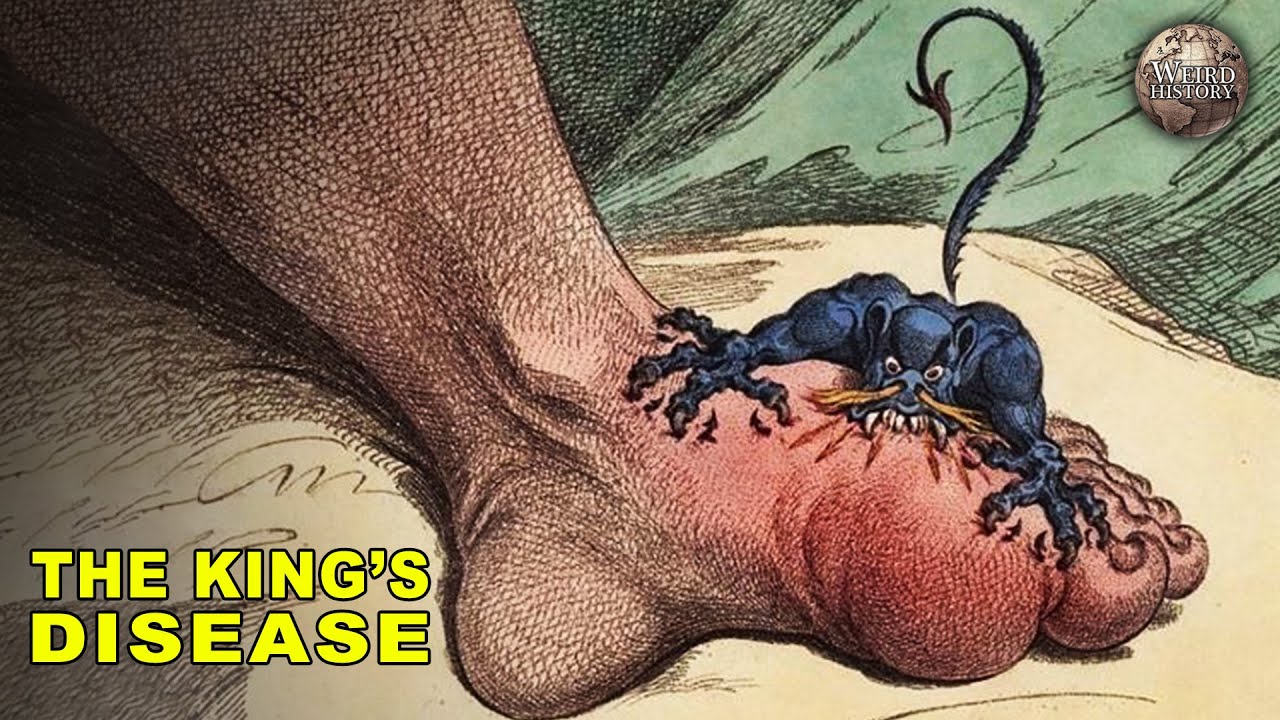
The pain was so savage that even a bedsheet touching his foot could feel unbearable.
Yet centuries ago—
some wealthy men almost wanted you to know they suffered from it.
Because this wasn’t considered an ordinary illness.
It was the disease of kings.
A swollen, burning big toe could announce something about you before you ever opened your mouth:
You could afford meat.
You could afford wine.
You could afford excess.
While ordinary people struggled to put food on the table, kings, aristocrats and wealthy statesmen were sometimes crippled by a disease associated so closely with luxury that having it could actually raise your social status.
And the pain?
Seventeenth-century physician Thomas Sydenham described gout as so excruciating that the sufferer could barely tolerate the weight of clothing or even vibrations caused by someone walking through the room.
Reverend Sydney Smith later offered an even more horrifying image.
He compared the sensation to—
walking on eyeballs.
But that wasn’t the strangest part of gout’s history.
Doctors once prescribed bizarre treatments.
Some people believed gout might increase male sexual vigor.
Powerful rulers were immobilized by attacks at critical political and military moments.
Benjamin Franklin became so frustrated with his gout that he wrote an entire imaginary conversation in which the disease personally accused him of eating, drinking and lounging too much.
And one sixteenth-century medical treatment became so grotesque that it involved—
kittens.
This is the bizarre history of the disease that could make a rich man scream in agony—
and still somehow advertise his wealth.
Long before anyone understood uric acid, people knew one thing about gout.
It hurt.
Badly.
The condition is an inflammatory form of arthritis capable of causing sudden attacks of intense pain, redness, swelling and tenderness.
And its most famous target is almost comically specific.
The big toe.
Imagine going to sleep normally.
Then waking in the middle of the night because your toe feels as if something inside it has suddenly caught fire.
It becomes swollen.
Red.
Hot.
Even slight pressure can become unbearable.
That experience was familiar thousands of years before modern medicine understood what caused it.
Ancient Greek physicians called the condition podagra—
essentially the “foot grabber.”
The name is brutally appropriate.
Because when gout grabbed the foot—
walking could become almost impossible.
Hippocrates described gout centuries before the birth of Christ and associated it with particular lifestyles and groups of patients.
But ancient medicine did not understand urate crystals.
Disease was interpreted through theories involving bodily humors.
So physicians could recognize the pattern—
without understanding the mechanism.
Today, the picture is much clearer.
Gout is associated with hyperuricemia—
too much uric acid in the blood.
When urate crystals accumulate in and around a joint, the immune system reacts violently.
Inflammation erupts.
Pain follows.
And cooler peripheral joints, especially around the big toe, are particularly vulnerable to crystal formation.
But for most of history, nobody could see those crystals.
All they could see was the victim.
And strangely—
the victim was often rich.
That gave gout one of the strangest reputations in medical history.
The disease became associated with prosperity.
Meat.
Alcohol.
Heavy meals.
Sedentary living.
Things ordinary people often could not consume in abundance.
If a laborer struggled to obtain enough calories—
a disease associated with overindulgence was unlikely to function as a status symbol for him.
But the aristocrat?
The king?
The wealthy merchant?
He could sit at a table covered with meat and wine.
And eventually—
his foot might announce the consequences.
This association became so culturally entrenched that gout earned its famous nickname:
“The disease of kings.”
The irony was extraordinary.
Most diseases lowered your status.
Gout could imply you had enough money to become sick from abundance.
A London newspaper joked around the beginning of the twentieth century that while the common cold was appropriately named—
gout seemed to elevate the patient’s social position.
Imagine that mentality today.
Your joint is swollen.
You can barely walk.
The slightest touch feels unbearable.
And somebody looks at you and thinks:
He must be doing well.
Gout became almost a grotesque badge of privilege.
And history’s list of sufferers reads like a gathering of powerful men.
Henry VIII.
Charles V.
Benjamin Franklin.
William Pitt the Elder.
And many others traditionally associated with wealth, power and indulgence.
But wealth couldn’t protect them once an attack began.
A king might command thousands of soldiers—
and still be defeated by his own toe.
Henry VIII is remembered for wives.
Executions.
Religious upheaval.
Political power.
And his enormous physical decline.
But gout has also long been associated with the king.
The image is almost too perfect.
A ruler famous for feasting—
immobilized by a disease associated with excess.
Other rulers suffered so visibly that gout became part of their identities.
Piero de’ Medici was remembered with the humiliating nickname—
Piero the Gouty.
Imagine possessing political power and family prestige—
only for history to attach your swollen joints directly to your name.
But perhaps one of the most interesting examples is Emperor Charles V.
Charles ruled an enormous collection of territories.
He dealt with wars.
Religious conflict.
Political rivals.
Military campaigns.
And gout.
His attacks could become debilitating.
During the struggle surrounding Metz in the sixteenth century, Charles’s physical condition, including severe gout, contributed to the misery surrounding his unsuccessful campaign.
Think about the scale of that contrast.
Armies waiting.
Commanders planning.
Territories at stake.
And the emperor can barely move.
History is often presented as if it is controlled entirely by strategy.
Kings decide.
Generals move armies.
Governments issue orders.
But those decisions are made by human bodies.
Bodies that become sick.
Bodies that hurt.
Bodies that fail.
And sometimes—
one inflamed joint can enter the story of an empire.
William Pitt the Elder provides another fascinating example.
Pitt suffered recurrent gout.
At important moments in British political life, illness could remove powerful figures from debate.
Later storytellers have even connected Pitt’s absences to the chain of taxation disputes surrounding Britain’s American colonies.
Claims that gout alone “caused” events such as the Boston Tea Party go much too far.
History is never that simple.
But the larger point remains fascinating:
A medical condition could silence an influential politician at exactly the moment his voice mattered.
One painful foot—
inside the machinery of empire.
Benjamin Franklin understood the absurdity better than almost anyone.
So he turned his own gout into literature.
Franklin wrote a humorous dialogue between himself and his illness.
He addressed it as if it were a woman.
“Madam Gout.”
And in Franklin’s imaginary conversation—
Madam Gout fought back.
She accused him of eating too freely.
Drinking too freely.
And not using his legs enough.
It is funny.
But underneath the joke is something recognizable even today.
Franklin understood that his habits might be contributing to his suffering.
He also understood something else.
He couldn’t simply command the disease to stop.
So one of America’s most famous thinkers essentially argued with his own swollen joints.
But earlier physicians had considerably stranger ideas.
Much stranger.
Because before modern chemistry explained gout—
treatment became an enormous medical guessing game.
Acupuncture appeared in ancient medical traditions.
Herbal remedies were tried.
Feet were wrapped.
Patients rested swollen joints on stools.
Heat was applied.
Different foods were prescribed or forbidden.
And among the historical remedies associated with gout, one sixteenth-century recipe stands out for all the wrong reasons.
A medical text attributed to physician Lorenz Fries described a preparation involving a fat goose—
stuffed with chopped kittens and other ingredients.
Yes.
Kittens.
The mixture’s drippings were then associated with topical treatment of painful joints.
It sounds less like medicine—
and more like something found in a medieval nightmare.
And no—
stuffing kittens inside a goose did not cure gout.
But hidden among centuries of strange experimentation was one remedy that turned out to contain something genuinely useful.
The autumn crocus.
Ancient and Byzantine medical traditions used preparations associated with Colchicum autumnale.
Today we know why that matters.
Colchicine—
a drug still used in gout treatment—
is derived from the autumn crocus.
So imagine the medical landscape.
On one side:
A plant containing a substance modern medicine still uses.
On the other:
A kitten-stuffed goose.
That was medicine before anyone understood what was actually happening inside the joint.
And somehow—
the theories became even stranger.
For centuries, gout wasn’t merely associated with wealth.
Some writers connected it with masculinity and sexual potency.
The reasoning was medically bizarre.
Michel de Montaigne wrote about ideas connecting weakened legs with supposedly greater vigor elsewhere in the male body.
Later writers developed equally strange anatomical explanations involving the kidneys, reproductive organs and the forced rest produced by gout.
In other words—
some men managed to reinterpret an agonizing inflammatory disease as evidence of virility.
A man couldn’t walk—
and someone decided this might mean he was more sexually powerful.
There was no good biological basis for this.
But it reveals something important about the culture surrounding gout.
The disease had become more than a disease.
It was a symbol.
Wealth.
Indulgence.
Masculinity.
Status.
Even character.
People projected meaning onto swollen joints because they didn’t understand their chemistry.
Modern medicine stripped away much of that mythology.
And what it found was far less romantic.
Uric acid.
Crystals.
Inflammation.
Genetics.
Diet.
Kidney function.
Metabolism.
Medication.
Age.
No royal curse.
No proof of masculinity.
No magical disease that selectively rewards rich men.
Just biology.
And biology doesn’t care whether you’re wearing a crown.
Gout occurs when urate builds up and crystals can form around joints.
Diet can influence risk—
especially certain purine-rich foods and alcohol—
but the old idea that gout is simply punishment for gluttony is far too simplistic.
Genetics matter.
Kidney function matters.
Body weight and metabolic health can matter.
Certain medications matter.
Age matters.
Sex and hormones matter.
Family history can matter significantly.
Women generally have lower uric acid levels before menopause, partly because estrogen influences urate handling.
After menopause, that protection diminishes and gout risk rises.
This is why modern gout is not confined to caricatures of overweight aristocrats drinking wine beside a fireplace.
Millions of ordinary people can develop it.
And modern treatment is dramatically better than anything available to Henry VIII or Benjamin Franklin.
Anti-inflammatory drugs can control acute attacks.
Colchicine can be used in appropriate patients.
Other medications can reduce uric acid over time and help prevent future attacks.
The disease that once defeated kings—
can now often be managed.
But untreated gout can still become serious.
Repeated attacks can damage joints.
Urate deposits called tophi can develop.
Kidney problems can occur.
The funny historical image of the wealthy aristocrat clutching his toe hides a genuinely painful chronic disease.
And that brings us back to the strangest part of the entire story.
For centuries—
people saw the same swollen foot we see today.
But they saw something completely different inside it.
Hippocrates saw bodily imbalance.
An aristocrat might see evidence of luxurious living.
A physician might prescribe herbs.
Another might recommend heat.
Another might reach for an unfortunate goose.
A satirist might see comedy.
Benjamin Franklin saw “Madam Gout” punishing him for his habits.
Modern medicine sees urate crystals triggering inflammation.
Same pain.
Different explanation.
And that difference tells us something larger about medical history.
People have always suffered.
What changes is the story we tell about why.
Once, gout could make a man appear wealthy.
Today, nobody should want it as a status symbol.
Once, a king could command an empire but have almost no effective way to prevent his next agonizing attack.
Today, an ordinary patient can possess medical knowledge that Charles V could not have purchased with all the wealth of his empire.
That may be the greatest irony of the “disease of kings.”
Kings had the meat.
They had the wine.
They had the doctors.
They had the palaces.
They had servants who could carry them when they couldn’t walk.
But when the crystals formed inside that joint—
the crown meant absolutely nothing.