John C. Frémont’s third expedition was officially described as a topographical survey of the Eastern Slope of the Rockies in present-day Colorado. In reality, Frémont and his men, once again guided by Kit Carson, headed straight for California—a territory still claimed by Mexico—and helped ignite a revolution that would change the American West forever. By 1845, California was deeply unstable.
The native-born Hispanic Californios felt neglected by the Mexican government, with some even discussing the possibility of forming their own republic or seeking annexation by Great Britain. That year, the Californios forcibly ejected the Mexican governor and installed their own leader, Pío Pico. Meanwhile, the territory’s rapidly growing population of American immigrants, many of them there illegally, were pushing for annexation to the United States instead. Mexican General José Castro ordered all Americans to leave California and, according to reports circulating among settlers, allegedly bribed local Indigenous people to attack American settlements.
When Frémont and Carson returned in the fall of 1845, tensions were at a breaking point. At the urging of American settlers, Frémont’s men massacred a large Indigenous village on the Sacramento River, not far from present-day Redding. A second bloody engagement followed in Oregon against the Klamath people, after which Frémont was joined by Marine Lieutenant Archibald Gillespie, who carried secret dispatches from Washington. Their contents remain unknown, but whatever they said convinced Frémont to drop all pretenses and set his sights on taking all of California for the Americans.
On May 13, 1846, the United States officially declared war on Mexico, though Frémont and his men did not yet know it. Continuing south, Frémont again agreed to lead an attack on local Indigenous people after settlers north of Sutter’s Fort grew nervous over raids and feared Castro was inciting the Indians against them. Frémont’s combined force struck several rancherías along the Sacramento River, killing dozens of poorly armed natives and driving the rest into the hills. Frémont had been encouraging American settlers to revolt, while insisting he could not get involved until the Californians committed a clear act of war.
In June 1846, a group of settlers calling themselves the Osos—Spanish for “Bears”—took control of the town of Sonoma. Whether this happened on their own initiative or at Frémont’s urgings is unclear. They captured leading citizens, raided the armory, and declared California an independent republic, raising a crude flag featuring a star, a red stripe, and a badly drawn bear that the Mexicans reportedly mistook for a pig. The emblem endures today as the modern flag of California.
After Sonoma fell, Frémont finally heard that the United States had declared war on Mexico. Declaring himself military commander of U. S. forces in California, he marched south with Carson, linked up with the Osos, and pushed their force of about 160 men toward San Francisco.
Mexican resistance crumbled almost without a fight. Historian David Roberts described California as all but helpless, noting that General Castro was already fleeing southward with the only army the territory could muster. Frémont’s battalion captured one small town after another without bloodshed, and it was during this triumphant march south that Frémont named the narrow channel separating San Francisco Bay from the ocean the “Golden Gate. ”
During this same march, Kit Carson captured three Hispanic Californios: an older man named José de los Reyes Berreyesa and his two nephews, the de Haro twins.
Accounts of what happened next vary, but all three men ended up dead. One version holds that when Carson brought the prisoners to Frémont, the captain said he had no use for prisoners and ordered Carson to shoot them, raising his voice with the words “Mr. Carson, do your duty” when Carson hesitated. Another account, from expedition member Jasper O’Farrell, claims Carson asked Frémont, “Captain, shall I take those men prisoner?
” and Frémont waved his hand and replied, “I have got no room for prisoners. ” The three unarmed men were then shot at close range. O’Farrell later said Carson told him he regretted the act and had intended to take the prisoners, but Frémont ordered otherwise. A week before the killings, two Bear Flaggers had been captured by Mexican soldiers and tortured to death in a gruesome manner, leading some to interpret the Berreyesa killings as frontier justice—an eye for an eye, even if the victims had no connection to the earlier murders.
Another expedition member, Thomas Martin, claimed the three dead men had been carrying dispatches from the Mexican army, though Martin had previously made exaggerated claims about Indigenous numbers on the Sacramento River, casting doubt on his reliability. On July 7, 1846, the U. S. Navy arrived at Monterey and took the capital without firing a shot.
Commodore Robert Stockton declared California U. S. soil and reorganized Frémont’s men into a battalion of mounted riflemen. Frémont was promoted to major, Gillespie to captain, and Carson to lieutenant.
On July 25, they sailed for San Diego, a four-day journey that was torture for Carson, who suffered severe seasickness. He later said he would never set foot on a seagoing vessel again so long as mules had backs. By late July, San Diego and Los Angeles fell without resistance. General Castro had effectively disbanded his army, and Governor Pico had fled the territory.
Frémont and Stockton, eager to get word of the conquest to Washington, decided to send dispatches overland in the hands of Kit Carson. In mid-September 1846, Carson handpicked about a dozen men and set out east. Twenty-six days and 800 miles later, he arrived in New Mexico, only to discover that the territory was also now American soil. In June, Brigadier General Stephen Kearny and his Army of the West had taken Santa Fe without firing a shot, establishing a new government with Kit Carson’s brother-in-law Charles Bent as governor.
Kearny then split his command, taking 300 dragoons westward to conquer California, unaware that Frémont and Stockton had already done so. When Carson arrived at his camp on October 6, Kearny commandeered the dispatches, gave them to his own guide Tom “Broken Hand” Fitzpatrick, and ordered Carson to turn around and guide Kearny west instead. Carson was devastated. He had planned to visit his wife Josefa in Taos, whom he had not seen in nearly two years, and remained loyal to Stockton and Frémont’s mission.
He even considered sneaking away in the night until a comrade talked him out of it. Kearny also sent most of his dragoons back, keeping only about 100 men, confident that California was already conquered. That confidence proved badly misplaced. After Carson left California, the territory had erupted in insurrection.
Americans had been driven out of Los Angeles, Santa Barbara, and every coastal settlement south of Monterey. Outraged by harsh measures imposed by Stockton—including curfews and arbitrary arrests—the Californios had risen up. Their manifesto swore not to lay down arms until the Americans were ejected from Mexican soil. By early December, Kearny and his exhausted force of just over 100 men were heading straight toward the uprising.
After requesting reinforcements from Commodore Stockton, still besieged in San Diego, Kearny received 39 marines and sailors under Captain Gillespie on December 5. Gillespie brought word that about 100 insurgents, led by Andrés Pico, were camped nearby in the San Pasqual Valley. Despite his men and animals being worn out from the desert crossing, Kearny chose to attack. Carson himself was confident of an easy victory, saying that all you had to do was yell and make a rush and the Californios would run away.
He would be proven seriously wrong. On the night of December 6, Kearny’s force advanced in darkness after scouts reported they had been spotted. The lead element, under Captain Johnson, mistakenly thought a charge had been ordered and rushed forward, leaving the main body behind. Johnson was shot dead almost immediately.
Carson was thrown from his horse and nearly trampled to death, later recalling that he saved himself by crawling under the horses. The Californios then counterattacked with lancers—horsemen wielding deadly nine-foot spears with iron tips. Many American rifles were useless due to rain and fog from the previous night, forcing the dragoons to fight with sabers or swing their rifles as clubs. The Californios then used an old trick, feigning retreat to draw the Americans into an ambush.
Captain Moore, who had replaced the dead Johnson, was run through with a lance. So was Captain Gillespie, and even General Kearny was wounded, taking a spear tip to his backside. Nearly every dragoon involved in the fight was wounded to some degree. Carson grabbed a working rifle and took cover behind a boulder, picking off lancers one by one.
The battle, which lasted less than half an hour, was only stopped from becoming a complete slaughter when the Americans brought a howitzer into play, prompting the Californios to withdraw. The battle is technically considered a U. S. victory because Kearny held the field, though the Americans suffered at least 18 dead and just as many wounded out of roughly 45 soldiers engaged.
According to Andrés Pico, not a single Californio was killed, though some historians believe he may have lost two men. That night or the next, Kearny sent Carson, Navy Lieutenant Edward Beale, and an unnamed Native American scout on a desperate mission to get reinforcements from Stockton. All three removed their shoes, crawled on their bellies for at least two miles, sometimes passing within feet of enemy sentries, and then continued on foot across ground covered with prickly pears and rocks, having lost their shoes in the process. Carson later downplayed the ordeal, but Lieutenant Beale became deranged from fatigue and took two years to fully recover.
Carson himself could not walk for several days, and the unnamed scout, who made it to San Diego, reportedly died soon after from his exertions. The midnight crawl became a cornerstone of Carson’s legendary reputation. Once reinforcements arrived, Kearny was able to get his remaining dragoons into San Diego—furious, and blaming both Stockton and Frémont for his troubles. Kearny would later place Frémont under arrest and have him court-martialed for unrelated reasons.
Frémont, who was not present at the Battle of San Pasqual, rejoined Kearny a month later as American forces retook Los Angeles and Santa Barbara. On January 13, 1847, Andrés Pico finally surrendered, and the war in California was officially over. Carson and Frémont would share many evenings by the fireplace in later years, hashing over their exploits together. Carson would even nurse his former commander back to health in 1849 after Frémont’s most extreme ordeal.
But never again after that day of triumph in Los Angeles did the two men ride together. In the early months of 1847, tragedy struck close to home for Carson. On January 19, a combined force of disaffected Hispanics and Pueblo Indians revolted against the American occupation in Northern New Mexico. At least 150 people were killed in Taos, including Carson’s brother-in-law Charles Bent and several members of his wife Josefa’s family.
Josefa narrowly escaped death by digging through an adobe wall and disguising herself as a Native American. Carson would not learn of the tragedy until April when he finally returned to Taos, nearly two years after last seeing his wife. After a layover of just ten days, he was on the move again. Carson finally got his chance to complete the transcontinental trip to Washington that Kearny had interrupted.
After the Californios relinquished control of Los Angeles, Frémont again gave Carson dispatches to deliver to the capital. He headed overland with a small party, surviving a close encounter with the Apache in the desert. After his brief visit with Josefa in Taos, Carson stopped in St. Louis, where he was reunited with his daughter Adeline after years apart.
Taking a riverboat and then a train, he arrived in Washington by the end of May 1847. Delivering his dispatches would have been quick, but President James K. Polk delayed him, wanting to meet the famous frontiersman. Carson, an illiterate former fur trapper who could barely read and had almost no education, found himself stuck in the capital, fêted by Washington society.
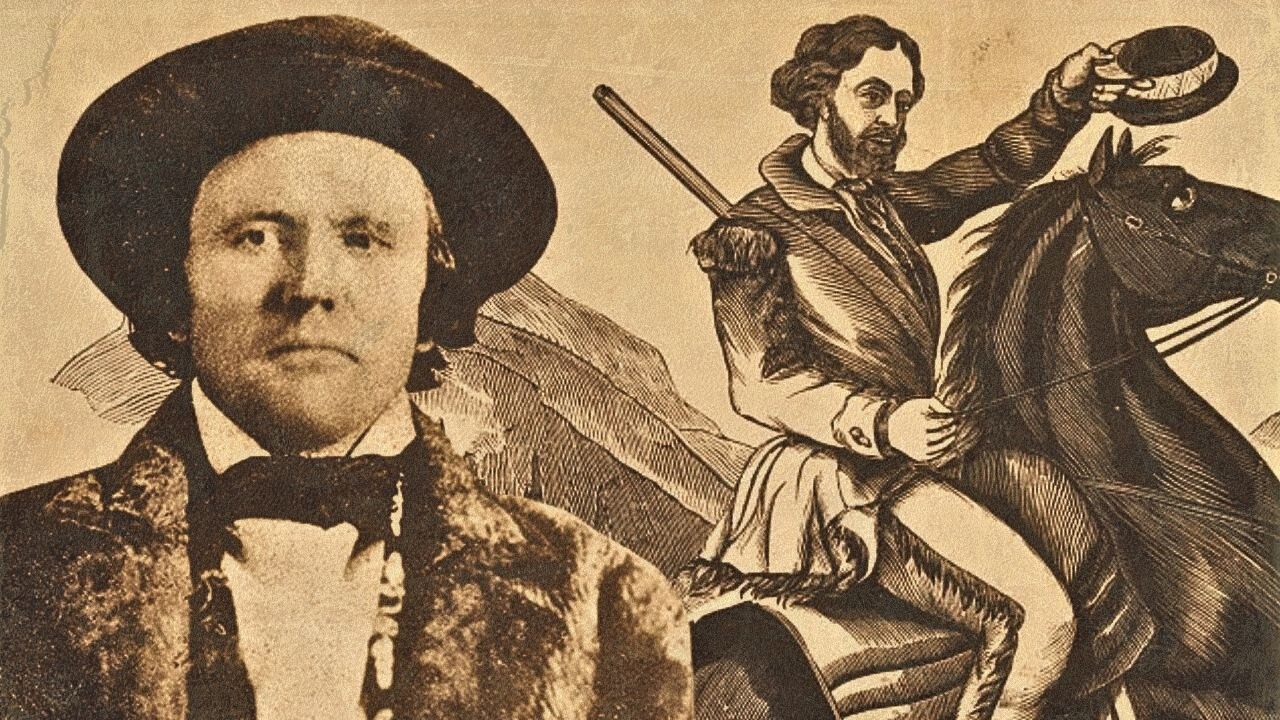
His appearance shocked many who had read the dime novels portraying him as a giant. One young army officer recalled his surprise at seeing “a stoop-shouldered man with reddish hair, freckled face, soft blue eyes, and nothing to indicate extraordinary courage or daring. ” Another acquaintance noted that the real Carson was “a plain, simple, unostentatious man, rather below medium height,” with a voice “as soft and gentle as a woman’s. ”
Carson felt inadequate among city dwellers, worrying that his past, including his previous marriage to a Native American woman, might scandalize Frémont and his father-in-law, Senator Benton.
No such scandal materialized. Carson never warmed to high society, disliked politicians, and found it impossible to sleep inside on a bed, choosing instead to sleep outside on an open-air patio. Frémont’s wife Jesse took him under her wing, reading literature aloud to him. According to her, Carson considered Sir Walter Scott’s poem “The Lady of the Lake” the finest expression of outdoor life he had ever heard.
On the morning of June 14, 1847, Carson was ushered into the president’s office. Polk quizzed him on his exploits and officially commissioned him as a second lieutenant, a promotion that came with a uniform and a raise. Polk also presented Carson with his own dispatches to deliver back to California, and honored him with dinner at the White House. Carson was extremely nervous about the occasion, far more at home in a tepee or an adobe than in a mansion.
First Lady Sarah Polk, however, found his table manners faultless, though he became red in the face and refused to speak when she asked about his famous night crawl through enemy lines. Carson soon left Washington by train, and before long he was sent straight back east with more dispatches from California. In total, he made the cross-country trip three times. During his third visit east in 1848, he allegedly delivered news of the California gold strike, which helped usher in the Gold Rush of 1849.
These journeys were dangerous, and Carson’s traveling companion Lieutenant George Brewerton left a detailed account of his survival habits. Carson arranged his saddle as a barricade for his head, kept his pistols half-cocked above it, and his rifle beneath his blanket, protected from damp. He never exposed himself to the full glare of the campfire. As Carson put it, “Hang around the fire if you will, it may do for you, but I don’t want to have an Indian slip an arrow into me when I can’t see him.
”
Brewerton also recorded a shift in Carson’s behavior toward Indigenous people. In the past, Carson and his companions had responded to any threat—real or perceived—by attacking and killing as many natives as possible. He had treated the Apache, the Blackfeet, and the Klamath that way. But by the late 1840s, traveling through Paiute territory, Carson took a different approach.
Rather than attack, he took a young man hostage, told him in his own tongue that he would not be harmed as long as his people didn’t attack the camp, and released him unharmed once they had passed through, giving him a pair of pants as a gift. Brewerton said the young man strutted around “like a city dandy” in his new trousers. Despite these adventures, Carson was growing tired. Since the beginning of the Mexican-American War, he had traveled nearly 16,000 miles, mostly on the back of a mule.
At nearly 40 years old, he wanted to settle down. According to stories passed down by the family, his wife Josefa was beginning to resent his prolonged absences. After his final trip to Washington, Carson returned to Taos and went into partnership with fellow former mountain man Lucien Maxwell, trying his hand at ranching. As Carson later put it, “We had been leading a roving life long enough and now was the time, if ever, to make a home for ourselves and children.
We were getting old. ”
But the wilderness was not finished with Kit Carson. He would soon be called into service again—rescuing captives held by the Apache and going to war once more on behalf of his country, the adventures far from over.
Carson would eventually attain the rank of brevet brigadier general, a remarkable achievement for an illiterate runaway from Boon’s Lick, Missouri.