On December 19, 1944, in a cold room in Verdun, France, General Dwight D. Eisenhower faced a crisis. The German offensive through the Ardennes had shattered the American front, Bastogne was surrounded, and the Allied position in Western Europe was hanging by a thread. Eisenhower turned to George S.
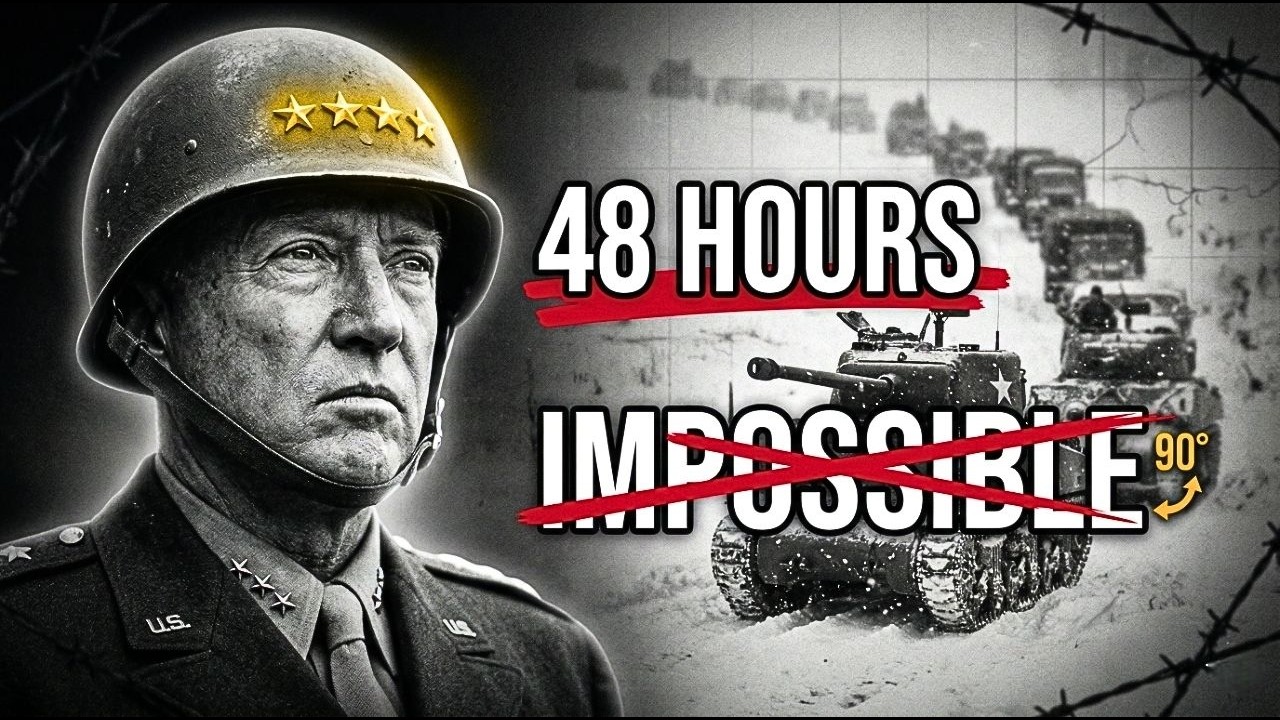
Patton and asked how fast the Third Army could pivot north to relieve the besieged town. The standard answer among the officers present was a week, maybe ten days. Patton replied, “48 hours, three divisions. ”
The room went silent.
Omar Bradley thought he was joking. The logistics officers stared in disbelief. Patton’s entire army, roughly 250,000 men, was locked in heavy combat in the Saar region, aimed east toward Germany. Eisenhower was asking him to disengage, turn 90 degrees, move over 100 miles on frozen winter roads, and launch an attack.
Yet Patton had an answer ready because, for three weeks, he had been secretly preparing for exactly this moment. The German attack began on December 16, 1944. Hitler launched his last major gamble in the West, throwing over 200,000 men and thousands of tanks against thinly held American lines in the Ardennes forest of Belgium. The offensive caught the Allies completely off guard.
The forest was considered a quiet sector, a place for rest, not combat. Within hours, the front collapsed. Entire American units were surrounded, communications were cut, and German armor raced toward the Meuse River. In the path of the German advance sat Bastogne, a small Belgian town holding a critical crossroads of seven roads.
Control of those roads was essential for the German drive to continue west. The 101st Airborne Division was rushed in and ordered to hold at all costs. By December 19, the town was completely surrounded. The paratroopers were low on ammunition, food, and medical supplies, while thick fog and snow grounded Allied aircraft.
No supply drops, no air support. The situation was dire. That was the backdrop for the emergency meeting in Verdun. Eisenhower gathered his top commanders, including Bradley, Courtney Hodges, Jacob Devers, and Patton.
Eisenhower pointed at the map, showing the growing German bulge, and asked who could counterattack from the south. When he turned to Patton, the answer was already prepared. Patton had not been caught off guard. His intelligence officer, Colonel Oscar Koch, had spent weeks warning him that German units were disappearing from the front lines, that radio traffic indicated something massive was building.
Most commanders dismissed such reports, believing the Germans were too weakened to attack. Patton listened. Without telling Eisenhower or Bradley, he ordered his staff to draft contingency plans for a possible northern pivot. Three divisions were alerted, routes were mapped, and commanders were quietly briefed.
At the meeting in Verdun, when Eisenhower expressed concern that Patton was being reckless, using the word “fatuous” for the proposal, Patton opened a notebook and showed his plans. The Fourth Armored Division, the 26th Infantry Division, and the 80th Infantry Division were ready. Eisenhower looked at the plans and gave the order: “Do it. ”
Patton left the meeting and drove through the night to his headquarters in Nancy, France.
After midnight, he gathered his staff. The order was simple: stop fighting east, turn north, and drive into Belgium. The Fourth Armored Division would lead, with the 26th and 80th following to protect the flanks and secure ground. The logistical challenge was immense.
The Third Army’s fuel dumps, supply lines, and artillery were all positioned for an eastern advance. Everything had to be redirected north in a matter of hours. Roads were covered in snow and ice, and temperatures were below freezing. Vehicles slid into ditches, engines froze, and exhausted soldiers who had been fighting for weeks in the Saar prepared for a 100-mile march into another battle.
Patton drove up and down the columns in his jeep, pushing for speed, checking progress, and demanding that convoys keep moving. On the evening of December 21, the lead elements of the Fourth Armored Division reached positions south of Bastogne. Patton had met his 48-hour deadline. On the morning of December 22, he launched the attack.
The Fourth Armored slammed into the German southern flank, catching the enemy off guard. The Germans had focused their attention on tightening the noose around Bastogne, not on defending their rear. Patton’s tanks drove north through heavy resistance, fighting through villages and opening roads while the 26th and 80th divisions protected the widening corridor. Inside Bastogne, the men of the 101st Airborne heard the artillery fire from the south.
They knew relief was coming. On December 26, four days after the attack began, lead tanks of the Fourth Armored Division broke through the German lines and reached Bastogne. The siege was over. The Battle of the Bulge continued for weeks, with savage fighting across the Ardennes, but Patton’s counterattack had stopped the German momentum and shifted the strategic initiative back to the Allies.
Eisenhower later described the maneuver as one of the most brilliant operations of the war. Military analysts still study it today as a case study in readiness and decisive action. The question historians continue to debate is whether Patton was lucky or prepared. Some argue that factors beyond his control played a decisive role: the Germans were overstretched, their fuel supplies were running out, and the weather cleared just enough to allow Allied air support.
Others argue that Patton created his own luck by listening to his intelligence officer, planning for contingencies others ignored, and keeping his preparations secret from a high command that might have overruled him. When the moment came, Patton had an answer. He had prepared for what might happen, not just what was happening, and when Eisenhower asked for the impossible, Patton had already done the work.
He is buried today at the American Cemetery in Luxembourg, the only four-star general interred there, with his grave facing the men he led.