Some of the most bizarre weapons ever devised saw action not on a science fiction set, but on the battlefields of the American Civil War. As both the Union and Confederacy scrambled for any military advantage, inventors flooded the war effort with experimental firearms, explosive devices, and naval contraptions that ranged from ahead of their time to dangerously impractical. One of the most unusual concepts was the Winans Steam Gun, a weapon believed capable of discharging 300 rounds per minute using a steam-powered rotating drum. It gained attention during the 1861 Baltimore riots, though it is often mistakenly attributed to industrialist Ross Winans.
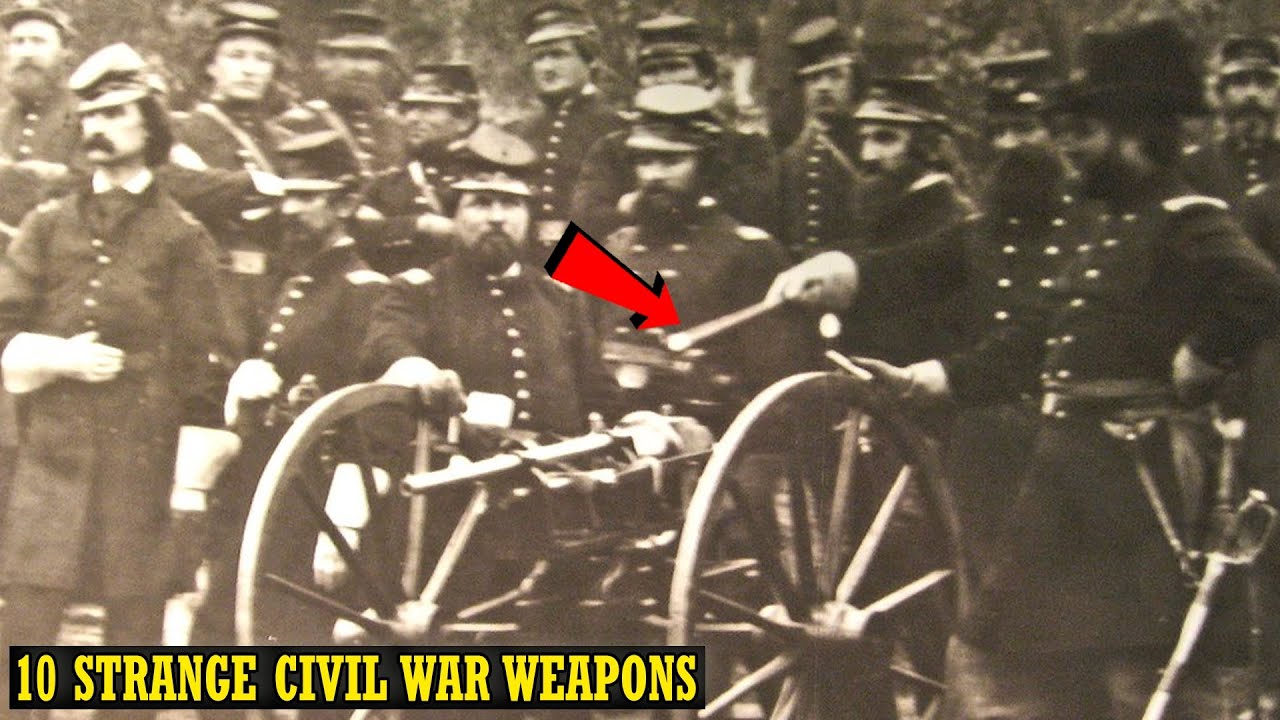
The actual inventor was Charles S. Dickinson, who traveled to Baltimore to demonstrate his creation to the city council. As tensions rose between secession supporters and federal authorities, local law enforcement seized Dickinson’s invention, possibly viewing it as a tool for city defense. When Dickinson later tried to remove the weapon, federal troops intercepted it.
The gun was eventually transported to Massachusetts and put on display as a captured artifact of the war era. In modern times, the MythBusters team tested a similar steam-powered machine gun concept to explore its potential effectiveness and limitations. A lesser-known early machine gun, officially called the Ager gun, was nicknamed the “Devil’s Coffee Mill” or coffee grinder gun due to its hopper-fed ammunition system. This hand-cranked firearm could fire at an estimated 120 rounds per minute.
In 1861, President Abraham Lincoln personally observed a demonstration and was reportedly impressed, leading the US War Department to acquire 60 units. However, the weapon proved flawed in practice. It consumed ammunition rapidly, its single barrel overheated quickly, and the hopper system was prone to jamming. Field commanders found it unreliable, and the gun was rarely used in active combat.
It was instead relegated to defensive roles, such as guarding bridges. Although it never became a staple, the Ager gun was an important step toward the development of the Gatling gun. The harmonica gun was another inventive attempt at a multi-shot firearm, using a horizontally sliding magazine that could hold up to 10 cartridges. Its rectangular shape inspired the name, though no musical instruments were involved.
The design dates to French inventor J. J. Jar, who patented it between 1859 and 1862, and was also produced in the United States by Jonathan Browning, father of legendary firearms designer John Moses Browning. Its biggest drawback was its cumbersome operation.
Unlike revolvers, which rotated automatically, the harmonica gun required the shooter to manually shift the magazine after every shot. This slow process made it less efficient than the revolver designs emerging at the time. Although rarely used in the field, the concept was applied to a percussion rifle owned by Texas Senator Sam Houston, which is now displayed at the National Museum of American History. To protect critical railway infrastructure, the US government experimented with armored railroad cars.
These repurposed baggage cars were reinforced with thick iron plating along the top and sides, serving as mobile fortifications. Strategically placed portholes allowed up to 50 armed soldiers inside to return fire, and some versions were equipped with small cannons. These defenses were not invulnerable. In 1864, a Confederate artillery strike destroyed one of the armored cars, and another was hit by a shell in 1865, injuring soldiers inside.
Several also fell into Confederate hands. While the concept did not revolutionize Civil War warfare, it laid the groundwork for the armored trains used in the Russian Civil War and both World Wars. The ancient weapon known as Greek fire saw a brief revival during the conflict. In 1864, a Confederate plot to set fire to New York City using Greek fire-based incendiary devices largely failed because many of the saboteurs did not know how to properly use the fuses.
Earlier, Philadelphia inventor Levi Short developed a rocket powered by his patented form of solidified Greek fire and demonstrated it to President Lincoln, who was not impressed. Rear Admiral David Porter, however, saw potential and ordered 1,440 of Short’s rockets for use on Union naval vessels along the Mississippi River. When tested against Vicksburg, the rockets did function, and some areas caught fire. However, the flames only burned for about seven minutes, far too brief to cause substantial damage.
Porter dismissed the invention as a “humbug. ”
In 1862, an ambitious designer in Athens, Georgia, created a double-barreled cannon intended to fire chain shot—two cannonballs connected by a chain—to devastating effect. The plan required both barrels to fire simultaneously. However, during the first field test, the barrels did not discharge at the same moment, causing the projectile to veer unpredictably.
In some cases, the chain snapped mid-air. The weapon proved dangerously unreliable and was never used in battle. It remains a landmark in Athens today. A similar piece, known as the Elizabeth Henry, had been used during the 17th century English Civil War but also suffered from mechanical challenges.
In modern times, the American Guns team recreated the design but found that perfectly synchronizing two barrels remained fundamentally difficult. The coal torpedo, developed in 1864 by Thomas Courtney of the Confederate Secret Service Corps, was an explosive disguised as a piece of anthracite coal with a hollowed-out core filled with gunpowder. The goal was for the fake coal to be unknowingly shoveled into the furnace of a Union steam-powered vessel, causing severe internal damage. At least two Union ships are confirmed to have been damaged by these devices.
There were also attempts to use coal torpedoes against land-based facilities, including a plot against the Springfield Armory, which failed when the device was discovered. The tactic was part of the Confederacy’s broader strategy of asymmetrical warfare. The concept later resurfaced in insurance fraud schemes and was modernized during World War II with plastic explosives. The turret rifle, patented by T.
P. Porter during the 1850s, featured a wheel-shaped cylinder containing nine rounds of . 48 caliber ammunition. As each round was fired, the cylinder rotated to align the next chamber.
The major flaw was that for every bullet fired, another chamber pointed in the opposite direction, often directly at the shooter or bystanders. Variations holding as many as 30 rounds were carried by individual soldiers, but these high-capacity designs introduced even greater hazards. A misfire or stray spark could ignite the entire magazine, causing a catastrophic explosion in the shooter’s hands. The weapon never gained widespread acceptance, though it represented an important chapter in the evolution of repeating firearms.
In 1862, the US Navy introduced its first submarine, the 47-foot USS Alligator, designed by French inventor Brutus de Villeroi. It was equipped with an air purifying system and a lockout chamber that allowed divers to exit while submerged. The project was highly confidential, with the intention of using the submarine against Confederate ironclads. The submarine was first tested on the Appomattox River but failed because the water was not deep enough.
It was later refitted with a screw propeller, but while being towed to Charleston, South Carolina, a powerful storm severed the tow line. The Alligator sank to the bottom of the “Graveyard of the Atlantic” off Cape Hatteras. While the submarine never achieved its goals, it was a bold early experiment in underwater warfare. The pike, a weapon with ancient roots, experienced a brief resurgence in the Confederacy due to severe firearm shortages.
In 1862, Georgia’s Governor Joe Brown ordered 10,000 pikes to arm local militia troops. Some featured three blades arranged in a cloverleaf pattern, while others had retractable spring-loaded blades. However, they proved ineffective against Union troops armed with rifles, and the weapons were not favored by soldiers.