The light had been on for nearly twelve hours, and still, the door remained closed. Inside that room, on the cold floor of his private study at the Kuntsevo dacha, lay the most powerful man on Earth, unable to move, unable to speak, his life ebbing away in a pool of his own urine. Outside that door, armed guards who had sworn to die for him stood frozen, their hands at their sides, their eyes fixed on the wood grain, paralyzed not by indecision but by a terror so profound it overrode every instinct of duty and humanity.
This was the night of March 1st, 1953, and the question that would haunt the next seven decades of history was already forming in the silence: Was this a tragic accident of biology, or was Joseph Stalin left to die by design?
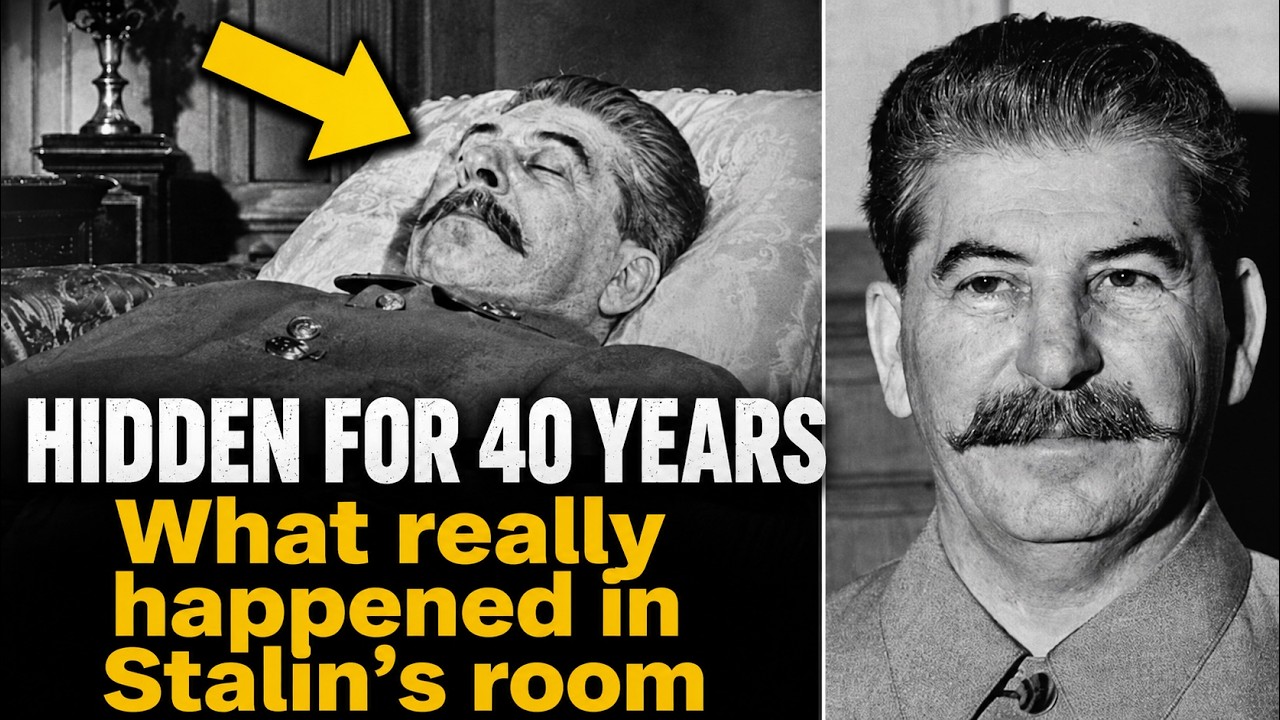 For nearly forty years, the official narrative remained sealed, buried in the vaults of the Soviet state, a story too dangerous to tell and too important to destroy. But in 1992, fragments of a secret commission’s findings surfaced, and with them, a single word that changed everything: “unjustified.” The delay in summoning medical help, the commission concluded, was unjustified.
It was a bureaucratic phrase, but it carried the weight of a confession. It meant that help could have come sooner. It meant that someone, somewhere, made a choice.
And to understand how a leader could be left dying on his own floor for the better part of a day, you have to understand the world he had built around himself, a world where entering the wrong room at the wrong moment could cost you your life.
By early 1953, Joseph Stalin was 73 years old. He had ruled the Soviet Union for 29 years, a span so vast that almost no adult citizen could remember a country led by anyone else. His portrait hung in every school, every factory floor, every government office from the Baltic to the Pacific.
The parades continued. The slogans continued. Loudspeakers in public squares still broadcast his name with the same reverence they always had.
But behind the closed doors of the Kremlin and the dachas outside Moscow, something else was happening: fear. Constant, low-grade, corrosive fear. The kind that doesn’t announce itself but sits in every corridor, every meeting, every glance between men who had survived purges by learning never to be the one who spoke first.
Stalin himself was changing. Those close to him in these final years described a man slowing down. He moved with more effort now.
He confused names he once knew instantly. There were long pauses, moments where he simply stopped, staring at one fixed point, saying nothing, as though some part of him had already left the room. One bodyguard from the Near Dacha, his identity never made public, gave testimony that would only be declassified in the 1990s.
He described watching Stalin in his final months sitting utterly alone in the great dining hall where feasts and late-night dinners once filled the space with noise and tension. In the last months before his death, Stalin often sat alone in the great hall where dinners were usually held. He sat and looked out the window at the garden.
Nobody called him. He demanded nothing. He just sat.
And then the detail that lingers longest: He looked like a man who was waiting for something but didn’t know what himself.
Meanwhile, the machinery of fear he built was still running. In January 1953, it produced its most explosive case yet. The Soviet press, Pravda, the paper of record, announced what history would remember as the Doctors’ Plot.
Nine physicians, several of them among the most respected medical minds in the country, were arrested. Six of the nine were Jewish. The accusation was that these doctors, acting on behalf of an international Zionist and American conspiracy, had been deliberately mistreating and even killing senior Soviet officials under the guise of medical care.
Some of the accused had treated Stalin personally. The effect was immediate and ugly. Patients across the country began refusing treatment from Jewish doctors.
Professors were fired from medical institutes overnight. Denunciations spread through hospitals and universities like a fever.
Some historians believe this was only the beginning, that plans were already underway for a mass deportation of Soviet Jews to Siberia and Kazakhstan, modeled on the brutal 1944 removals of the Chechen and Crimean Tatar populations. There are accounts, still unconfirmed, of trains being quietly prepared. This theory remains debated, but the atmosphere it points to is not in dispute.
In the last weeks of Stalin’s life, the machinery of state terror was once again fully awake. This is the Moscow of February 1953. And this is the world that arrives on the evening of February 28th at Stalin’s main residence, a modest wooden house standing among pine trees at Kuntsevo, just outside the city.
They call it the Near Dacha.
Dinner at the Near Dacha followed rituals that had hardened into law over decades. On this particular night, four men joined Stalin at the table: Lavrentiy Beria, Georgy Malenkov, Nikita Khrushchev, and Nikolai Bulganin. These were the men closest to power in the entire Soviet Union.
And Stalin, even now, treated the dinner as an instrument of control. Contrary to the legend that surrounds him, Stalin himself drank little, but he made certain his guests drank heavily. A drunk man, after all, talks too much.
A drunk man is defenseless. Even at 73, even in decline, he was still running the room. After dinner, as he often did, Stalin watched a film, a Soviet production whose details were later forgotten even by Khrushchev, who was there.
It was a habit of his, watching the same films again and again, as if searching them for something new each time.
The dinner ran late. It didn’t end until around 4 in the morning on March 1st. Stalin walked his guests out to their cars.
He waved. He turned and walked back into the house. This is the last time anyone sees him on his feet.
Inside the Near Dacha, an unbreakable rule governed everything: No one, not a guard, not a servant, not a senior official, entered Stalin’s private rooms unless he summoned them. This was not mere etiquette. It was a rule with the weight of life and death behind it.
Breaking it, disturbing him without invitation, could be treated as an act against the state itself. For years, this rule had protected the leader’s privacy. On this particular day, it would do something else.
It would nearly 𝓀𝒾𝓁𝓁 him.
Morning came. At 10:00, the light in Stalin’s room switched on. The usual signal that he was awake, that the day’s business could begin.
 The guards saw it and relaxed. Everything was normal. Any moment now, the call would come.
The bell would ring and the machinery of the Soviet state would resume its daily rhythm around the will of one man. But the call didn’t come. 11:00 passed.
Noon. 1 in the afternoon. 2.
The house held its breath. Nobody moved toward that door. Nobody dared.
The rule was the rule, and the rule had always been obeyed. No exceptions, not once, not for anyone. By early evening, unease had settled over the staff, but still no one acted.
It was not until 10:00 at night, nearly 20 hours since the dinner began, and 18 hours since the last guest departed, that a guard named Lozgachev finally found a way in.
He didn’t break the rule outright. He invented a reason: mail and packages arriving from Moscow that supposedly required Stalin’s personal signature. It was a pretext, a small crack in the wall of protocol just wide enough to justify opening that door.
What he found inside would set off nine more hours of decisions, hesitations, and silence. Decisions made not by doctors, but by men who had every reason to think carefully about what happens next. Stalin was on the floor.
He was lying in his own urine, in his underwear, alive, but his left arm and leg no longer answered him. His face had twisted on one side. He could not speak.
As Lozgachev leaned over him, Stalin weakly raised his right hand. A gesture that could mean anything: a greeting, a plea, a last attempt to reach for help that for hours now had already been too slow in coming.
They lifted him onto a couch, and then Lozgachev picked up the phone, not to call a doctor, but to call his superior. What happens on that call and in the hours that follow will determine whether Stalin lives or dies, because the man on the other end of the next call up the chain is not thinking about medicine at all. He’s thinking about something else entirely.
And what he decides to do next will remain one of the most chilling episodes in the history of the Kremlin. The phone rang in Moscow, and the man who answered it would decide in the next few minutes whether the most powerful man in the Soviet Union lived or died. Lozgachev didn’t hesitate once he saw Stalin on the floor.
He called Strobin, the chief of security at the Near Dacha. Strobin arrived quickly, looked at the man lying on the couch, twisted face, unmoving arm, unable to form a single word, and made a decision that in hindsight is almost impossible to justify on medical grounds alone.
He didn’t call a doctor. He called Beria. It was around 11 o’clock at night on March 1st.
Lavrentiy Beria, head of the secret police apparatus, the second most feared man in the entire Soviet Union, picked up the phone and heard that Stalin was lying paralyzed and speechless on the floor of his private room. And Beria’s response was not urgency. It was dismissal.
He told them not to worry. Stalin, he said, was simply sleeping deeply. Don’t disturb him unnecessarily.
No doctor was called that night. Not at midnight. Not at 2 in the morning, not at 4, not at 6.
The sun rose over the pine forest at Kuntsevo, and Stalin was still lying there, untreated, while the men who could summon help decided instead to wait. It would take until the morning of March 2nd, a full 9 hours after Lozgachev first found him on the floor, before a single doctor was allowed anywhere near Stalin’s body.
Nine hours. In a case of catastrophic stroke, doctors today will tell you that early hours are precisely when intervention matters most. When swelling can sometimes be managed, when the difference between life, death, and the depth of permanent damage is still being decided inside the skull.
Nine hours were allowed to simply pass. Who decided this? Officially, it wasn’t one man’s choice.
An improvised, unofficial meeting formed that night among four of Stalin’s closest circle: Beria, Malenkov, Khrushchev, and Bulganin. These four, without formal authority, without any doctor in the room, took it upon themselves to decide when or whether medical help should be summoned for the leader of the Soviet Union. Khrushchev, years later, after he had already pushed Beria into a grave and inherited Stalin’s chair for himself, dictated memoirs describing that night.
In his telling, the four of them genuinely believed Stalin was only sleeping, that there was no reason for alarm, that the delay was an honest, if tragic, misunderstanding born of caution rather than calculation. But even within Khrushchev’s own account, details slip through that don’t sit comfortably with that framing. He describes Beria that night not as fearful, not as anxious for his master’s safety, but as agitated, podniky, excited, energized, a man moving with purpose rather than dread.
It is a strange kind of energy for someone who supposedly believes his leader is merely enjoying a long, peaceful sleep. It is worth remembering too that Khrushchev’s memoirs were dictated after he had already won the struggle for power that followed Stalin’s death, after Beria had been arrested, tried, and executed, unable to ever offer his own version of that night. Whatever Khrushchev says about Beria’s behavior in those hours, there is no one left alive from that room to contradict him.
By the time doctors finally arrived on the morning of March 2nd, they walked into a house thick with a very different kind of fear. This was a country where the Doctors’ Plot was still an open, active case, where physicians accused of murdering Soviet officials through deliberate medical sabotage were still sitting in Lubyanka’s cells. Every doctor who stepped into that room to examine Stalin understood with total clarity that a wrong diagnosis, a wrong word, an unlucky guess could be the difference between walking out of that house and disappearing into the same system that had already swallowed nine of their colleagues.
Academician Lukomsky was the one who conducted the examination. Witnesses would later describe his hands trembling as he worked, not from excitement, not from the strain of a difficult case, but from plain terror. This was a man diagnosing the most dangerous patient in the world in a system that had just spent weeks publicly proving that doctors who failed their patients were traitors and murderers.
His diagnosis: a hemorrhagic stroke. A cerebral hemorrhage, bleeding inside the brain, causing paralysis down Stalin’s left side, robbing him of speech and leaving his consciousness fluctuating in and out. Sometimes alert, sometimes gone entirely.
On March 2nd, there were moments when Stalin’s eyes opened and he seemed to look at the people gathered around him. At one point, he raised his working hand and pointed, not at a person, not at the door, but at a picture hanging on the wall. It was a simple reproduction, a painting of a young girl feeding a goat kid.
 Nobody in the room understood what he meant by this gesture. Was it a memory? A delusion?
A final attempt to communicate something that no longer had words attached to it? No one ever found out. The moment passed unexplained and became one of the small, haunting details historians can describe but never interpret.
By March 3rd, Stalin’s condition was deteriorating fast. The hemorrhage was spreading. His breathing grew labored, uneven, effortful.
Outside the walls of the Near Dacha, the Soviet public was being told almost nothing specific. Official bulletins went out three times a day describing, in the careful bureaucratic language of the era, a severe circulatory disturbance. No mention of stroke.
No mention of the 9-hour delay. Just enough information to keep the nation waiting and no more. And the nation did wait, many of them, it seems, in genuine grief.
Remember, Stalin had ruled for 29 years. For most adult citizens of the Soviet Union, he was the only leader they had ever known, embedded so deeply into daily life that his death was almost impossible to imagine, even as it was happening. Factories across the country gathered workers around loudspeakers to listen for updates.
In villages far from Moscow, people wept, not performative grief for the cameras, but something that appeared by every account to be real.
In Moscow itself, something darker unfolded. Crowds began gathering spontaneously in the streets, drawn especially toward Trubnaya Square, where hundreds of thousands of people converged, pressing toward the center of the city to catch some glimpse of what was happening, to be near the moment history was turning. The crush became deadly.
Estimates of the dead in these crowds range from several hundred to several thousand. The exact number was classified for decades. Another piece of this story, the state chose to bury rather than admit.
Behind the closed doors of the dacha, a different kind of activity was underway. Beria, in these final days, was remarkably active, organizing watch shifts at Stalin’s bedside, positioning himself, deliberately or not, as the man managing the situation, the one in control, while the leader who once controlled everything lay dying in the next room. Malenkov, by contrast, stayed quiet, watchful, saying little, doing less, observing everything.
Khrushchev, in his own later account, claimed that he wept during these days. A claim, like so much else in the story, that cannot be verified by anyone else who was present.
Then, on March 5th, 1953, at 9:50 in the evening, it ended. Dr. Myasnikov, present at the death, would later describe the final moments: Stalin’s breathing turning irregular, his face darkening, a sudden gasp, and then nothing.
29 years of absolute rule ended in a quiet room with a small circle of men standing around a couch watching. And what happens in the seconds immediately after is perhaps the most telling detail of this entire story. Beria was the first to step toward the body.
He leaned in. He confirmed what everyone already suspected. And then, according to witnesses, he didn’t linger, didn’t grieve, didn’t pause.
He turned, walked quickly out of the room, and said something loudly into the corridor, a single word remembered by those present as something like, “Finally.” Khrushchev’s later account goes further, describing Beria as openly rejoicing, making no effort to hide his relief. It’s a vivid, damning image.
But it’s worth remembering again that Beria was executed within the year and never had the chance to offer his own version of that moment.
What is beyond dispute is this: Nobody in that room, despite the formal mourning protocols that would soon roll out across the entire country, appeared to be overcome with grief. And in the hours that followed, before the body had even fully cooled, the men closest to Stalin were already negotiating who would inherit his power. For decades, this is where the official story stopped.
Fear. Protocol. An old man’s failing heart.
A tragic, unfortunate delay. Case closed. But in 1992, a set of sealed documents would surface.
The findings of a secret commission convened in 1953 itself, one that quietly investigated the exact circumstances of Stalin’s death and then vanished from public record for almost 40 years. What that commission concluded about the 9-hour delay would reopen a question that Soviet history had tried very hard to close for good.
For nearly 40 years, the file didn’t exist. Not officially, not in any archive a historian could request, not in any index a researcher could search. A commission had been convened in 1953 in the immediate aftermath of Stalin’s death to examine exactly what happened during those hours at the Near Dacha.
And then its findings simply disappeared into the sealed vaults of the Soviet state, as if the question itself had been buried alongside the man it concerned. It would take until 1992, the Soviet Union itself already gone, its archives cracking open under the weight of a new era, for fragments of that commission’s work to finally see daylight. What it found was not a dramatic confession.
There was no smoking gun, no signed order, no single sentence reading, “Someone wanted him dead.” Archival commissions rarely produce such things. What this one produced instead was a phrase, cautious and bureaucratic on its surface, but devastating once you understand what it implies.
The delay in summoning medical help, the commission concluded, was unjustified.
Unjustified, not unavoidable, not a simple failure of communication in a chaotic night. Unjustified, a word that in the language of Soviet officialdom carries a very specific weight. It means help could have come sooner.
It means someone chose otherwise. The documents do not name that someone outright. Even decades later, even after the regime that protected these secrets had collapsed, the paper trail stops just short of pointing a finger directly.
But it doesn’t have to spell it out. The sequence of events does the work on its own. Strobin looks at Stalin, paralyzed and speechless on the floor, and instead of calling a doctor, he calls Beria.
 Beria, hearing exactly how serious the situation is, tells them to wait. Nine hours pass. One name sits at the center of that chain before, during, and after the decision to delay.
And there is more. Among the physicians who had treated Stalin in his final year was Dr. Smirnov, one of the men responsible for monitoring the leader’s declining health through the last months of 1952.
Testimony revealed in the 1990s shows that Smirnov had issued a warning as early as late 1952. Another serious physical or emotional strain, he cautioned, could 𝓀𝒾𝓁𝓁 Stalin outright. This was not a vague general concern about an aging leader’s health.
It was a specific, documented warning about the fragility of his condition. That warning didn’t stay in a medical file somewhere unread. It was passed along to the security apparatus responsible for protecting Stalin around the clock.
And that apparatus in 1953 sat under structures controlled by one man: Beria. Which means that whoever decided on the night of March 1st to wait rather than call a doctor was not acting in ignorance. If the warning had reached him, as the record suggests it had, he understood precisely what kind of risk Stalin’s body was carrying, and he chose delay.
There is a second thread the archives reveal, one that is quieter but in its own way just as unsettling. In the days immediately before that final dinner on February 28th, several meetings took place inside the world around Stalin that never appear in the official visitor logs. This isn’t speculation built from nothing.
It comes from cross-referencing guard diaries, staff memoirs, and later archival discoveries, piecing together gaps where the paperwork simply goes silent. Historians point to Beria and Malenkov as likely participants in these undocumented meetings, possibly joined by others whose presence cannot be confirmed. What was discussed in them?
Nobody knows. No transcript exists, no memo, no note passed between secretaries. And that absence, in a system built entirely on documentation, is itself the loudest clue in this whole story.
This was a state that recorded everything: every visitor, every phone call, every meeting logged with obsessive bureaucratic precision because that paperwork was itself a tool of control, a way of watching everyone watching everyone else. For meetings to occur and leave no trace at all in a system engineered never to forget anything suggests they were never meant to be remembered. Deliberate silence in this world doesn’t happen by accident.
Then there is the speed of what follows. Stalin dies on the night of March 5th. By March 6th, the very next day, a new leadership structure is already publicly announced.
Malenkov becomes Chairman of the Council of Ministers, the head of government. Beria is named First Deputy and Minister of Internal Affairs, placing him in control of both the secret police and a vast internal security empire. Khrushchev secures his position within the party leadership, the seat from which he will eventually maneuver past both of them.
Consider what that timeline actually requires. Reorganizing the entire top of a global superpower’s government, deciding who holds which office, negotiating the balance of power among rivals who have spent decades learning to fear and undermine one another, in less than 24 hours. That is not the speed of men improvising in shock and grief.
That is the speed of men executing a plan that had already been agreed upon, waiting only for the formality of a death certificate. It raises an uncomfortable question the declassified files never fully answer: Was the succession negotiated in secret before Stalin’s heart stopped? Perhaps in those very meetings that left no trace in the record.
None of this proves poisoning. None of this proves a plot to murder Stalin outright. It’s important to be precise about what the evidence actually shows and what it doesn’t.
What it shows is negligence severe enough that a Soviet commission itself, operating under Soviet rules, called it unjustified. What it shows is a security chief who called the second most powerful man in the country instead of a doctor. What it shows is that man ordering everyone to wait despite knowing, or having every reason to know, exactly how dangerous that wait could be.
What it shows is a suspiciously clean, suspiciously fast transfer of power completed within a day of death. Whether that adds up to murder by delay or simply cowardice and self-interest colliding at the worst possible moment remains something historians still argue over without full agreement to this day.
There’s also the plain medical reality to weigh against any theory of the crime. This was, first and foremost, a massive hemorrhagic stroke. And in 1953, neurosurgery had almost nothing to offer a patient in Stalin’s condition.
Two of the doctors who eventually treated him left their own memoirs stating plainly that by the time they arrived on the morning of March the 2nd, the damage to his brain was already so extensive that the outcome was, for all practical purposes, already decided. The bleeding, the tissue damage, irreversible. All that remained for medicine to do, one of them wrote, was buy time.
Not save him. Just delay the end that was already coming. Stalin’s agony stretched across four full days, from his collapse late on February 28th through his death on the night of March 5th.
Four days in which a nation waited outside, official bulletins written in euphemism, in which crowds wept in villages and crushed each other in the streets of Moscow, in which the men closest to him watched, calculated, and in at least one case appeared visibly relieved rather than devastated.
And then, almost as quickly as the succession was settled, another piece of this puzzle resolved itself in a way that historians still find suspicious. Within weeks of Stalin’s death, the Doctors’ Plot, the case that had terrorized Soviet medicine, filled Lubyanka’s cells, and threatened to unleash a mass deportation, was quietly closed. The doctors were released.
The charges dissolved. It was almost as if the entire machinery of that case had been built around one man’s continued rule, and once he was gone, its purpose evaporated with him. As for the men who stood in that room during Stalin’s final hours, their own fates would not wait long to catch up with them.
Beria, who had positioned himself at the center of the crisis, who had ordered the delay, who had organized the watch shifts at Stalin’s bedside as though staging his own claim to authority, was arrested that same summer in 1953 at a meeting of the Presidium. Khrushchev’s later account describes him as plotting to seize sole power for himself. He was executed in December 1953, just 9 months after the man he supposedly served.
Nearly every historian today regards his trial as fabricated, a convenient way to eliminate a dangerous rival who conveniently was no longer alive to tell his own version of that March night. Malenkov held on to power for roughly two years before being pushed aside entirely, edged out by the very man who had once claimed to weep at Stalin’s bedside.
So, the story ends not with a confession, but with silence. A locked door. A 9-hour delay.
A sealed file that surfaces decades too late to settle anything for certain. What we’re left with is a chain of decisions that a Soviet commission itself once called unjustified. A warning that reached the one man positioned to act, and acted too slowly.
And a transfer of power completed with a speed that still, to this day, refuses to look entirely innocent. Whether Stalin died simply because the body of a 73-year-old tyrant finally failed him, or because the men around that bed found it useful to let the hour slip away, that question was never officially answered. It may never be.
The door that stayed locked for nine hours in March of 1953 has, in one sense, never fully opened.