On an October evening in 1944, Florence Foster Jenkins stepped onto the stage of Carnegie Hall dressed in white robes with a crown of laurel on her head. The auditorium held more than 3,000 people, and tickets had sold out within hours. Many in the audience had come not out of reverence for her art, but out of curiosity to hear the voice that had become the talk of New York. She was 76 years old, and her health had long been fragile.
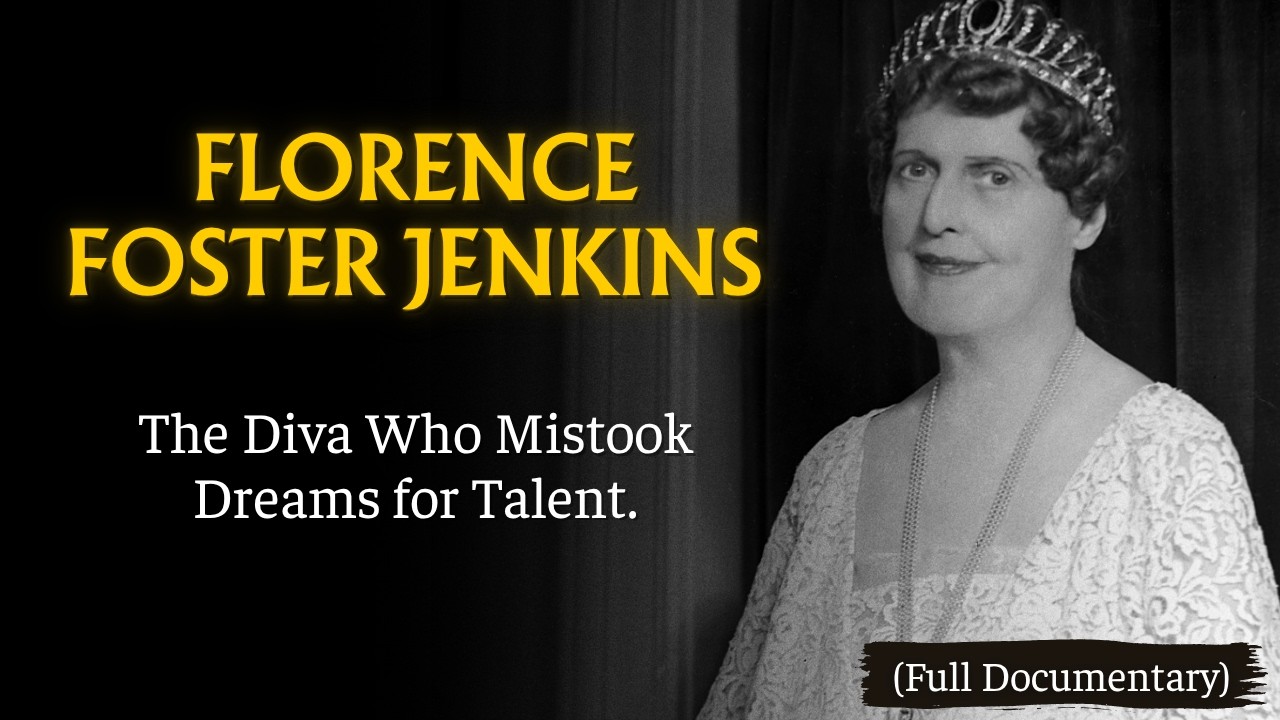
But she was convinced this was her moment of triumph, the fulfillment of a destiny she had believed in since childhood. The concert she gave that night became one of the most talked-about events in the history of the hall, though not for the reasons she believed. Born in 1868 in Wilkes-Barre, Pennsylvania, Florence was the daughter of a prosperous lawyer and banker. From an early age, she was drawn to music, first to the piano, where her parents arranged lessons and she dreamed of becoming a concert pianist.
Her ambition reached toward the great stages of Europe, the conservatories and opera houses that seemed impossibly distant from her provincial hometown. When she was still young, she contracted scarlet fever. She survived, but the illness left lasting damage. Her hands lost their strength and dexterity, and her progress at the piano faltered.
Some accounts suggest the fever may also have affected her hearing. Whatever the precise effects, the illness redirected her path. If she could no longer command the keyboard, she would command her voice instead. Her first marriage brought another wound.
She married Dr. Frank Thornton Jenkins, a man older and more worldly than herself. The marriage did not last. She later contracted syphilis from him, a disease that was incurable and deeply stigmatized at the time.
It left her unable to bear children and burdened her health for the rest of her life. She kept his name but parted from him, and never remarried. Deprived of family life, she turned more fiercely toward music. After her mother died in 1930, an inheritance gave her complete financial independence, and she used her wealth to pursue her singing ambitions without restraint.
She began hosting recitals in private salons, where her wealthy circle of friends and acquaintances applauded her politely. In those protected settings, criticism was suppressed by good manners, and Florence heard only praise. She was joined by St. Clair Bayfield, an English actor who became her manager and companion.
Their relationship was not a conventional marriage, but a partnership of deep loyalty that lasted for decades. Bayfield arranged her performances, selected her accompanists, managed her invitations, and shielded her from harsh criticism. He maintained his own private relationship with another woman, but he remained devoted to Florence until her death. Her performances grew more elaborate over time.
She began designing and commissioning costumes of astonishing imagination, appearing as angels with white feathered wings, as Valkyries with gleaming breastplates, and as queens in flowing silks. Audiences were drawn less by her singing than by the spectacle of her costumes and her fearless confidence. She also made recordings. Between the late 1930s and 1944, she produced more than a dozen sides that captured her voice in its raw, unvarnished state.
She believed these recordings would preserve her genius for posterity. They did preserve her, but in a very different light. The newspapers began to take notice. At first, they covered her as a curiosity of society.
But as her fame grew, critics sharpened their pens. She was mocked openly, her voice compared to shrieks and broken instruments. Still, she continued performing, convinced that the laughter was envy and that the applause, which was often ironically given, confirmed her greatness. She was surrounded by a circle of loyal admirers who never openly challenged her belief in her own talent.
Bayfield made certain that audiences were carefully selected and that criticism was kept from her. Within this protective bubble, she lived entirely inside her own vision of herself, serene and unshaken in her conviction that she was destined for greatness. The decision to perform at Carnegie Hall was the culmination of that vision. Bayfield had reservations, fearing the cruelty of a large public audience, but Florence saw only her destiny.
The concert sold out quickly. Some in the audience came to laugh, some to marvel, and some with genuine curiosity. When she stepped onto the stage, the applause was thunderous, and she took it as sincere. She sang arias by Mozart and Verdi, pieces that demanded precision and control she did not possess.
Her voice wavered and broke, sliding off pitch, but she performed with complete conviction, her gestures grand and her face radiant with joy. Between numbers, she changed costumes, appearing as an angel and as a Valkyrie, each entrance drawing fresh applause mixed with suppressed laughter. The audience sat caught between ridicule and awe. Some laughed openly, others covered their smiles behind gloved hands.
Many felt admiration for her courage, her refusal to yield to any sign of weakness. She heard only the applause and believed the night was the greatest triumph of her life. The critics were not so kind. In the days that followed, the newspapers published reviews that mocked her without mercy, and the laughter could no longer be contained behind doors.
For the first time, Florence could not entirely escape the ridicule that had been hidden from her for so long. Accounts of those weeks suggest she was shaken, though she continued to maintain her serene public face. Her health declined rapidly after the concert. The strain of the performance and the sting of the reviews weighed heavily on a body already weakened by decades of illness and the legacy of syphilis.
She grew frailer, her energy faded, and she withdrew into the quiet of her apartment with the curtains drawn. Florence Foster Jenkins died in November 1944, only weeks after her Carnegie Hall performance. Bayfield was at her side. News of her passing was noted quietly, without the fanfare that had surrounded her performances.
The city was absorbed in the closing months of World War II, and her death went largely unmarked by the wider public. Her legacy, however, did not fade. The recordings she made to preserve her genius preserved instead her paradox. They continue to be played and shared, drawing laughter and fascination from new listeners.
Her story has been told in plays and films, and her name has become a symbol of both delusion and courage. She remains remembered not as the great soprano she believed herself to be, but as a woman who sang without talent and yet with unshakable conviction. Her life left open the question that still lingers: did she truly hear beauty in her own voice, or did she choose to believe in it to survive the pain of her reality?
The answer, like her final note, remains unresolved.


