On May 22, 1973, a 26-year-old engineer at Xerox’s Palo Alto Research Center circulated a memo marked “Xerox Sensitive. ” Robert Metcalfe proposed renaming the office networking project from “Alto Aloha Network” to “Ether Network” and invited suggestions. That single page became the birthplace of Ethernet, the standard that would eventually connect billions of devices worldwide. Within six years, Metcalfe left Xerox, founded 3Com in his Palo Alto apartment, and spent two decades turning his invention into a global standard.
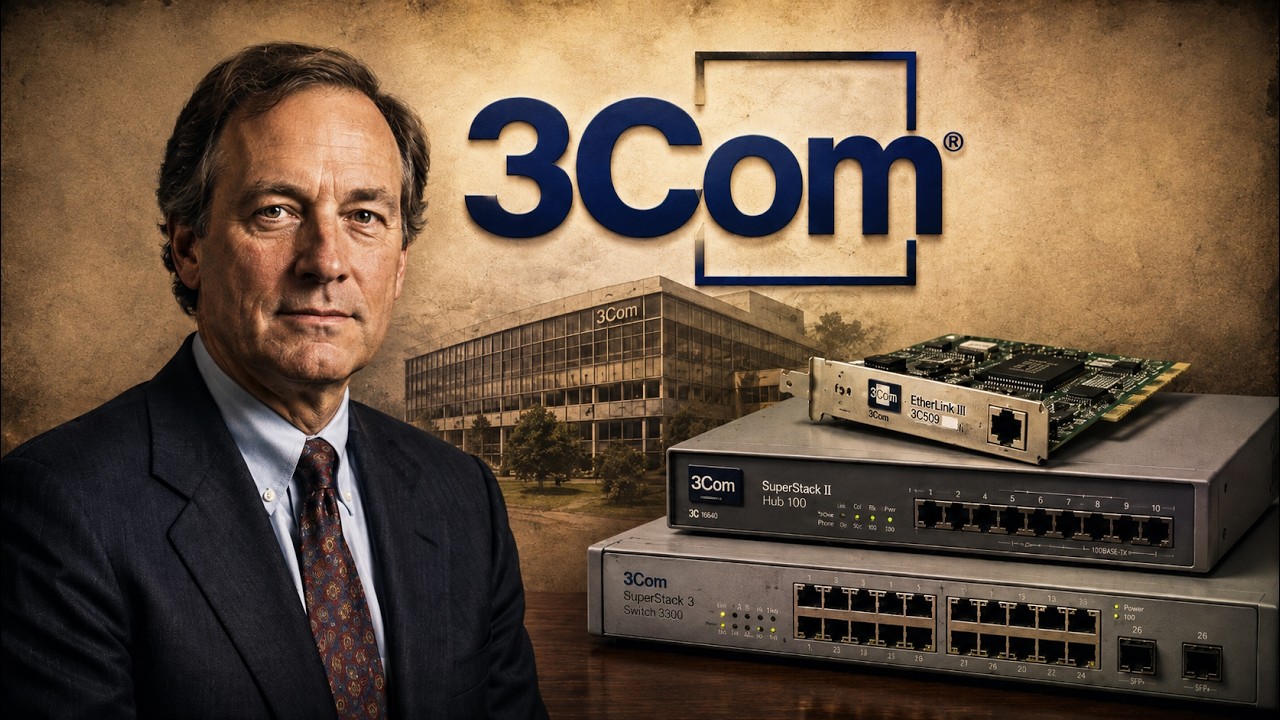
At its peak, 3Com employed more than 13,000 people, generated $5. 7 billion in annual revenue, and had its name on the stadium where the San Francisco 49ers played. On April 12, 2010, Hewlett-Packard completed a $2. 7 billion acquisition, and the 3Com name vanished from the Nasdaq ticker.
The company that turned Ethernet into an empire disappeared inside a competitor, largely unnoticed by the public. Robert Metcalfe was born in Brooklyn, New York, on April 7, 1946. His father was an electrical technician, and Metcalfe inherited a practical understanding of wiring and signals. He graduated from Bay Shore High School in 1964, earned two bachelor’s degrees from MIT in 1969, and completed a master’s in applied mathematics at Harvard in 1970.
His first doctoral thesis was rejected for lacking original theoretical contribution. He took a job at MIT’s Project MAC, connected Harvard to the ARPANET, and found his missing theory in the work of Professor Norman Abramson at the University of Hawaii, whose ALOHAnet used random access packet broadcasting over radio. Metcalfe analyzed its collision behavior, resubmitted his thesis, and Harvard accepted it, though the university refused to publish it. MIT published it instead.
By then, Metcalfe was at Xerox PARC, the legendary lab assembling the future of personal computing. PARC had built the Alto, one of the first computers with a graphical user interface, a mouse, and a bitmapped screen, along with the first high-speed laser printer. But the machines were isolated from one another. Metcalfe’s job was to build a way for them to communicate across the building.
He took the radio broadcast concept of ALOHAnet and replaced the radio waves with coaxial cable, the same wire used for cable television. The key insight was that a computer could tap into the cable without cutting it. By June 1973, he had approval to build a prototype and recruited Stanford graduate student David Boggs, an amateur radio builder. Together, they built the first Ethernet in PARC’s basement, connecting Alto computers at 2.
94 megabits per second. On March 31, 1975, Xerox filed a patent listing Metcalfe, Boggs, Chuck Thacker, and Butler Lampson as inventors. Metcalfe named the technology after the luminiferous ether, the theoretical substance 19th-century physicists once believed carried light waves. The ether was later disproved; the name stuck.
But Xerox management declined to commercialize Ethernet. Metcalfe left once in 1975 and was lured back, but the pattern repeated. On June 4, 1979, he incorporated 3Com with three co-founders: Howard Charney, Greg Shaw, and Bruce Borden. The company began in Metcalfe’s living room, with a conviction that the technology Xerox refused to sell would become the backbone of computing.
Metcalfe made a strategic political move early on, convincing Xerox to share the Ethernet patent with Digital Equipment Corporation and Intel, creating the DIX standard. The group published the first 10 megabit-per-second Ethernet specification in 1980. In 1983, the IEEE ratified it as the 802. 3 standard.
Ethernet was open, and 3Com, founded by the man who wrote the standard, intended to be the manufacturer everyone bought from. In 1981, Bill Krause joined 3Com as president, bringing seasoned management from Hewlett-Packard. Metcalfe held 21% of the company; Krause received 9%. That summer, a cash flow problem led to a hiring freeze and pay cuts.
Sales for the fiscal year ending May 1982 totaled $1. 8 million. Then IBM released the PC, and the world shifted. In October 1982, 3Com shipped the 3C500, branded as the EtherLink, one of the first Ethernet adapter cards for the IBM personal computer.
It was built around a chip developed by a Silicon Valley semiconductor company called Seeq, in partnership with 3Com. The card did something nothing else could do reliably: it let two personal computers talk over Ethernet. 3Com wrapped it in a full system called EtherSeries, bundling file sharing, printing, and electronic mail. Sales for fiscal year 1983 jumped 162% to $4.
7 million, and 3Com turned its first profit. The board was restructuring power. Metcalfe was moved from VP of engineering to VP of sales and marketing, and the CEO title was given to Krause. On March 21, 1984, 3Com went public on the Nasdaq under the ticker COMS, raising $12.
8 million at a post-money valuation of $80 million. By fiscal year 1987, revenue reached $64 million. Then came the first major acquisition. In 1987, 3Com merged with Bridge Communications for $151 million.
Bridge’s co-founder, French-born engineer Eric Benhamou, joined 3Com in the deal. Within three years, the board chose him as CEO, and Metcalfe was gone. In 1990, Metcalfe lost the boardroom contest for CEO succession. He retired from the company he had built at age 44.
He spent a year as a visiting fellow at Oxford, then became CEO and publisher of InfoWorld magazine. Under Benhamou, 3Com grew roughly 20-fold, with revenue climbing from about $250 million to over $5 billion. The company acquired more than 30 companies, including switch maker SynOptics and high-speed Ethernet switch maker Chipcom for $775 million. By fiscal year 1996, revenue reached $2.
33 billion. 3Com was the number two networking company in the world behind Cisco Systems. In September 1995, the company paid the city of San Francisco to rename Candlestick Park, calling it 3Com Park at Candlestick Point. Baseball fans were furious; 3Com did not care.
The golden age product was the EtherLink III, model 3C509, a 16-bit ISA combo card supporting virtually any wiring a building might already have. It became the industry benchmark. Network administrators installed them by the thousands and forgot about them because they never failed. At its peak, 3Com held roughly a third of the Ethernet adapter market.
The 3C509 was so well-built that units manufactured in the early 1990s still run today; on eBay, new old stock sells for $30 to $40, with users leaving five-star reviews. But inside 3Com, the seed of decline had been planted. The adapter market was commoditizing, and Cisco was dominating the enterprise. In June 1997, Benhamou acquired US Robotics for $8.
5 billion. On paper, the logic was elegant: combine networking infrastructure with the dominant American modem maker and its subsidiary Palm Computing, whose Palm Pilot was selling faster than predicted. The reality was a catastrophe in three parts. First, the modem business was dying as cable and DSL arrived.
Second, the merger was a cultural collision between Silicon Valley engineers and Midwest sales teams. Third, Palm was brilliant but distracting, a consumer electronics business pulling executive attention away from the fight against Cisco. Revenue hit $5. 42 billion in fiscal year 1998, but the company was barely profitable.
Jeff Hawkins and Donna Dubinsky, the creators of the Palm Pilot, left 3Com in 1998 because the company refused to spin off Palm as a separate entity. They founded Handspring and licensed Palm’s own software to compete. By late 1999, Benhamou concluded Palm was a distraction and announced a spin-off. The announcement sent 3Com’s stock surging from under $30 to a record $119 per share by March 1, 2000.
The market was not valuing 3Com’s networking business; it was valuing Palm. On March 2, 2000, Palm went public. Shares priced at $38 soared to $165 before closing at $95. 06, giving Palm a market capitalization of $53.
4 billion. Here was the problem: 3Com still owned 94% of Palm. The value of that stake exceeded 3Com’s entire stock market valuation, meaning the implied value of 3Com’s networking business was negative. The market was saying everything 3Com had ever built, except Palm, was worth less than nothing.
On the same day, 3Com stock fell 21%, dropping $22. 31 to $81. 81. It became one of the most studied anomalies in financial economics, with textbooks using the case to teach violations of the law of one price.
On July 27, 2000, 3Com distributed the remaining Palm shares to its stockholders. Without Palm, 3Com was exposed. Fiscal year 2001 revenue collapsed 35% to $2. 82 billion, with a net loss of $969.
9 million. Thousands of employees were laid off. Headquarters moved from Santa Clara, California, to Marlborough, Massachusetts. Revenue kept falling, and cumulative losses between 2001 and 2004 exceeded $2 billion.
3Com tried to reinvent itself through China, forming a joint venture with Huawei Technologies called H3C in 2003 and buying it out entirely in 2006 for $882 million. In September 2007, Bain Capital agreed to buy 3Com for $2. 2 billion, with Huawei taking a minority stake. Members of Congress raised national security objections, and the Committee on Foreign Investment in the United States made clear it would block the transaction.
Bain withdrew in March 2008. One buyer remained. On November 11, 2009, Hewlett-Packard announced it would acquire 3Com for $7. 90 per share, an enterprise value of approximately $2.
7 billion. On April 12, 2010, the deal closed. 3Com ceased to exist. Its networking products were folded into HP’s ProCurve division, and the name was retired.
In its final fiscal year, 3Com reported revenue of $1. 32 billion, a decade after doing $5. 77 billion. The technology Metcalfe sketched in 1973 did not disappear inside Hewlett-Packard.
It conquered the world. More than 1. 2 billion new Ethernet ports ship every year, and every Wi-Fi connection is a descendant of Ethernet. Modern Ethernet runs at 400 gigabits per second, more than a hundred thousand times faster than the original.
The fundamental architecture survives at the core of it all. In 2022, the Association for Computing Machinery awarded Metcalfe the Turing Award, computing’s highest honor, for the invention, standardization, and commercialization of Ethernet. He was 76 years old. David Boggs, the Stanford intern who helped build the first prototype, died on February 19, 2022, at Stanford Hospital.
He was 71. Boggs never joined 3Com, never founded a company, never put his name on a stadium. He co-holds the original Ethernet patent but does not appear on a Turing Award citation. The gap between Metcalfe’s fame and Boggs’ obscurity is one of the quieter injustices in the history of American technology.
The EtherLink cards still work. On eBay, on retrocomputing forums, in basements where engineers keep old machines running, the green circuit boards built in the 1980s and 90s still slot into ISA buses and still move packets. Thirty years after the factories closed, the hardware keeps its promise. 3Com did not fail because Ethernet failed; Ethernet is the most successful networking standard in computing history.
3Com failed because it forgot that Ethernet was enough.


