Bumpy Johnson, one of Harlem’s most powerful numbers operators, discovered that Raymond “Smooth” Taylor, a man who had counted his money for 18 straight weeks, had been skimming small amounts from the ledgers all along. The theft totaled $2,200. But Johnson did not simply kill the thief. He turned the betrayal into a warning designed to last far longer than any single act of revenge.
The discovery began in the back room of the Red Rooster in October 1942. Johnson reviewed the worn pages of his ledger and found a pattern of careful, deliberate theft dating back to July. Rather than confront Taylor immediately, Johnson ordered his lieutenant, Illinois Gordon, to follow the man and identify who he was working with. Johnson suspected that a man who steals slowly is planning to leave, and he wanted to know where Taylor intended to go.
Gordon tracked Taylor through his daily routine for days. Everything appeared normal until Taylor walked into Moretti’s diner on 143rd Street, a known meeting place for the Italian crime family operating in upper Manhattan. There, Taylor met Vincent Moretti, the nephew being groomed to take over family operations. In broad daylight, Moretti handed Taylor an envelope thick enough that Gordon could see its bulk from across the street.
The payment was $15,000. The Italians were attempting to buy Taylor’s loyalty to take over the numbers game in Harlem. Johnson recognized the threat immediately. He saw that the betrayal was not just about the missing money, but about whether his authority could be undermined by a rival family willing to pay for it.
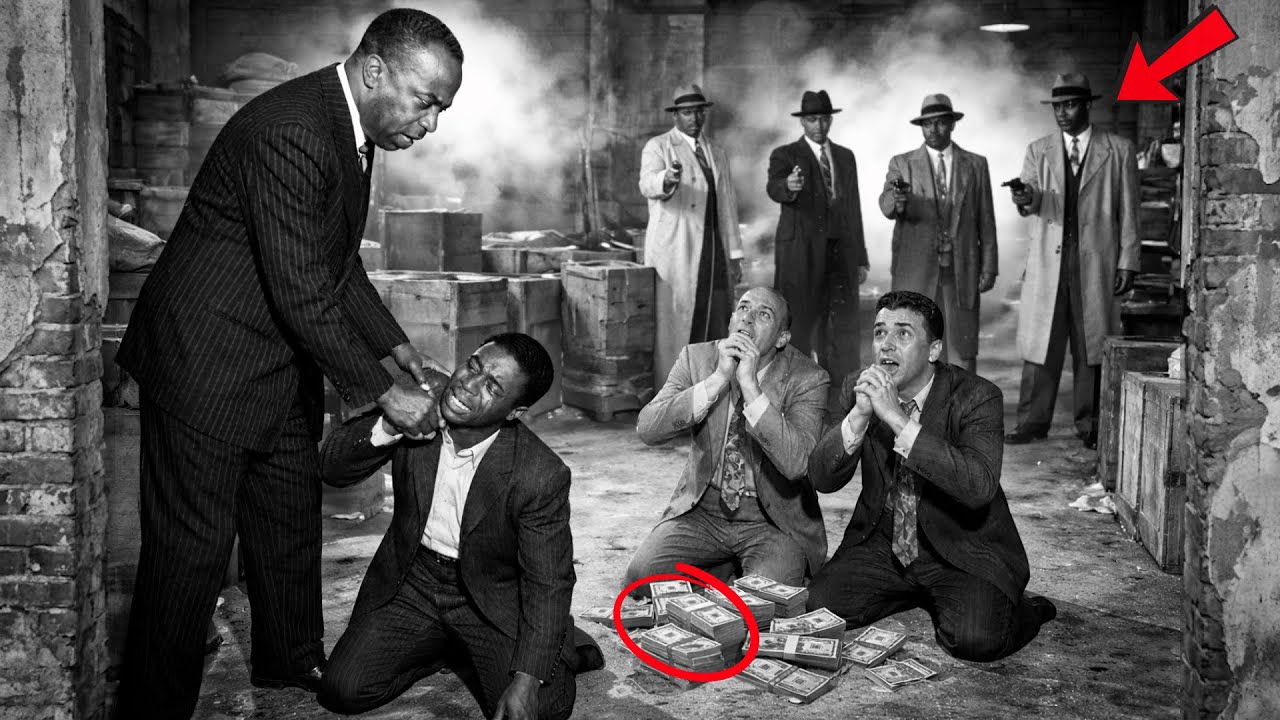
Johnson decided to make an example of both the thief and the men who sought to buy him. Johnson set a trap using the truth. He announced at a meeting that the weekend count would be moved to an empty warehouse on 145th Street, a location he knew Taylor would report to the Italians. He made sure Taylor was present to hear every detail.
The plan was simple: the information would travel from Taylor to Vincent Moretti, and the Italians would walk into a warehouse that contained no money at all. By Friday, the warehouse was prepared. Four electric lamps were placed in the corners. Six armed men were positioned outside.
Five gallons of gasoline were stored in the back room with the door left open so the fumes drifted into the main space. Johnson wanted the Italians to smell the fuel when they entered and to understand that they were not walking out unless he allowed it. On Saturday night, Vincent Moretti arrived with three soldiers carrying Thompson submachine guns. They entered the warehouse expecting to find the weekend count.
Instead, they found an empty floor, bright lights, and Johnson waiting in the shadows. When Moretti demanded to know where the money was, Johnson told him there never was any count. He explained that the warehouse was a conversation about what happens when a rival tries to buy his men. Moretti’s soldiers raised their weapons, but Johnson’s men responded with shotguns.
The standoff ended when Johnson stepped forward with a straight razor and cut Moretti’s face from his ear to the corner of his mouth. The wound was deep enough to leave a permanent scar. When Moretti’s soldiers moved, shotgun blasts tore through two of them. The third, a young man barely 20 years old, dropped his weapon and raised his hands.
Johnson knelt beside the wounded Moretti and delivered his message. He told him to return to his uncle and explain that Harlem was not for sale. He warned that the next Italian who tried to buy one of his men would not walk away with just a scar. Moretti was helped to his feet and dragged out of the warehouse with the two bodies of his soldiers left trailing blood across the concrete.
Taylor was taken from his apartment later that night. He sat at his kitchen table with a cold cup of coffee, waiting. He was brought to the Red Rooster, where Johnson confronted him with the ledger and the $15,000 envelope that had been recovered from Moretti. Taylor admitted he took the money because he needed it.
Johnson responded that everyone needs money and that this was an excuse, not a reason. Johnson placed the razor against Taylor’s right hand and broke the fingers one by one, starting with the pinky and continuing through the ring, middle, and index fingers. Taylor screamed as each knuckle gave way. When it was done, Johnson dropped the stolen bills into Taylor’s lap and told him to leave Harlem that night.
He warned that if Taylor ever returned, he would finish the job. Taylor took a 3:00 a. m. train to Chicago.
He lived another 32 years in Gary, Indiana, working as a night janitor in a factory. He never touched a ledger again. His right hand remained twisted and useless for the rest of his life. Vincent Moretti returned to his uncle with the scar that pulled the corner of his mouth into a permanent sneer.
The family made a brief phone call to Johnson after seeing the wound. No threats were exchanged. The call lasted less than two minutes and ended with an agreement that Harlem would remain Johnson’s territory and the Italians would take their business elsewhere. Within a week, Italian soldiers who had been active north of 110th Street returned to Little Italy.
The numbers game stayed in Johnson’s hands. The Moretti family never spoke of the warehouse again, and the two soldiers who went in that night were never mentioned. The scar on Vincent’s face was the only message that needed to be delivered. A month later, Johnson learned from a newspaper that Vincent Moretti had been promoted to run operations in New Jersey.
Gordon observed that the family was cleaning house, removing anyone involved in the failed plan. Johnson saw it as proof the lesson had been learned. He reflected that power did not come from violence alone. It came from knowing when to use it and when to let the threat of it do the work.
The betrayal had been handled not with anger but with calculation. Taylor was still alive, carrying a permanent reminder of what he had thrown away. The clubs reopened that night. The numbers runners made their rounds.
Harlem returned to its rhythm, and Johnson sat in the back room of the Red Rooster, watching the city move below him, aware that somewhere else men were making the same mistakes Taylor had made.