The Novel Written on an Overturned Wheelbarrow

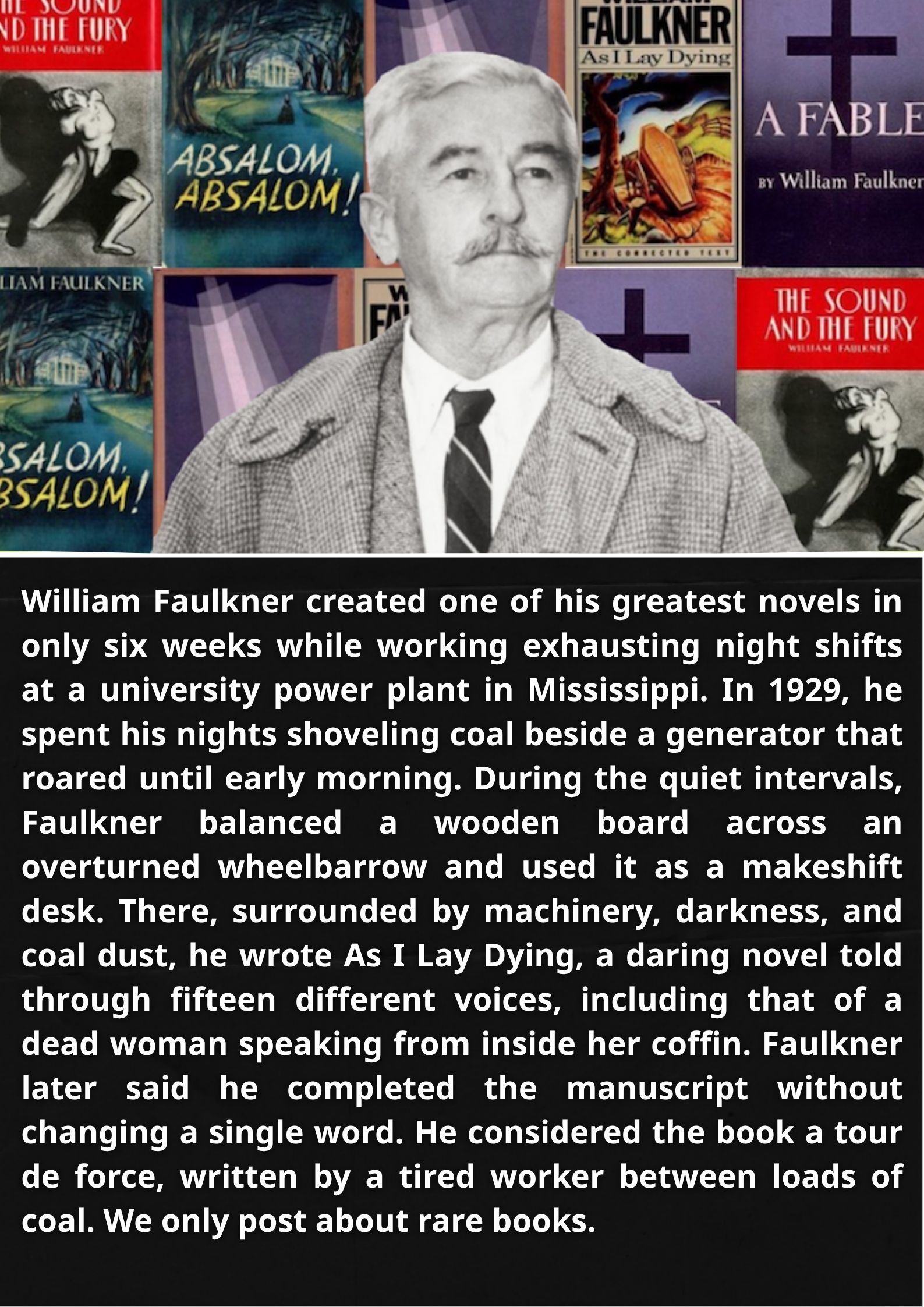
Some literary masterpieces are created in peaceful studies, surrounded by shelves of books, comfortable chairs, and long hours of uninterrupted thought. William Faulkner’s As I Lay Dying was born in a very different place. It emerged at night inside a university power plant, beneath the constant hum of machinery, while its author worked a demanding job shoveling coal.

William Faulkner | Mississippi EncyclopediaIn 1929, Faulkner was living in Oxford, Mississippi, and working the night shift at the University of Mississippi power plant. The job was not glamorous. His duties involved feeding coal into the machinery and watching over a generator that supplied electricity to the campus. The work required physical effort, patience, and long hours in an environment filled with heat, dust, and mechanical noise.

Faulkner’s shift stretched deep into the night, often lasting until four in the morning. At the beginning of each shift, the plant could be busy and noisy. Coal had to be moved, machinery had to be monitored, and the generator demanded constant attention. But there were also quiet intervals when the equipment was running steadily and little needed to be done.

Most workers might have used those pauses to rest. Faulkner used them to write.

There was no proper desk waiting for him inside the power plant. Instead, he improvised. He reportedly found an overturned wheelbarrow, placed a wooden board across it, and transformed it into a crude writing surface. With the generator humming nearby and coal dust settling around him, he began creating what would become one of the most important American novels of the twentieth century.

The book was As I Lay Dying.

Its story follows the Bundren family as they attempt to honor the dying wish of Addie Bundren, a wife and mother who asks to be buried in her hometown of Jefferson. After her death, her husband and children place her body in a homemade coffin and begin a difficult journey across rural Mississippi.

What appears at first to be a simple funeral journey quickly becomes a story of hardship, selfishness, loyalty, grief, resentment, and hidden motives. The family faces floods, injuries, fire, poverty, and emotional conflict. As the journey continues, each character reveals a different understanding of Addie’s death and of the family itself.

The structure of the novel was highly unusual. Faulkner told the story through fifteen different narrators. Each voice offers a separate version of events, and no single narrator provides the complete truth. The reader must piece the story together from conflicting thoughts, memories, fears, and private desires.As I Lay Dying

Some voices are practical and direct. Others are confused, poetic, bitter, or deeply emotional. One narrator is a young child who struggles to understand death. Another is a son slowly losing his grip on reality. Most famously, Addie Bundren speaks in one section even though she is already dead, allowing the woman inside the coffin to describe her own life, marriage, and feelings toward her children.

This choice gave the novel an unforgettable psychological power. The dead woman at the center of the journey is not merely a silent body being transported by her family. She becomes one of the story’s most revealing voices, challenging the assumptions of those around her and exposing the complicated truth behind her final request.

Writing such a novel would have been difficult under ideal circumstances. Faulkner attempted it while physically tired and working through the night. Yet he later described the process as unusually controlled and intense. According to his own recollections, he completed the manuscript in approximately six weeks.

He also claimed that he knew the story so clearly that he did not need to revise it significantly. He sometimes said that he wrote the entire novel without changing a word. Whether taken literally or as part of Faulkner’s own legend, the statement reflects the confidence he felt about the book. He believed the story had come together exactly as he intended.

Faulkner called As I Lay Dying a “tour de force.” The phrase suggests an achievement produced through exceptional skill, control, and creative energy. He seemed proud not only of the final novel but also of the extraordinary circumstances under which it had been written.

The image of Faulkner composing the book on a wheelbarrow has become one of the most memorable stories in literary history. It represents the contrast between the physical world around him and the imaginative world growing in his mind. Outside the manuscript, there was coal, machinery, exhaustion, and darkness. Inside it, there was a grieving family, a dead mother, a dangerous journey, and fifteen voices competing to tell the truth.

The power plant also seems strangely appropriate for the novel. As I Lay Dying is filled with labor, discomfort, heat, dirt, suffering, and ordinary people trying to endure impossible circumstances. Faulkner was writing about exhausted rural families while he himself worked through exhausting nights. The rough conditions may have helped shape the book’s urgency and directness.

When the novel was published in 1930, it did not immediately bring Faulkner widespread popular success. His writing was often considered difficult because of its shifting viewpoints, experimental structure, and intense psychological detail. Over time, however, As I Lay Dying came to be recognized as one of his major achievements.

The novel remains widely studied because it transformed a simple journey into a complex examination of human nature. Each family member believes that he or she understands what is happening, yet every perspective is incomplete. The result is a story in which truth changes depending on who is speaking.

Faulkner’s unusual working conditions have become part of the book’s legacy. Readers are often astonished that such a formally ambitious novel could have been written so quickly, in such an uncomfortable place, by a man balancing creative work with physical labor.

The story also challenges the romantic idea that writers need perfect circumstances before they can begin. Faulkner did not wait for silence, comfort, or financial security. He used the time and materials available to him. An overturned wheelbarrow became his desk. The pauses between coal deliveries became his writing hours. The noise of a generator became the background to one of literature’s most haunting journeys.

Years later, the power plant job would be remembered mainly because of what Faulkner created during those long night shifts. The coal was burned, the machinery was replaced, and the ordinary working nights disappeared into history. But the words written on that makeshift desk survived.

What began as a manuscript created by a tired worker in the darkness became a masterpiece read around the world.
10 July 2026

The Billionaire Who Bought an Entire Library for One Book

At the beginning of the twentieth century, New York City was rapidly becoming a global center of finance, industry, culture, and extraordinary private wealth. Among the powerful figures who helped shape that era, few names carried more influence than John Pierpont Morgan. Known simply as J. P. Morgan, he was a banker whose decisions could move markets, rescue struggling companies, and affect the direction of the American economy. Yet behind the imposing public figure was another side of Morgan—a passionate collector fascinated by rare books, manuscripts, art, and objects that carried the memory of past civilizations.

Morgan did not view books merely as objects to be read. To him, a rare book was a physical connection to history. The paper, ink, binding, handwriting, and signs of age all told a story that no modern reproduction could fully preserve. He wanted to hold the same pages that scholars, writers, printers, and noble families had touched centuries earlier. As his wealth increased, so did the scale and ambition of his collection.La Morgan Library & Museum célèbre le 250e anniversaire de Jane Austen avec  une exposition époustouflante - mais il ne vous reste qu'un mois pour la  voir.

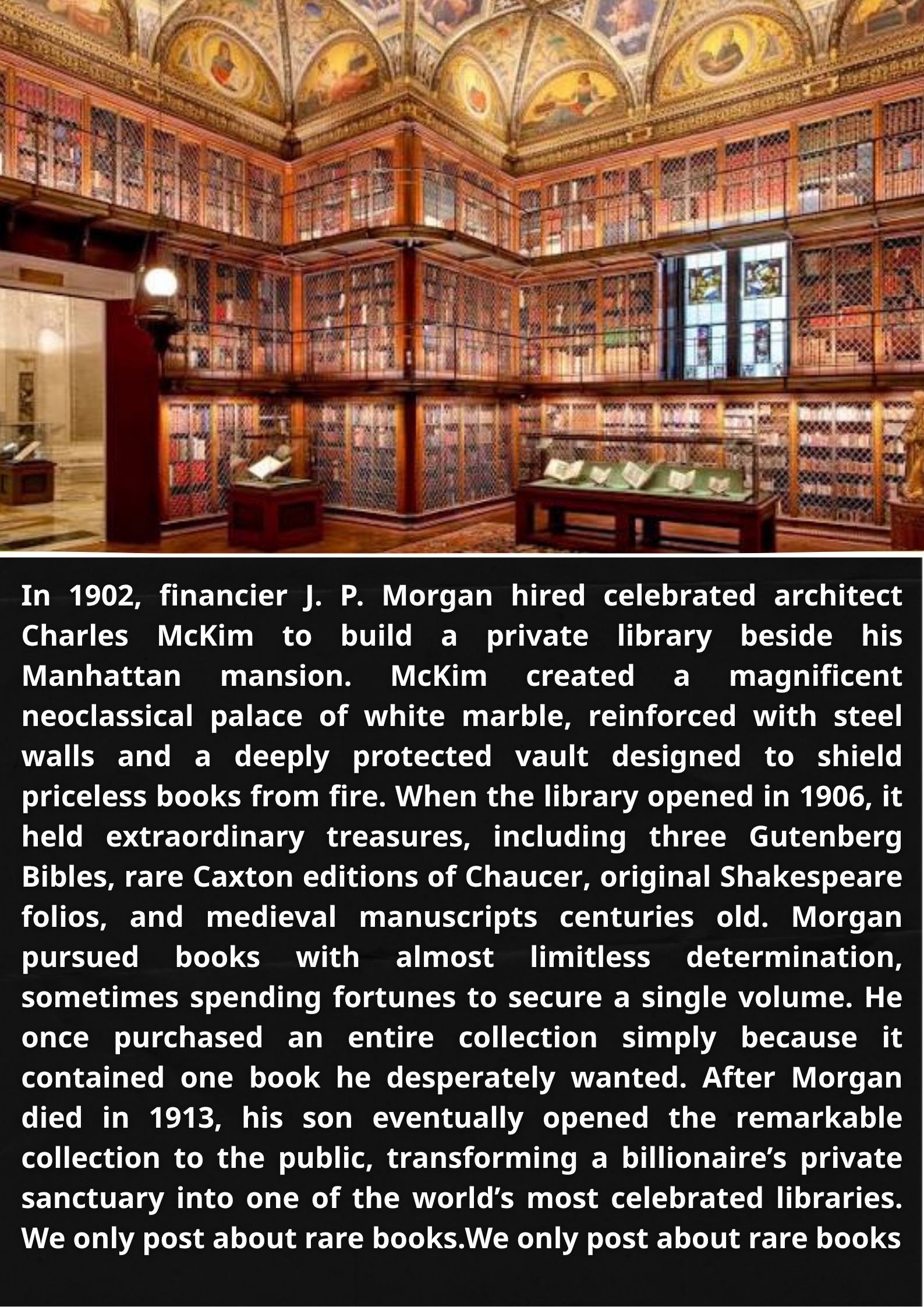
By 1902, Morgan possessed so many important books and manuscripts that an ordinary room was no longer sufficient. He decided to build a private library beside his residence on Madison Avenue in Manhattan. For the project, he selected Charles Follen McKim, one of the most respected American architects of the period and a leading figure in the firm McKim, Mead & White. The firm was associated with some of the most significant buildings in the country, including the original Pennsylvania Station.

Morgan did not ask McKim to design a simple place filled with shelves. He wanted a monument to knowledge—a building that would reflect the dignity, permanence, and grandeur of the treasures stored inside it. McKim responded with an elegant neoclassical structure inspired by the architecture of the Italian Renaissance. Its exterior was built from pale marble, while its interiors featured richly decorated ceilings, carved woodwork, elaborate bookcases, and paintings influenced by European artistic traditions.

The most famous room was Morgan’s private study, sometimes called the West Room. Dark red walls, antique furnishings, precious artworks, and shelves of carefully selected books surrounded the enormous desk where Morgan conducted both personal and professional business. The room felt less like an office and more like the private chamber of a Renaissance prince. Visitors entering it were immediately reminded that Morgan’s power extended beyond banking into the worlds of art, culture, and history.

But beauty alone was not enough. Morgan understood that fire was one of the greatest dangers facing any collection of books. New York had experienced devastating fires, and many irreplaceable libraries throughout history had been destroyed within hours. To protect his collection, the building incorporated unusually strong security measures. Steel was used within the structure, and a heavily protected vault was installed for the most valuable objects. The library was designed not only to display treasures but also to defend them.

When the building was completed in 1906, it contained a collection that rivaled those of major institutions. Among Morgan’s most celebrated possessions were three copies of the Gutenberg Bible, one of the earliest major books printed in Europe using movable metal type. Produced during the fifteenth century, the Gutenberg Bible represented a turning point in human history because printing allowed knowledge to be reproduced and distributed on a scale previously impossible.

Morgan also collected works connected to William Caxton, the first person to establish a printing press in England. These included rare editions of Geoffrey Chaucer, whose Canterbury Tales became one of the foundational works of English literature. Owning such books was not simply a matter of possessing valuable antiques. They represented decisive moments in the development of language, printing, and storytelling.

His shelves also held early editions and folios associated with William Shakespeare, illuminated manuscripts decorated by hand, historical letters, musical scores, and medieval texts created long before the invention of modern printing. Some manuscripts were older than many famous museums and institutions. Each object had survived wars, fires, political revolutions, neglect, and the slow damage of time before arriving in Morgan’s protected rooms.

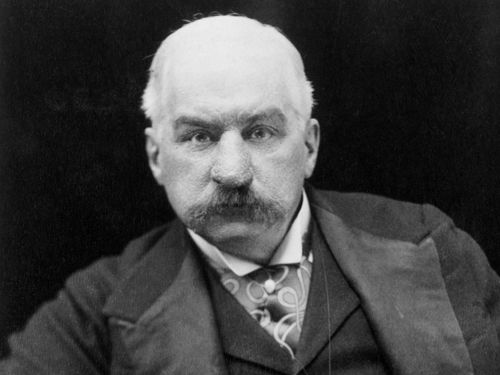
J.P. Morgan - Life, Family & PhilanthropyMorgan pursued these treasures with relentless determination. Dealers throughout Europe and America knew that he was willing to pay extraordinary sums for items he considered important. Wealthy collectors competed with him, while booksellers searched estates, monasteries, private collections, and auctions for objects that might capture his attention.

One story came to symbolize the intensity of his collecting. Morgan reportedly purchased an entire library because he wanted a single volume contained within it. For most people, such a decision would have been unimaginable. For Morgan, however, the value of the desired book outweighed the cost and inconvenience of acquiring everything around it. The incident revealed both the enormous resources available to him and the almost obsessive seriousness with which he approached collecting.

Yet Morgan’s library was never merely a display of wealth. He employed experts to organize, study, and care for the collection. One of the most important was Belle da Costa Greene, who became Morgan’s personal librarian. Brilliant, knowledgeable, and highly skilled in the rare-book trade, Greene helped Morgan locate important works, negotiate purchases, and develop the library into a collection of international significance. Her judgment played a major role in shaping the institution’s future.

When J. P. Morgan died in 1913, questions arose about what would happen to the extraordinary collection he had assembled. His son, J. P. Morgan Jr., inherited responsibility for the library and its treasures. Rather than allowing the collection to remain permanently hidden as the private possession of one family, he took steps to make it accessible to a wider audience.

In 1924, the library became a public institution. Scholars, researchers, and visitors could finally enter a world that had once been reserved for Morgan and his invited guests. Over time, the institution expanded, acquiring more books, manuscripts, drawings, music, and works of art. Today, it is known as the Morgan Library & Museum.

The transformation was remarkable. A building originally created as the private sanctuary of one of America’s richest men became a place where the public could encounter some of humanity’s rarest cultural achievements. Morgan’s collecting had been driven partly by personal desire and prestige, but the final result reached far beyond him.

The marble rooms, protected vaults, and ancient volumes still tell the story of a man who believed certain objects were too important to disappear. He spent fortunes pursuing books that had survived for centuries. In doing so, he created not only a collection, but also a lasting bridge between the private passions of one collector and the shared cultural inheritance of the world.

10 July 2026

„Die Flugbegleiterin warf mich aus der First Class – Sekunden später betrat mein Mann das Flugzeug… und niemand war auf die Wahrheit vorbereitet.“

Ein einziger Blick veränderte alles Es heißt, manche Menschen erkennen deinen Wert, bevor du überhaupt ein Wort gesagt hast. Leider erkennen andere nur deine Kleidung. Als ich an diesem Morgen den First-Class-Bereich am Flughafen Frankfurt betrat, ahnte ich nicht, dass mich wenige Minuten später das schlimmste Erlebnis meines Lebens erwarten würde. Noch weniger ahnte ich, … Read more

10 July 2026

„Meine Eltern verschenkten MEIN Traumhaus an meine Schwester – doch sie wussten nicht, dass ich bereits ihren größten Betrug entdeckt hatte.“

Sie wollten ihr Traumhaus stehlen – doch niemand ahnte, welches Geheimnis sie wirklich verbargen  Der Albtraum beginnt Als Katharina Berger den Fingerabdruckscanner an der Haustür ihres neu gebauten Hauses aktivieren wollte, hörte sie Stimmen aus dem Inneren. Sie blieb regungslos stehen. Sie hatte niemandem einen Schlüssel gegeben. Langsam öffnete sie die Tür. Im Wohnzimmer standen … Read more

9 July 2026

STEP 2 – Full Story The Children Beneath St. Mercy Hospital

In 2018, Daniel Pierce took the night security job at St. Mercy Hospital because he needed money, not because he believed in ghosts. He was forty-two, recently divorced, and living in a rented room above a garage in Akron, Ohio. The job was simple on paper: watch the cameras, patrol the main floors twice a night, keep teenagers and vandals away, and report anything unusual. The hospital had been abandoned for more than twenty years, but the property company still paid for security because developers were planning to tear it down.

Daniel had worked lonely jobs before. Warehouses. Parking lots. Construction sites. Darkness did not bother him. Silence did not bother him. What bothered him was the way St. Mercy Hospital seemed to listen.

The building sat behind a rusted iron fence at the end of a dead road. Most of the windows were boarded. The entrance doors were chained from the inside. Old signs still hung in the hallways: Pediatrics, Emergency, Radiology, Basement Records. The air smelled of mildew, dust, and something faintly chemical, as if the hospital had never fully stopped being a hospital.

On his first night, the property manager, Mr. Collins, gave him one warning.

“Do not go into the basement.”

Daniel almost laughed. “Why? Is it unsafe?”

Collins looked toward the stairwell at the end of the lobby. “It’s sealed. Has been for years. Fire damage, bad flooring, old pipes. Just don’t mess with it.”

Daniel nodded. That was enough for him. He had no interest in exploring dark basements for minimum pay.

For the first week, nothing happened. Daniel sat in the security office with a thermos of coffee and watched twelve grainy camera feeds. Empty hallway. Empty nurses’ station. Empty waiting room. Empty stairwell. Every few hours, he walked the first and second floors with a flashlight. The building creaked. Pipes knocked. Wind moved through broken vents. Nothing he could not explain.

Then, on the eighth night, at exactly 2:41 AM, he heard children laughing.

Daniel froze with his coffee halfway to his mouth.

The sound came through the security speakers. Soft at first. Then louder. A giggle. Another giggle. Then several small voices laughing together somewhere deep in the building.

He checked the cameras.

Camera 6, the first-floor hallway near Pediatrics, flickered once.

Three shadows ran across the screen.

Daniel leaned forward. They were small, child-sized, moving fast from left to right. Their shapes were dark and thin, and they seemed to be holding hands. The hallway itself was empty when the image cleared.

Daniel replayed the footage twice. The shadows were still there.

He grabbed his flashlight and radio, then stepped into the hallway. “Security,” he called. “Whoever is inside, you need to leave.”

His voice echoed too long.

He walked toward Pediatrics. The air became colder with every step. Near the old nurses’ station, he found something that had not been there during his earlier patrol: a small red ball sitting in the middle of the floor.

Daniel stared at it.

The ball was clean. Not dusty. Not old. Clean, as if someone had just been playing with it.

He bent down slowly, but before his fingers touched it, the ball rolled away by itself. It moved down the hallway, stopped in front of the basement stairwell door, and rested against the metal frame.

Daniel stood up.

The basement door was exactly as Collins described it: welded shut, chained, and covered with a thick glass panel reinforced by wire mesh. A faded warning sign read: DO NOT ENTER.

From behind that sealed door came a tiny knock.

Once.

Then twice.

Then a child whispered, “Open it.”

Daniel backed away so quickly he nearly tripped.

The next morning, he told Collins everything. Collins did not laugh. He did not look surprised either. He only asked, “Did you touch the door?”

“No,” Daniel said.

“Good. Don’t.”

That answer bothered Daniel more than disbelief would have. “What happened down there?”

Collins rubbed his face. For a moment, Daniel thought he would refuse to answer. Then the man said quietly, “There was a fire in 1997. Basement playroom. They used to keep children down there during long treatments. Three kids died before firefighters could reach them.”

Daniel felt the blood drain from his face. “I thought the basement was records.”

“It was many things,” Collins said. “Hospitals don’t always tell the truth after lawsuits.”

Daniel should have quit that day.

But he needed the job.

The next few nights were worse. The laughter returned at 2:41 AM. The cameras caught quick movements: a small figure peeking around a doorway, tiny feet vanishing behind a corner, three dark shapes standing near the stairwell before the feed cut to static. Every time Daniel approached, the hallway was empty.

On the fourth night, he found handprints on the inside of the basement glass.

Tiny handprints.

Pressed from the other side.

He took photos and sent them to Collins. No reply.

By the end of the second week, Daniel was barely sleeping. He began hearing children even when he was home: giggling under his shower water, whispering through radio static, tapping from inside his closet. One night, he woke to find his bedroom window fogged from the inside. Written in the condensation were four words:

YOU LEFT US THERE.

Daniel went back to St. Mercy determined to end it. He brought a crowbar, bolt cutters, and an old camera. If someone was hiding in that basement, he would prove it. If it was a prank, he would expose it. If it was something else… he did not let himself finish that thought.

At 2:41 AM, the laughter started.

This time, it came not from the speakers, but from the hallway outside the security office.

Daniel opened the door.

Three children stood near the basement stairwell.

A little girl in a hospital gown. A boy with dark soot around his mouth. A smaller child holding a burned teddy bear by one arm.

They were pale, wet-eyed, and smiling.

Daniel could not move.

The little girl pointed at the sealed basement door. “He locked us in.”

Daniel whispered, “Who?”

The boy lifted one blackened finger and pointed behind Daniel.

Daniel turned.

On the security monitor, Camera 6 showed the hallway behind him. A man in an old doctor’s coat stood in the darkness, his face blurred by static. He was holding a ring of keys.

The children began crying.

The basement door behind them rattled violently. The welded metal groaned. Daniel heard screaming now—not ghostly, not distant, but raw and terrified, as if the fire were happening again behind that door.

Daniel ran to the basement entrance and struck the chain with the bolt cutters. Once. Twice. Three times. The chain snapped.

The moment it fell, the hallway filled with heat. Smoke poured through the cracks of the sealed door, though there was no fire. Daniel covered his mouth, grabbed the handle, and pulled.

The door opened.

It should not have been possible.

Behind it was a staircase leading down into blackness. At the bottom, three small voices whispered together, “Thank you.”

Then something heavier spoke from below.

“You should not have opened it.”

A hand shot out of the darkness and grabbed Daniel’s wrist. It was not a child’s hand. It was large, burned, and cold as ice. Daniel screamed and pulled back, falling hard onto the hallway floor. The basement door slammed shut by itself.

The cameras died.

When police arrived the next morning, they found Daniel unconscious near the stairwell. The basement door was sealed again, chain intact, welds untouched. But the glass panel was covered with tiny handprints from the inside.

And one large adult handprint from the outside.

Daniel quit that day and never returned. The hospital was demolished six months later. Workers claimed the basement was empty when they finally broke through. No bodies. No toys. No evidence of a playroom. Only scorched walls and a row of small chairs facing a locked metal cabinet.

Inside the cabinet, they found an old hospital logbook from 1997. Three children’s names were listed on the last page. Beneath them, in different handwriting, someone had written:

THE GUARD OPENED THE DOOR TOO LATE.

Daniel moved out of Ohio soon after. He refused interviews. He refused to talk about St. Mercy. But according to his sister, he still woke every night at 2:41 AM, listening.

Because sometimes, just before dawn, he heard children laughing outside his bedroom door.

And one voice always whispered, “Daniel, we’re still downstairs.”

9 July 2026

Nagelpilz — warum keine Creme hilft und was wirklich dahintersteckt

„Sie schmieren seit Monaten jeden Abend Nagellack aus der Apotheke, teure Cremes und Lösungen auf den Nagel. Der Nagel bleibt gelb, dick und brüchig. Und Sie fragen sich: Warum hilft nichts, obwohl ich alles richtig mache? Die Antwort wird Sie überraschen: Was Sie auf den Nagel schmieren, bekämpft nur das letzte Glied einer langen Kette. … Read more

9 July 2026