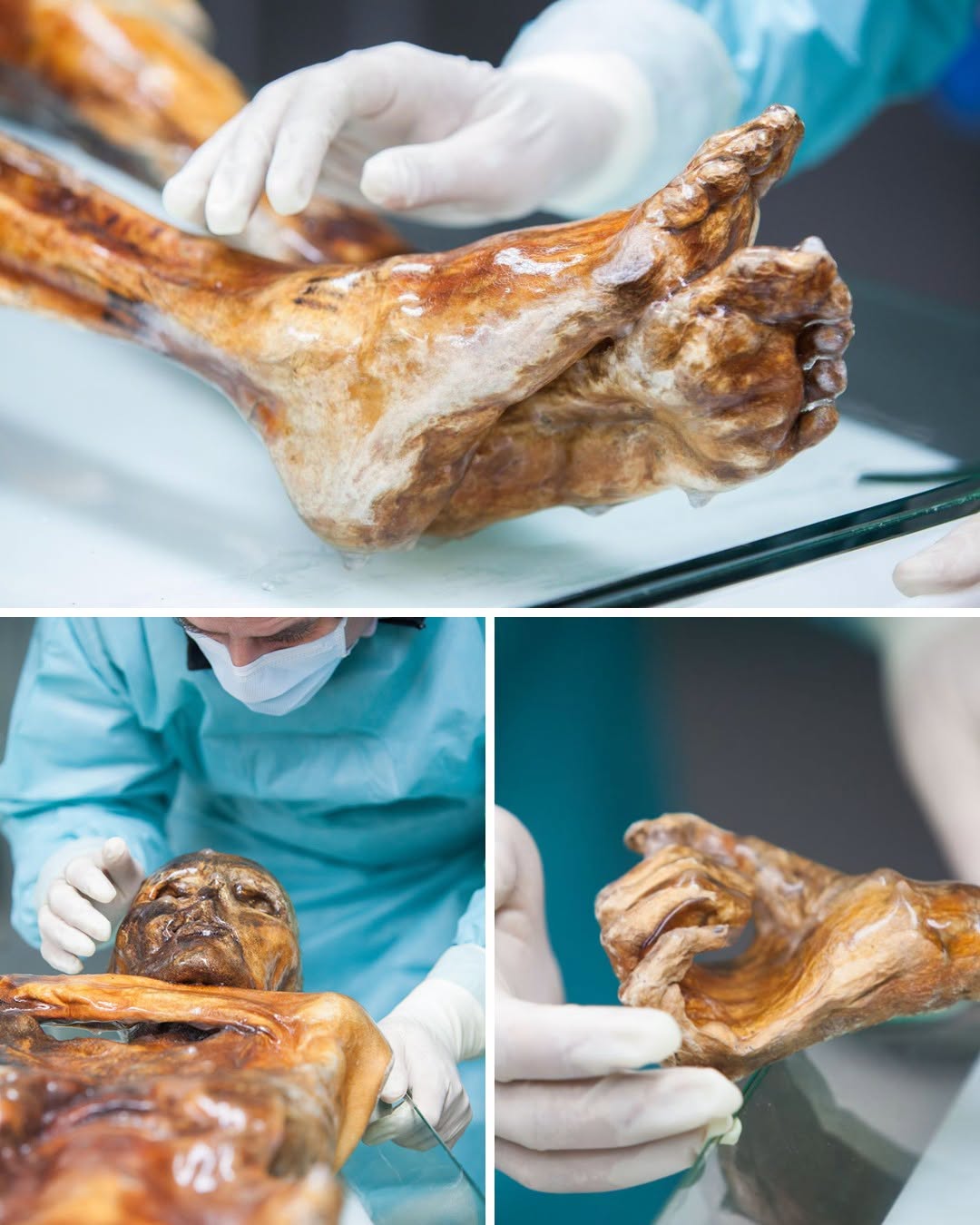
When hikers discovered a frozen human body in the Ötztal Alps in 1991, they initially believed they had found the remains of a recently deceased mountaineer. The truth was far more extraordinary. The body belonged to a Copper Age man who had died more than 5,000 years earlier and had remained sealed inside glacial ice with his skin, internal organs, clothing, weapons, and final meal unusually well preserved.
The mummy became known as Ötzi the Iceman. Since his discovery, researchers have studied nearly every visible aspect of his life and death. They have examined his tattoos, teeth, tools, clothing, injuries, ancestry, diet, diseases, and the arrow wound that contributed to his violent end. Yet one of the most revealing investigations has focused on something invisible to the human eye: the microorganisms that lived within and around his body.
Researchers at Eurac Research in Italy recently carried out one of the most detailed examinations ye t of Ötzi’s microbial environment. Rather than treating the mummy as a single isolated object, they sampled different parts of the preserved body and its surroundings. These included swabs from the skin, material from internal areas, ice from the mummy’s surface, and meltwater collected from within or around the remains.
Their goal was to reconstruct the complex community of bacteria, fungi, and other microorganisms associated with Ötzi. The results revealed that the mummy is not microbiologically simple. Instead, it contains traces of several biological worlds layered together through time.
Some organisms may reflect Ötzi’s original gut microbiome—the bacteria that lived in his digestive system while he was alive. Others may have colonized his body shortly after death. Still others likely came from the glacier, the surrounding rock, meltwater, conservation environments, or later human contact.
This distinction is crucial. Finding a microorganism on an ancient body does not automatically mean it lived inside that person during life. A mummy buried in soil, ice, or a tomb can be colonized repeatedly by environmental microbes over centuries. Researchers therefore compare samples from different locations and study genetic patterns to determine which organisms are likely ancient residents and which are later arrivals.
Among the most intriguing discoveries were cold-adapted yeasts linked to the glacial environment. These organisms are capable of surviving in conditions that would kill or disable many other forms of life. Low temperatures, limited nutrients, darkness, and long periods of freezing create an extreme habitat, yet certain fungi have evolved mechanisms that allow them to persist.
Eurac Research reported that the yeast strains may have accompanied the mummy for millennia and may still form part of a dynamic microbial ecosystem. This does not necessarily mean that individual yeast cells have remained continuously alive for 5,300 years. It may instead indicate that related microbial populations have persisted, reproduced, or repeatedly recolonized the mummy and its icy surroundings.
The possibility is scientifically fascinating because it changes how we think about mummies. A preserved body is often imagined as biologically silent—a frozen object locked outside the processes of life. But Ötzi’s remains may be better understood as part of a changing environment where microbial communities continue to interact with tissue, ice, water, and temperature.
The microorganisms may also help scientists reconstruct what happened after Ötzi died. His body was not immediately transformed into the mummy seen today. It passed through stages of exposure, freezing, thawing, burial, and preservation. Microbial signatures could reveal when certain parts of the body became accessible, whether the corpse was exposed before being covered by snow, and how the glacier changed around it.
Ötzi’s death itself remains one of archaeology’s most dramatic cases. He suffered an arrow wound near the shoulder, and researchers believe he died violently around 5,300 years ago. His body froze in the high mountains, preserving details that would normally disappear within days or weeks.
His internal organs survived well enough for scientists to examine his stomach contents. Earlier studies revealed that his last meal included a large amount of fat, along with animal and plant material. The food offered insight into how Copper Age travelers prepared for difficult journeys through high-altitude terrain.
The microbiome adds another dimension. Gut bacteria can provide information about diet, health, disease, and the relationship between ancient humans and their environments. Ötzi has already been linked to evidence of infection and other health conditions, while broader ancient microbiome studies have shown that human gut communities have changed significantly with industrialization, sanitation, antibiotics, and modern diets.
However, the recent yeast findings have also inspired exaggerated online claims. One viral version states that scientists baked bread using yeast taken from Ötzi’s stomach or intestines. The official Eurac Research material does not report such an experiment. It describes the identification and study of microorganisms, including cold-loving yeasts, but does not say that the strains were used to make bread.
The confusion likely comes from the dramatic idea of reviving ancient yeast. Similar experiments have been performed in other archaeological contexts, where researchers or bakers have used microorganisms associated with ancient pottery or historic environments. But those separate stories should not be transferred to Ötzi without evidence.
The real discovery is compelling enough without embellishment. Scientists have identified a complex biological community associated with one of the world’s most famous mummies. They are attempting to separate Ötzi’s original microbes from organisms that arrived after his death and from those belonging to the glacier itself.
This work requires extreme caution. Ancient microbial DNA is often fragmented and easily contaminated. Modern bacteria and fungi can enter samples through excavation, storage, conservation, laboratory handling, or even the air. Researchers therefore use control samples and multiple analytical methods to test whether a signal is truly ancient.
The condition of Ötzi makes this task especially complicated. Since 1991, he has been examined by many specialists and maintained in a carefully controlled environment. Conservation is necessary to protect the mummy, but every intervention can potentially alter the microbial community on its surface.
Even so, the new research demonstrates how much information remains hidden inside and around the Iceman. After decades of study, Ötzi continues to reveal unexpected details. A single body has become a record of Copper Age diet, technology, violence, migration, disease, climate, and now microbial ecology.
The cold-adapted yeasts may ultimately tell scientists more about the glacier than about Ötzi himself. They could reveal how microorganisms survive long-term freezing, respond to repeated thawing, and colonize preserved organic tissue. Such knowledge may have implications beyond archaeology, including research into climate change, food preservation, biotechnology, and life in extreme environments.
As Alpine glaciers retreat, other preserved remains and ancient biological materials may emerge. These discoveries could offer valuable scientific information, but they are also highly vulnerable. Once removed from stable frozen conditions, tissues can decay rapidly, while microorganisms may change or become contaminated.
Ötzi’s microbial world therefore carries a warning as well as a mystery. Ice can preserve evidence for thousands of years, but that preservation is not permanent. Climate shifts, meltwater, exposure, and human activity can transform ancient remains in a short time.
The most haunting part of the story is not the unsupported image of scientists baking bread from a mummy. It is the possibility that the frozen body never existed in complete biological silence. Around it, microorganisms may have continued to survive, spread, disappear, and return as the glacier changed.
Ötzi died more than five millennia ago, yet the ecosystem surrounding him may still be active. His body preserves not only the story of one Copper Age man, but also a hidden world of microscopic life that endured beside him in the darkness of the ice.