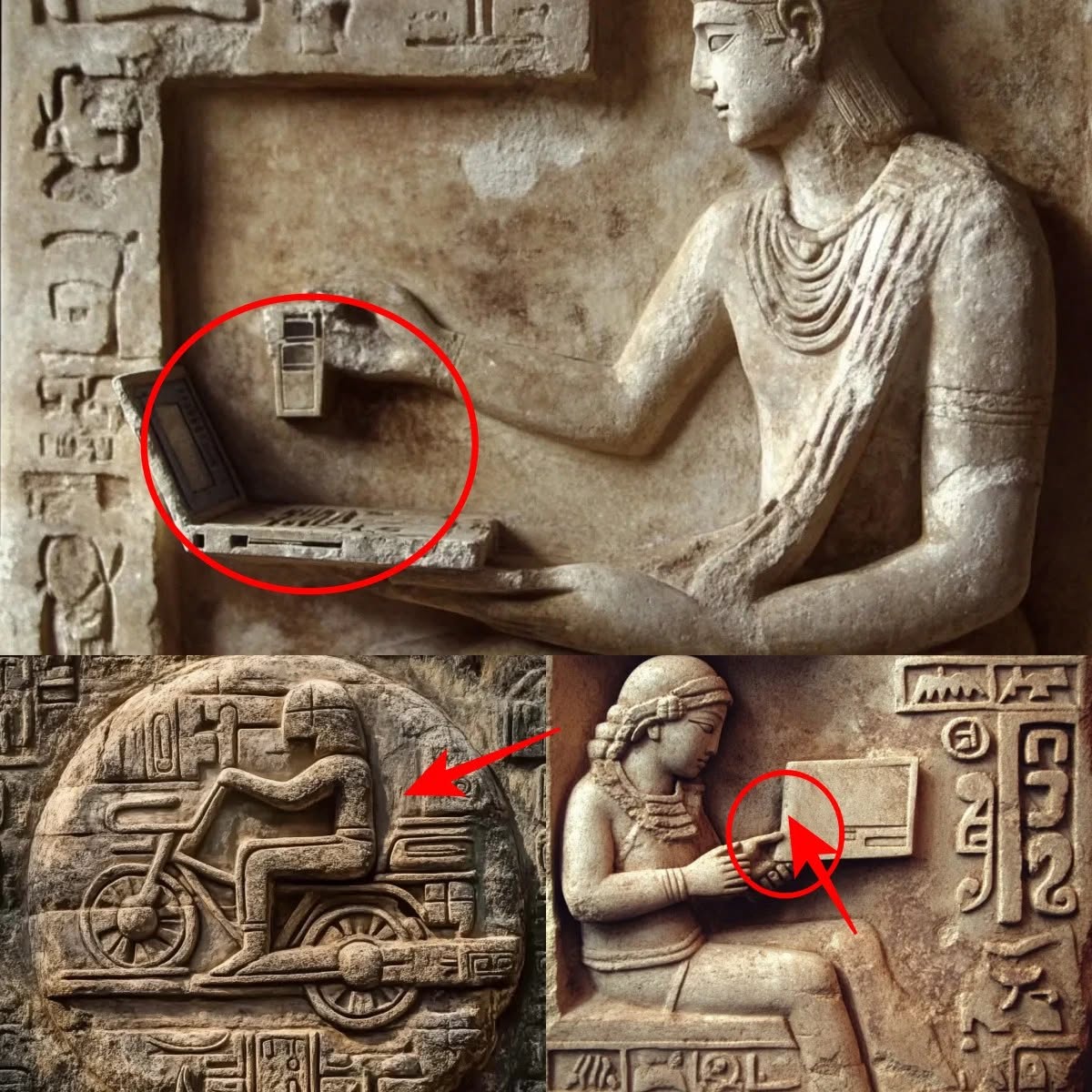
A sensational story has spread across social media claiming that archaeologists discovered 5,000-year-old hieroglyphs inside an ancient Mexican tomb. According to viral posts, the carvings depict people using objects that look like modern computers, bicycles, advanced vehicles, and technological devices that should not have existed in the ancient world.
The story has everything needed to capture attention: a hidden tomb, mysterious symbols, impossible technology, and the suggestion that accepted history may be completely wrong. Some versions claim the carvings could prove that an advanced civilization once existed in Mexico. Others go further, suggesting time travel or contact with extraterrestrial beings.
There is, however, one major problem.
No credible archaeological evidence confirming this discovery has been produced.
The articles sharing the claim usually repeat nearly identical language. They describe an unnamed archaeological team, an ancient tomb supposedly located in Mexico or the jungles of Chiapas, and carvings that allegedly show a laptop and bicycle. Yet they provide no official excavation report, no precise archaeological coordinates, no names of researchers, no university affiliation, and no museum or government institution responsible for the objects.
These missing details are important. Genuine archaeological discoveries are normally documented carefully. Researchers record the site, soil layers, associated objects, dating methods, conservation procedures, and the exact context in which an artifact was found. Major discoveries in Mexico would also usually involve or be acknowledged by the country’s National Institute of Anthropology and History.
Without this documentation, there is no reliable way to confirm the carvings’ age, origin, or authenticity.
The phrase “5,000-year-old hieroglyphs” also raises questions. Writing systems and artistic traditions in ancient Mexico developed across different regions and periods. An object claimed to be 5,000 years old would require strong scientific dating and archaeological context. A photograph alone cannot prove that a carved stone is ancient, much less establish an exact age.
Objects can be newly created and artificially weathered. They can be photographed without scale or location. Modern art can also be misidentified after images are separated from their original source.
This has happened before.
AFP investigated a widely shared image that appeared to show an ancient figure seated before a computer. Social media posts falsely described it as an old temple carving. The creator, a Mexico-based artist, explained that it was a modern artwork made from resin and acrylic roughly 25 years earlier, inspired by science fiction and Maya and Aztec imagery.
The artwork looked convincing because it borrowed the visual language people associate with ancient reliefs. Its surface appeared aged, the figure wore stylized clothing, and the supposed “computer” resembled a monitor and keyboard. Once the image circulated without its original context, viewers interpreted it as evidence of impossible ancient technology.
Other collections of viral images have included carvings that seem to show bicycles, astronauts, helicopters, or electronic equipment. Fact-checking investigations found that some were modern creations, while others were older artworks being interpreted through modern expectations.
This tendency is known as pareidolia—the human habit of recognizing familiar objects or patterns in ambiguous forms. A person living today may see a rectangular shape and immediately imagine a laptop. A circular form connected to a frame may resemble a bicycle. But the original artist may have intended something entirely different, such as a ceremonial object, animal, throne, weapon, or abstract symbol.
Context determines meaning.
Archaeologists do not identify ancient imagery solely by asking what it resembles to a modern viewer. They compare it with other examples from the same culture, region, and period. They examine inscriptions, materials, tools, burial context, and patterns repeated across securely documented sites.
A genuine representation of a modern-style bicycle in a 5,000-year-old Mexican tomb would create an enormous historical problem. It would require evidence that such vehicles existed thousands of years before their documented development. Researchers would expect to find supporting traces: wheels, metal components, workshops, roads, written descriptions, or additional images.
One isolated carving would not be enough to rewrite technological history.
The same applies to claims about ancient computers. A computer is not simply a rectangular box. It depends on an entire technological system involving mathematics, power sources, information storage, manufactured components, and specialized knowledge. If an ancient civilization had possessed such technology, it would almost certainly have left more evidence than a single ambiguous image.
Supporters of the story sometimes respond that all physical evidence was lost, destroyed, or deliberately hidden. But this makes the theory impossible to test. When missing evidence is treated as proof of a cover-up, almost any claim can be protected from criticism.
Extraordinary discoveries do occur in archaeology. The ancient world produced technologies that once seemed surprisingly advanced. The Antikythera mechanism, for example, demonstrated remarkable knowledge of gears and astronomical calculation. Ancient societies also achieved extraordinary engineering, medicine, mathematics, architecture, and navigation.
These real accomplishments do not require time travelers or aliens.
In fact, attributing ancient achievements to outside intervention can distract from the intelligence and creativity of the people who actually built them. Ancient Mexican civilizations developed sophisticated calendars, writing systems, cities, agricultural techniques, trade networks, and monumental architecture through human knowledge accumulated across generations.
The false computer-and-bicycle story offers no comparable evidence.
The websites repeating the claim appear to rely largely on sensational storytelling rather than documented research. One widely circulated article describes the alleged discovery as “groundbreaking” and claims that it has puzzled archaeologists, yet it does not identify those archaeologists or link to a scholarly publication.
Another version uses almost the same narrative structure, presenting the supposed carvings as a challenge to accepted history while providing no verifiable source.
This repetition can make a story appear legitimate. When readers encounter the same claim on multiple pages, they may assume each site independently verified it. In reality, many pages may simply be copying from one another.
The most responsible conclusion is that the alleged 5,000-year-old Mexican carvings remain unsupported and are likely part of a modern viral myth. There is no verified archaeological discovery demonstrating that ancient people in Mexico depicted computers or bicycles.
That does not mean the story is uninteresting. It reveals how easily visual ambiguity, fascination with lost civilizations, and distrust of experts can combine to create an online mystery.
The carvings may never have existed as genuine archaeological objects, but the legend surrounding them has become a modern artifact of its own. It shows how people interpret the past through the technology of the present—and how quickly imagination can become mistaken for evidence.
The greatest mystery is therefore not whether ancient Mexicans owned computers.
It is why so many people were ready to believe they did.