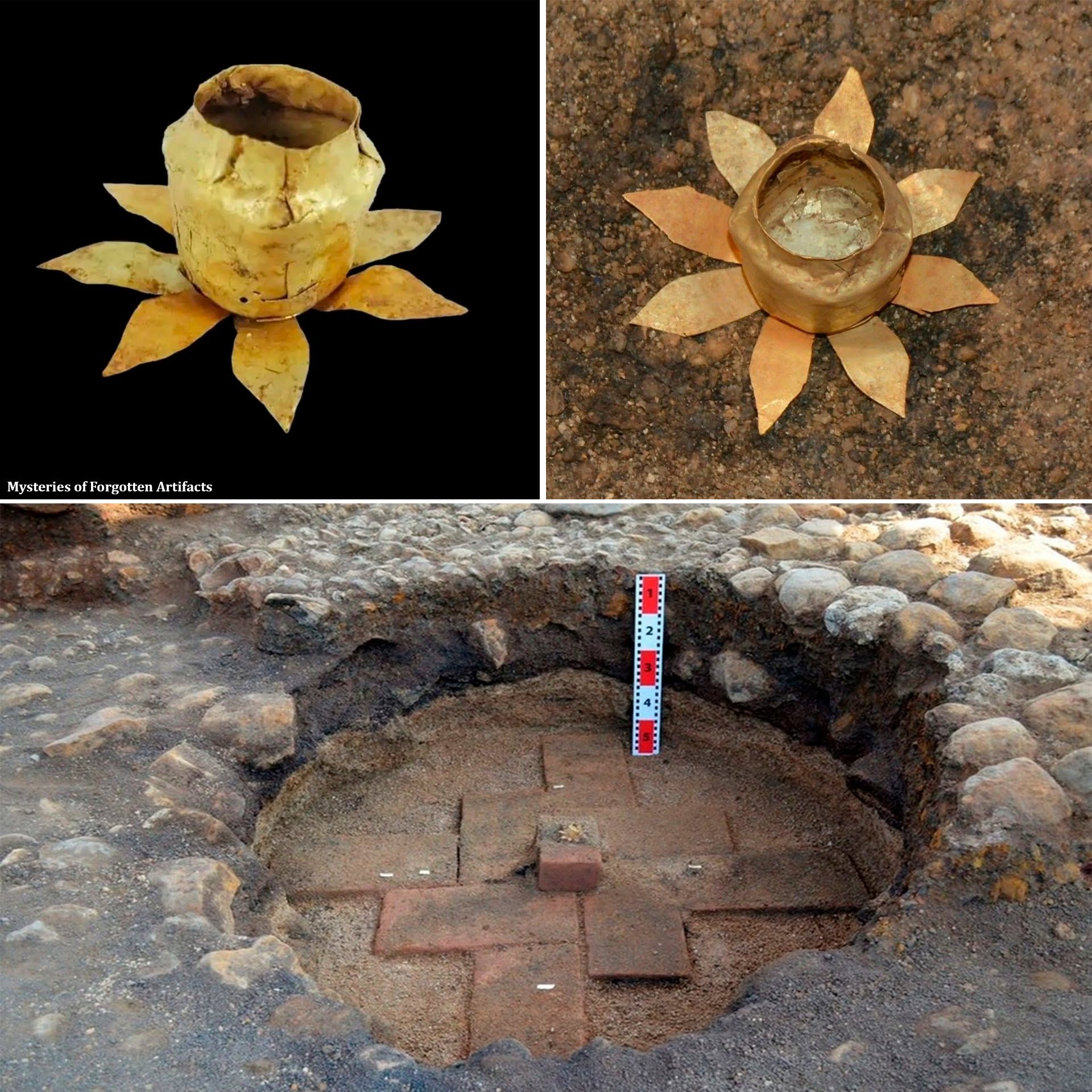
Beneath the remains of an ancient religious complex in Vietnam, archaeologists uncovered a discovery that had remained hidden for approximately 1,000 years. At the An Phu Cham archaeological site, researchers identified a sacred pit associated with a Buddhist temple dating to the 9th or 10th century, when the Champa Kingdom controlled large areas of central and southern Vietnam.
At the center of the pit lay an extraordinary group of ritual objects. Among them was a golden Kamandalu, a sacred water vessel traditionally associated with religious purity and ceremonial practice. The vessel rested upon an eight-petaled lotus made of gold and was accompanied by precious gemstones and delicate gold leaves bearing Buddhist inscriptions.
The objects were not discarded possessions or an ordinary cache of wealth. Their careful placement beneath the temple suggests that they formed part of a highly organized religious ceremony. Archaeologists believe the deposit may have been created during the construction or consecration of the sanctuary, when priests placed sacred materials beneath the building to purify the site and establish its spiritual foundation.
The discovery provides a rare glimpse into the religious world of ancient Champa, a civilization known for its distinctive temple architecture, maritime trade, sculpture, and complex combination of Hindu and Buddhist beliefs.
The Champa Kingdom existed for many centuries along the coast of present-day Vietnam. Its territories changed over time, but Cham communities were strongly connected to trade routes linking Southeast Asia with India, China, and the wider Indian Ocean world. These exchanges brought not only luxury goods but also religious ideas, artistic styles, languages, and ritual traditions.
Hinduism played a major role in Cham royal culture, particularly the worship of Shiva. However, Buddhism also flourished during several periods, especially under rulers and communities influenced by Mahayana traditions. Temples, statues, inscriptions, and ritual objects demonstrate that Buddhist worship formed an important part of Champa’s spiritual life.
The sacred pit at An Phu appears to belong to this Buddhist tradition.
Its most visually striking object is the golden Kamandalu. Similar vessels were used in religious ceremonies across South and Southeast Asia. They could hold purified or sacred water and were associated with monks, deities, and ritual specialists. Water from such a vessel might have been used to bless an altar, image, temple foundation, or participant in a ceremony.
The material of the vessel added another level of meaning. Gold was valued not only because it was rare and beautiful, but also because it resisted corrosion and symbolized purity, divine radiance, and permanence. By placing a golden ritual vessel beneath the temple, the builders may have intended to create an enduring spiritual center that would remain protected even if the visible structure above eventually disappeared.
Beneath the vessel was an eight-petaled golden lotus. The lotus is one of the most important symbols in Buddhism. It grows from muddy water yet opens into a clean and beautiful flower, representing spiritual awakening, purity, and liberation from suffering.
The number of petals may also have carried symbolic significance. The eight-petaled form can be connected with the Noble Eightfold Path, the Buddhist path of ethical conduct, mental discipline, and wisdom. It may also reflect sacred geometric arrangements used in ritual diagrams and temple planning.
The combination of the Kamandalu and lotus therefore appears carefully designed. A vessel associated with purity was placed upon a symbol of enlightenment, creating a powerful ritual image hidden beneath the temple floor.
The accompanying gemstones further strengthened the sacred character of the deposit. Precious stones were widely used in Buddhist and Hindu ritual settings. Their brilliance, rarity, and durability made them suitable offerings to divine beings and symbols of spiritual treasure.
In some traditions, groups of gemstones represented cosmic directions, protective powers, celestial bodies, or qualities of enlightenment. Without complete knowledge of their arrangement, archaeologists cannot determine exactly what each stone represented at An Phu. Nevertheless, their presence confirms that the pit was created with considerable wealth, planning, and religious importance.
Perhaps the most informative objects are the thin gold leaves inscribed with Buddhist scriptures or sacred formulas. Such leaves were often deposited in foundations, reliquaries, statues, or ritual chambers. Because gold survives well underground, it allowed sacred words to endure long after organic manuscripts had vanished.
The inscriptions may have functioned as prayers, protective texts, dedications, or invocations. They could have named Buddhist figures, recorded donations, or requested blessings for the temple and its community. Even when hidden from human sight, the written words were believed to retain spiritual power.
This helps explain why valuable objects were buried rather than displayed. Modern observers may wonder why anyone would conceal gold and gemstones beneath a building. But the deposit was not intended as treasure in the ordinary sense. It was an offering to the sacred realm.
Once sealed, the objects became part of the temple itself. Their purpose was fulfilled through concealment. They did not need to be seen by worshippers because their presence beneath the sanctuary continually supported its religious meaning.
Foundation deposits have been found in many ancient cultures. Temples, palaces, tombs, and city gates were sometimes built above offerings intended to protect the structure or dedicate it to a deity. These deposits could include figurines, food, tools, inscriptions, metals, or precious stones.
The An Phu discovery demonstrates how these wider traditions were adapted within the Champa Kingdom. Its combination of gold, scripture, gemstones, water symbolism, and the lotus reflects a sophisticated ritual system shaped by both local culture and international Buddhist traditions.
The find also reveals the extraordinary artistic skill of Cham craftspeople. Producing a golden vessel and carefully formed lotus required specialized knowledge of metalworking. Artisans had to shape thin sheets or cast pieces, control heat, create balanced forms, and possibly add engraved details.
The gold leaves demanded an equally delicate process. Gold had to be hammered into extremely thin sheets without tearing, then inscribed with small characters using precise tools. Such work indicates the presence of trained specialists serving religious and elite patrons.
Although the temple itself may have suffered from centuries of weathering, conflict, abandonment, and rebuilding, the hidden deposit remained protected. The pit acted like a sealed chamber, preserving evidence that might otherwise have disappeared.
For archaeologists, the original arrangement of the objects is as important as the objects themselves. Their position can reveal the sequence of the ceremony: whether the lotus was placed first, whether gemstones surrounded the vessel in a deliberate pattern, and whether the inscribed leaves were folded, stacked, or oriented toward particular directions.
Careful conservation is essential because ancient gold, though resistant to corrosion, can still be fragile when extremely thin. Gemstones and surrounding soil may also contain traces of organic material, pigments, resins, or textiles used during the ritual.
Scientific analysis could help determine the source of the gold and stones. If the materials came from distant regions, they may provide evidence of Champa’s trade networks. The inscriptions could also reveal which Buddhist school influenced the temple and whether the language used was Sanskrit, an ancient Cham form, or another liturgical tradition.
The sacred pit transforms An Phu from a ruined temple site into a deeply personal record of belief. Around 1,000 years ago, priests, artisans, patrons, and workers gathered there to create a sanctuary. They placed some of their most precious materials beneath it, spoke prayers that have been lost, and sealed the chamber.
They could not know how long the temple would stand. Yet they created something intended to survive beyond their own lives.
Today, the golden Kamandalu, lotus, gemstones, and inscribed leaves speak again. They reveal a Champa society in which religion, art, craftsmanship, and international exchange were closely connected.
The objects had remained invisible for centuries, but their message is clear: the builders of An Phu believed that a sacred place required more than walls and statues. Its true power began beneath the ground, where gold, words, and symbols were entrusted to the earth as an offering for eternity.