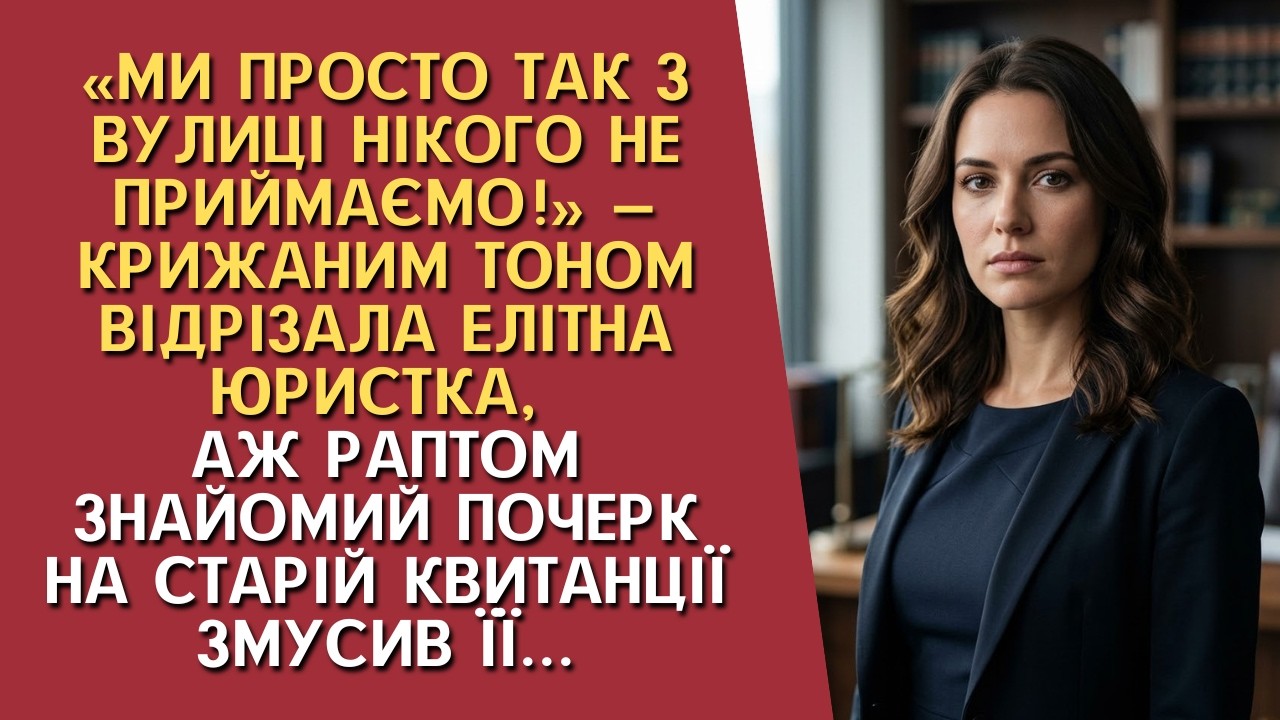
She was the coldest lawyer in Kyiv—a woman people swore had a proofread corporate contract in place of a heart. On a Wednesday afternoon, fresh from crushing opposing counsel in court, Lesia Melnyk walked into her firm’s lobby, and an old man in a worn gray coat lurched out from behind a marble column, nearly falling at her feet. “I just need to talk to a lawyer, just for a minute,” he pleaded, pressing a battered cardboard folder to his chest. His voice trembled.
“They’re evicting me. Throwing me out onto the street. Where will I go at my age? ”
The receptionist had already explained the rules—appointments only, paid consultations, corporate clients only.
Lesia glanced at her Swiss watch. “We don’t accept people off the street. Go to the free legal aid center. Or social services.
”
“I was already there,” he said desperately. “They said the case is very complicated. Time is running out. I got a notice from the developer.
”
He tried to open his folder, but his arthritic fingers only pulled the string into a knot. The folder slipped, hit the marble floor, and burst open. Papers scattered everywhere—faded copies, certificates with wet stamps, old receipts, yellowed pages, black-and-white photographs of a life already lived. The receptionist moved to gather them, but the desk phone rang.
Lesia, irritated, crouched down to help. Her fingers touched a utility receipt. Vadym Danylovych Boyko, Konovaltsia Street, building 8m, apartment 12. On the back, in pencil, carefully written: “Don’t forget to pay by the 15th.
” Old, uneven handwriting, but achingly neat. Letters clinging to each other like desperate passengers on a lurching tram. And suddenly, lines from a different sheet, written in the same careful hand, surfaced in her mind: “Lesyunyu, the borscht is in the fridge. Be sure to take your hat.
Don’t catch a cold. ”
Her chest tightened. “Give it here,” she said sharply, taking the folder. He stared at her.
“I said, give me your folder. ”
She straightened. He stood, gripping his lower back, looking at her with a mixture of fear and timid hope. “You’ll look at my case?
”
“Yes. But I’m promising you nothing. ” She turned to the receptionist. “Write down his contacts.
”
“Thank you,” he said quietly, but with incredible force. “I knew when I saw you. You’re a very good person. ”
The words hit her like a slap.
She hated sentiment. Hated it. She walked away without saying goodbye. For the rest of the day she was unbearable.
She spoke to the VIP client so coldly he flinched twice. She humiliated a junior lawyer until he went pale and nearly cried. And the cardboard folder sat on her desk, burning through the marble professionalism she had built her life around. Late that evening, when the office stood empty, she opened it.
The building on Konovaltsia was a classic Kyiv apartment house from the early twentieth century. Four-meter ceilings, wide windows, elegant stucco, an old linden tree in the courtyard. It had been declared dangerous a year earlier. Most apartments had been aggressively bought up by a developer called Kyivmiskbudlit, which planned to demolish the historical landmark and raise an apartment hotel in its place.
The pattern was familiar enough: a valuable plot in the center, a bought-out expert report, residents pressured to sell their square meters for pennies. But Vadym Danylovych wasn’t even an owner. He had lived there his whole life under a Soviet order and a social tenancy contract registered to his wife, who had died nine years before. He had never finished the privatization.
The developer claimed he had no right to live there and offered him a pitiful sum and a bed in a dormitory on the edge of the city. Lesia checked the registries, studied the inspection act, mapped the ownership chain. When she reached the final beneficiary, she understood everything. Ponomarenko.
A local oligarch. A dangerous man. “Don’t get involved,” she whispered to herself. She called Vadym Danylovych anyway.
“I’ll come by tomorrow before noon,” she said dryly, and hung up. The next morning she parked near the old building. It still stood, fragile but proud, the linden’s roots lifting the asphalt as if the structure and the tree had grown into one body refusing to die. He waited on the steps, smaller without his coat, an old intellectual in a knitted sweater who had wandered into a world he didn’t recognize.
His apartment was tiny and spotless. Books filled an entire wall. A burgundy blanket lay folded over the sofa. On the dresser, framed photographs: a much younger Vadym by the sea, a smiling girl of about ten beside him.
“Your daughter? ”
“Yes, Irynka. She lives in Toronto now. ” He said it quickly, apologetically.
“She wants me to come. But where would I go? I’m here… ”
He made tea and put out a plate of homemade pirozhki—slightly uneven, generously filled with egg and green onion.
Lesia, who had eaten nothing but espresso all day, reached for one without thinking. “My favorites,” she said quietly, almost closing her eyes. “My mother used to bake these. ”
She cut herself off.
From memory came a warm, teasing voice: “Where are you rushing, child? You’ll burn your tongue. ” Her mouth filled with bitterness. She swallowed hard.
“Very tasty. Thank you. ”
He looked at her with gentle understanding and said nothing. She pulled out her pen.
“Tell me exactly when they notified you about the resettlement. ”
He told her everything. She spent the next week building a defense. She sent bar inquiries, pulled archives, called experts she knew from previous battles.
The strategy took shape: challenge the fictitious inspection report, prove his continuous residence, secure his right to the apartment, and block any eviction until equivalent housing was provided. The case was not hopeless. She felt professional fire—and something underneath it she wasn’t prepared to name. On the eighth day, her boss summoned her.
Ihor Lvovych Levytsky, a distinguished man of sixty with a lion’s mane of gray hair, sat behind a desk the size of a runway. “Lesya, dear. What is this about the building on Konovaltsia? ”
“I’m handling it in my free time.
It doesn’t interfere with—”
“Ponomarenko called me,” Levytsky cut in. “He’s very unhappy. You need to stop. ”
“The case involves obvious violations—”
“Why do you need this?
” The softness vanished from his voice. “It’s not for money. One hour of your work costs more than that old man’s pension. ”
She said nothing.
She was afraid of what might escape her mouth. “We’ve known each other over ten years. You’ve never mixed work with emotions. Don’t disappoint me.
Promise me you’ll drop it. ”
She looked out the window at the city glittering with new towers built over old demolished ones. She didn’t promise. Back in her office, her phone vibrated.
Vadym Danylovych’s number. She declined the call—and her brother’s voice rose from the past, desperate, reckless:
“Lesya, she keeps asking when you’ll come. She’s really bad. ”
“Then call an ambulance.
I’m not a doctor. ”
“She doesn’t need a doctor. She asks about you. ”
“I can’t drop everything right now.
Don’t call me about these stupid things anymore. ”
That was the last time they spoke. Aunt Hanna died the next day. Her parents had died in a car crash when Lesia was four.
Young, engaged Hanna chose two orphaned children over her own future. She never married. She worked as a nurse, cleaned offices at night, never complained. And Lesia loved her—and resented her, because the anger she couldn’t aim at her dead parents she poured onto the only person who would take it.
She was ashamed of their poverty. Ashamed of her aunt’s worn coat at school meetings. She swore she would escape, become powerful, rich, untouchable. She got her wish.
She left and never came back. Her aunt died alone. Her brother, gentle Mykhailo, started drinking and drowned in the local lake three years later. Lesia was abroad.
She sent money instead of coming. When anyone asked about her family, she said she was an orphan. Now, years later, she drove four hours to the town she had forbidden herself to remember. She stopped outside the old house but could not force herself to go in.
She drove to the cemetery instead. She found the grave easily. Someone had tended it faithfully—fresh flowers, painted fence, no weeds. She knelt on the cold ground, pressed her hands to the granite, and finally, after all those years, the tears came.
She knew how to atone. Even criminals have that right. The next morning she packed her awards and personal belongings into a cardboard box. “What is this?
” Levytsky roared from the doorway. “A circus? ”
“Everything is written clearly. I’m resigning.
”
“You’re destroying your career over a senile old man? ”
“I’m grateful to you for everything,” she said, calm, with titanium in her voice. “But my decision is made. ”
“If you go against Ponomarenko, he will eat you alive.
”
She lifted the box, straightened her shoulders, and looked him in the eye. “We’ll see who chokes. ”
The legal fight became a war of attrition. Alone, without the machinery of the firm, Lesia was more dangerous than ever.
She filed motion after motion, froze all construction on the disputed site, and handed evidence to investigative journalists. Ponomarenko’s lawyers tried to bribe her. She showed them the door. They made mistakes.
The frozen project bled millions. She couldn’t save the historical building. The old linden fell under the excavators. But she won what truly mattered: Vadym Danylovych’s right to his home was confirmed, and the developer, desperate to break the deadlock, offered a serious settlement.
He received a bright one-bedroom apartment in a good neighborhood and enough money to start again. They walked through his new home together, the air smelling of fresh paint. “See? ” she said softly.
“Warm, bright. Supermarket, clinic, post office—all nearby. ”
“Yes, Lesyunyu,” he replied, smiling. “A wonderful apartment.
”
They both understood what he had lost. But they also understood this was the truest victory possible. And he was endlessly grateful to the woman who had become his closest friend. Six months later she opened a small practice of her own on Podil.
Two cramped rooms above a quiet courtyard, cheap furniture bought at a clearance sale. On the windowsill stood a violet in a ceramic pot—a housewarming gift from Vadym Danylovych. By the door hung a printed notice: free legal consultations for pensioners every Wednesday. One autumn morning he arrived and hesitated at the threshold.
“Lesyu, you have no secretary, no assistants. You carry everything alone. Let me answer the phones, sort the papers, make tea for your clients. ” When she opened her mouth to refuse, he hurried on, afraid she’d stop him.
“Don’t say no. You saved my life. Let me be useful to you in return. ”
She looked at this small old man in his knitted sweater.
And the ice that had held her heart closed for so many years finally cracked open. She stood, walked around the cheap desk, and put her arms around him. He couldn’t see that she was crying, but she was. He said nothing.
He only held her, carefully, fatherly, one hand gently patting her shaking back. They stood in the middle of the cramped office, listening to the autumn city breathing through the half-open window. Then she stepped back and said, with absolute sincerity: “Thank you, Vadym Danylovych. I would be very grateful for your help.
”
Outside, a new, different life was stirring. They had saved each other. And exactly who had saved whom first—that remained an open question.