The cafe owner barely lifted his eyes. “Listen, we’ve got enough of our own problems. We don’t need ex-cons here. Sorry for the bluntness, but you don’t seem to take a polite refusal.
”
Maria turned and walked down the corridor, the words burning long after she’d left the building. Thirty-two years old, and she’d become a ghost of the woman she once was—a German teacher with a pleasant apartment, a quiet life, and dreams of a family. Now she had nothing but a rented cot in a rundown dormitory and a parole certificate that made employers flinch like she was on fire. She’d tried to explain once.
Told a shop owner that she’d been framed by her own husband, that the conviction was a lie built on false testimony. He’d laughed in her face. After that, she stopped explaining. The worst part was how much of it was true.
Vadim had appeared at the school gates one day, handsome and confident, claiming he’d seen her and wanted to meet. She’d refused at first. Her colleagues insisted she was crazy—a young, generous man with a good salary was a gift from fate. He was a driver for an important man, he said.
Divorced, betrayed by his wife, dreaming only of a loyal family. He spoke about children the way other men spoke about cars. She believed every word. The year that followed was a slow, careful dismantling of her life.
He’d crashed his boss’s car and needed compensation—she gave him her savings. Then came the sudden illness, the urgent operation, the private clinic doctor who convinced her to take out a loan against her apartment. Then the pregnancy. Then the knock on the door.
Vadim’s ex-wife stood there with a cold smile. “Get rid of him before you lose everything. He doesn’t work. He’s never worked.
He drains women like you for money and moves on. ”
Maria lost the baby from the shock. Then came the letters from the bank—her husband had forged payment checks, blocked her bank number, pocketed everything. The apartment went to the bank.
Maria, half-mad with grief, smashed his car in broad daylight, screaming curses at the sky. Vadim and his new lover had connections. False testimony turned her broken act into attempted murder. She got the maximum sentence.
She was still thinking about all this when she stopped in the middle of an old bridge, staring down at the water. “Hey. You’re not thinking of jumping, are you? ”
A man in his forties, light-haired, looking at her with quiet concern.
“It’s in the past,” Maria muttered. “I have to live somehow. Though honestly, I don’t know how. ”
“I don’t usually get people wrong,” the man said slowly, studying her face.
“I think I can help you. My name’s Anton. ”
He told her he’d come to visit his mother. His sister had been caring for her, but the old woman was only getting worse.
He needed a reliable, honest caregiver. He couldn’t pay much, but he offered decent wages and a private room in a large house. “The truth is,” he admitted, “I just want a good person in that house. Someone I can trust around my mother.
”
Maria hesitated. She had no medical training. But she had nowhere else to go. —
Irina Stepanivna turned out to be a gentle, intelligent old woman—a former schoolteacher who’d once taught the same German that Maria had taught.
She had memory lapses and slept most of the day. But Svetlana, Anton’s sister, was another matter entirely. From the first day, Svetlana eyed Maria like a threat. She and her husband Vasyl, who also lived in the sprawling house, constantly whispered to each other.
They accused Maria of stealing money, of misdosing medication, of everything and nothing. “If my mother dies,” Svetlana hissed once, “you’ll go straight back to prison. ”
Anton spent a week at the house, and while he was there, things stayed mostly calm. When he left, the atmosphere turned toxic.
Maria couldn’t breathe without being watched. She called Anton and told him she was leaving. He offered her a raise, pleaded with her to stay. She refused.
She’d almost accepted that she’d leave without a proper goodbye to Irina Stepanivna. But the old woman found a way. “Dear, my former student sent me a letter from Germany,” Irina said one afternoon, her voice thin and weak. Svetlana hovered nearby, as always.
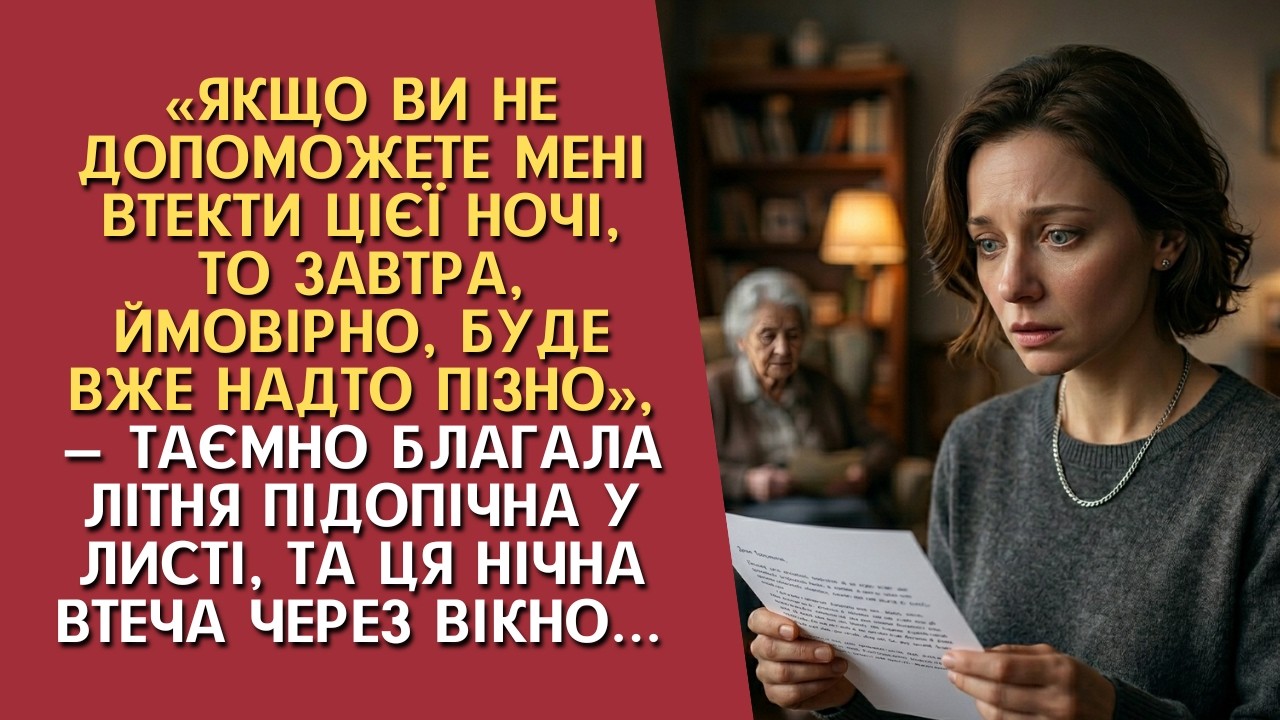
“My eyes are no good anymore. Would you read it to me? ”
Maria took the sheet of paper. The moment she read the first lines in German, she understood: the letter was addressed to her.
*Please don’t show any sign that this isn’t a letter from my student. I had to use this trick because my daughter and her husband don’t understand a word of German, but you do. They plan to send you away tomorrow morning. They’ve already hired a replacement.
If you don’t help me escape tonight, it will be too late. But there’s more. I heard them talking. Vasyl intends to kill me and make it look like an accident—or blame you.
I have heard my own daughter arguing against it, but I am not sure she will win. Meet me in my room at two in the morning. We’ll go out through the window. If you agree, say at the end that you also love Dresden.
*
Maria’s blood went cold, but she kept her face calm. “What a wonderful, warm letter,” she said steadily. “I also love Dresden very much. ”
Svetlana stormed over.
“I asked for all of Mother’s mail to be given to me personally. Where did you get a key to the mailbox? ”
“I gave her the letter,” Irina said innocently, and Svetlana backed off. The rest of the day stretched into an eternity.
Maria didn’t know what to believe. The old woman was frail and forgetful—maybe she’d imagined the whole thing. But something in that polite German letter had sounded completely clear. And if she was wrong, what did it cost her?
At two in the morning, she pushed open the door to Irina’s room. The old woman was fully dressed and waiting, her eyes sharp, any sign of frailty gone. “But I don’t even know where to hide you,” Maria whispered. “I have no money, no home.
”
“I have money,” Irina said firmly. “And my health is fine. I’ve only been pretending to take their pills. ” She moved toward the window.
“I’ve already called a taxi. Just help me get out. ”
They slipped through the window into the grass, crossed the yard, found the waiting car. Irina gave the driver an address outside the city.
In the back seat, she explained: they were going to her oldest friend, the one person who wouldn’t ask questions. The house was a large estate, dark against the night sky. Maria’s doubts crept back—was she following a confused old woman on some delusion? But the intercom answered almost immediately, a warm female voice, and within twenty minutes they were sitting by a lit fireplace, drinking tea with homemade cookies and a kind, elegant woman named Olga Mykytivna.
“Why didn’t you call me earlier? ” Olga scolded. “Running away in the middle of the night—that was so risky. ”
“You never leave your estate anyway,” Irina said with a faint smile.
“My husband died,” Olga explained to Maria softly. “I haven’t been the same since. ”
Maria felt the relief wash over her. “We should call Anton right away,” she said.
“He needs to know what’s happening. ”
“In good time,” Irina said calmly. “There are still a few things I need to find out. ”
—
It took two weeks for the full truth to emerge.
Before her escape, Irina had hidden cameras throughout the house with the help of a trusted neighbor. The recordings showed everything. Vasyl, Svetlana’s husband, was planning to kill her. He’d been steadily isolating her, undermining her health, and his plan was to finish the job and frame either Irina’s son or the hired caregiver.
Svetlana had been complicit only so far as wanting to have her mother declared legally incompetent to control the property. She had argued against murder. “I won’t pretend it’s easy,” Irina said, crying openly. “But at least my daughter is not a killer.
I raised Svetlana with all my heart—she’s adopted, and she always felt like she was missing something. I loved them both equally, Anton and her. But her fate has been hard. ”
Days passed.
Maria helped around Olga’s estate, feeling more at peace than she had in years. But she couldn’t stay forever. “I’m so grateful to all of you,” she said one evening, struggling with the words. “But I think it’s time for me to go.
I’ve been living in someone else’s fairy tale. ”
“Where would you go? ” Olga Mykytivna looked at her thoughtfully. “Back to that terrible dormitory?
To look for another job that will never come? ” She paused. “Why don’t you stay here? I need a good person in this house.
It’s too big for one woman alone. I’ll pay you well, I promise not to overwork you. And Irina and Anton will visit often—we’re practically family now. ”
Maria felt tears burning behind her eyes.
She accepted. —
Anton did visit. He found endless small excuses—delivering gifts, fixing a loose railing, checking on the water heater. He was patient, kind, always there.
After six months, he stopped inventing reasons. “The truth is,” he told Maria one evening, his voice unsteady, “I noticed you that first day on the bridge. I thought something was telling me to stop and talk to you. When I found out my mother needed a caregiver, I knew it was my chance to see you again.
”
Maria couldn’t look at him. “I’m a broken woman,” she whispered. “I might not even be able to have children after everything. Why would you want all my troubles?
”
“Let’s just try,” he said gently. “One date. Nothing more. ”
One date became many.
Anton never pushed, never rushed her. He was patient with every scar, every moment she pulled back. By the end of the year, they were married. And a year after that, their daughter Olenka was born—a lively, bright-eyed little girl the exact image of Irina Stepanivna.
The old woman, holding her granddaughter in her arms, looked ten years younger. All her ailments seemed to melt away. “Well, now I simply must live a long time,” she said, smiling through her tears. “I need to wait until Olenka has a little brother or sister.
”
As it turned out, they didn’t have to wait long.