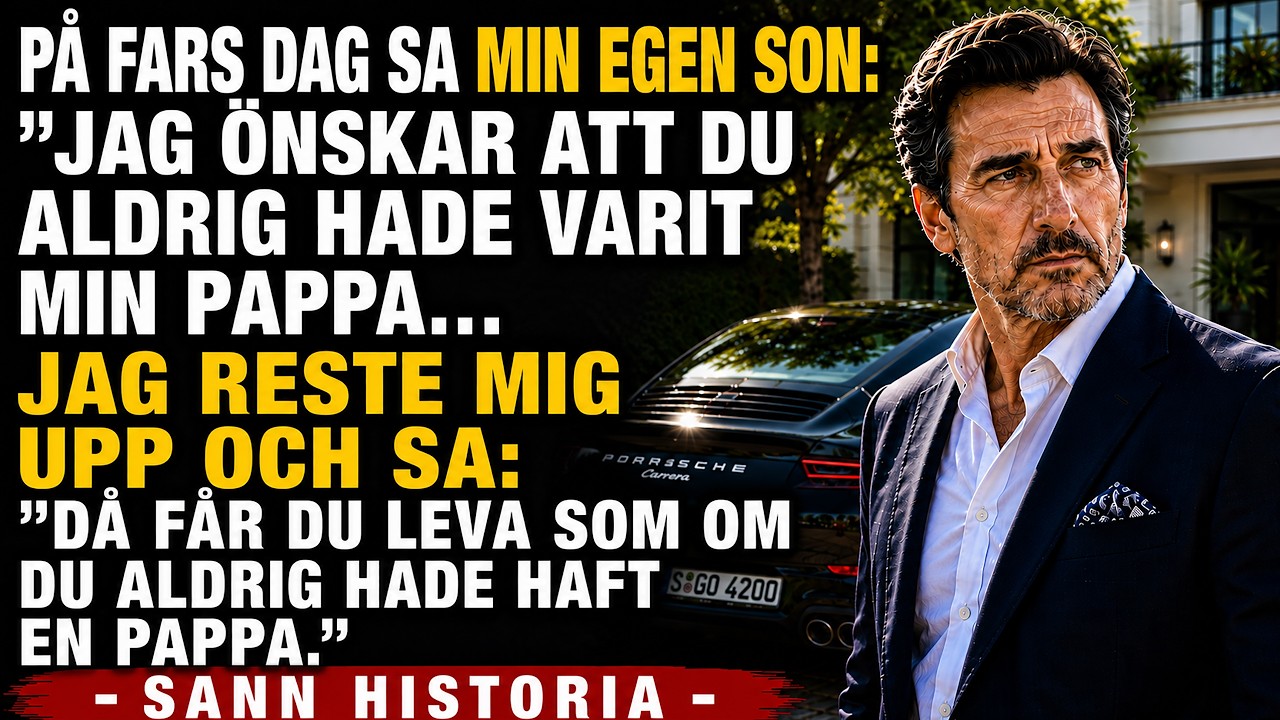
On Father’s Day, my son stood in front of forty people, raised a crystal glass, and smiled as if he were about to honor me. Then he said, “I wish you had never been my father. ”
The laughter died so fast I could hear small birds in the lilac hedge. My granddaughter Elsa froze with a paper plate in her hands.
My youngest grandson Leo slowly lowered the little Swedish flag he had been waving. Even the grill seemed to go quiet. I looked straight into my son’s eyes. He was waiting for anger.
Maybe shouting. Maybe tears. He had already decided I was the villain in the story he had repeated to himself. Instead, I stood up, smoothed the crease in my navy polo shirt, and said calmly, “Then you’ll have to live as if you never had a father.
”
I set my untouched glass on the table, walked past every frozen guest, took the keys to the black Porsche 911 in the driveway, and drove away. Ten minutes later, stopped at a red light, my phone vibrated. “Lars, bring back my car or I’ll call the police. ”
I laughed.
Not because it was funny, but because my son, after everything I had sacrificed, still believed the Porsche belonged to him. It didn’t. It never had. My name is Lars Holmgren.
I’m 63, a widower, a retired businessman. Until that Father’s Day, I would have told anyone that my greatest achievement wasn’t building a successful company. It was raising my son. It turned out I was wrong about at least one of those things.
I kept driving. The low November sun reflected off the hood as I headed north, leaving behind a celebration I had paid for myself. I had booked the catering, ordered the decorations, planned the custom cake. Strange how quickly a celebration can become a funeral.
Not for a person. For a relationship. I pulled into a lookout point at Edsviken and turned off the engine. For the first time all afternoon, the silence felt honest.
I remembered the rented apartment where Viktor and I had lived with his mother when we were newlyweds. No money back then. Just determination. I worked construction during the day.
Evenings I repaired heat pumps in a borrowed garage. Weekends belonged to customers who couldn’t afford emergency fees. There were years I saw four hours of sleep a night. My wife Ingrid used to tease me.
“One day you’ll own the biggest ventilation company in Mälardalen. ”
“I’ll settle for paying off the service van,” I said. Somehow we managed both. Over the next 35 years, Holmgren Klimateknik AB grew from a single service van into a respected regional company with over 80 employees.
Not a billion-dollar business. Something better. A company people trusted. A company where technicians stayed for 20 years because I remembered their children’s birthdays.
Viktor grew up in that world. And because Ingrid and I remembered what it felt like to struggle, we promised each other he never would. Football camps. Music lessons.
A safe used car when he turned 18. University without debt. When he wanted to start a marketing firm, I quietly guaranteed the bank loan. When the business struggled, I paid off the debt without telling anyone.
When he proposed to Sofia, I paid for most of the wedding. I never kept score. Parents shouldn’t. At least that’s what I believed.
After Ingrid died from pancreatic cancer eight years ago, helping Viktor became my way of staying close to her. She had always believed family came first. Sometimes I wonder if I misunderstood what she meant. Family comes before pride, not before responsibility.
Looking back now, I can see the moments I ignored. When Viktor introduced friends to my summer cottage, he called it “our family place. ” Then “my place. ” When someone admired the Porsche, he’d smile and say, “I’ve always loved German engineering.
” He never claimed he’d bought it. He just never corrected anyone. I heard it once at the golf club. “Must be lovely driving that Porsche, Viktor.
”
“It is. ”
I stood three meters away. He never looked at me. I should have said something then.
Instead, I convinced myself it wasn’t worth embarrassing my son. It became a dangerous habit, excusing things because confronting them seemed harder. The Porsche had a simple history. I bought it two years after retiring.
A retirement gift to myself. Ingrid had always laughed when a Porsche drove by. “If we ever do really well, do you deserve one of those? ” she used to tease.
She never got to see me buy it. When I signed the paperwork, I cried in the dealership parking lot. Not because of the car, but because she wasn’t sitting beside me. A few months later, Viktor asked to borrow it for a charity event.
Of course, I said. Then another event. Then weekends. Eventually it became easier to let it stay at his house since he asked so often.
The registration, insurance, purchase agreement, everything remained in my name. There was never any discussion about changing ownership because I had never intended to. Apparently Viktor had rewritten that story in his own head. Or maybe Sofia helped him.
She had a talent for making temporary arrangements sound permanent. “One day it’ll all be yours anyway,” she used to tell him when she thought I wasn’t listening. The phone vibrated again. “I’m reporting the car stolen.
”
I placed the phone face down on the passenger seat. If my son really believed he could report my own car as stolen, he was about to learn that reality doesn’t bend to self-absorption. Minutes later, the phone rang. Police, Region Stockholm.
“Herr Holmgren, we’ve received a report of a stolen black Porsche 911. The reporting party says the car was taken this afternoon. ”
“May I ask who filed the report? ”
“Your son, Viktor Holmgren.
”
“Do you have the vehicle in your possession? ”
“I do. ”
“Can you prove ownership? ”
“I have the original registration, insurance, purchase agreement, and every service receipt since I bought it.
”
“You bought it? ”
“Yes. ”
“I apologize. The reporting party stated the vehicle belongs to him.
”
“It doesn’t. ”
“Could you email us copies of the documents? ”
“I’ll send them in five minutes. ”
Before he hung up, he added something that stayed with me.
“I’ve handled many family disputes. They’re rarely actually about the car. ”
“No,” I said. “They almost never are.
”
Twenty minutes later, I sat in a café in Täby, forwarding every document. The registration showed one owner. Lars Thomas Holmgren. No co-owner, no loan.
Just me. I stared at the document longer than I should have. A simple piece of paper. Strange how much truth fits on one page.
My phone vibrated. Viktor. Then a voicemail. “Dad, this isn’t funny.
Bring back the Porsche before you make everything worse. ”
Make everything worse. I almost smiled. He still thought I was the unreasonable one.
Fifteen minutes later, my lawyer Karin Sjöberg called. I had known her for nearly thirty years. “You sound tired,” she said. “I had an interesting Father’s Day.
”
“I heard. The police contacted me to verify the ownership documents. ” She paused. “Lars, I think we’ve reached the point where it no longer helps anyone to ignore the problems.
”
“I know. I’ve been waiting for this call. ”
“You’ve been telling me for years not to say anything every time Viktor crossed another boundary. ”
She was right.
There had been many boundaries. I had just kept erasing them. The first time should have been enough. Five years earlier, Viktor had brought me to a charity dinner.
A property developer admired the Porsche parked outside. “Beautiful car. ”
Viktor smiled proudly. “Thanks.
”
Just one word. Not “it’s my father’s car. ” Just thanks. Later that evening I said, “You forgot to say whose car it was.
”
“Dad, does it really matter? ”
“It’s not about the car. ”
“Exactly. ”
He hugged me and left.
And because I wanted peace, I let it go. Then came the summer cottage. One afternoon I arrived unexpectedly and heard Viktor talking to another couple. “You should see this place at Christmas.
It’s basically our second home. ”
Sofia added, “We’re thinking of renovating the kitchen once everything becomes official. ”
Official. The biggest warning came nearly two years earlier.
At the company’s 40th anniversary, a senior technician congratulated Viktor. “It must feel good knowing you’ll take over one day. ”
Viktor nodded. “I’m looking forward to putting my own stamp on the company.
”
I saw long-time employees exchange glances. I had never promised him the company. He had assumed it was automatic. That realization settled in my chest like a stone.
Still, I said nothing. Karin interrupted my thoughts. “Lars, I’m still here. You went quiet.
”
“I was remembering all the times I should have said something. ”
“You can’t change them. ”
“No, but I can stop creating new ones. ”
That evening I unlocked the fireproof safe and placed the thick folder labeled Estate Planning on my desk.
Ingrid and I had written it together, imagining we’d grow old surrounded by grateful grandchildren. Everything went to Viktor. The company. The summer cottage.
Investment accounts. Generous terms. Because I had believed generosity would strengthen family bonds. Instead, it may have weakened something more important.
Responsibility. The next morning I sat in Karin’s office. “Before we talk about changes, I need to ask you something,” she said. “Are you doing this because you’re angry?
”
I shook my head. “If I were angry, I’d cut him out of everything. ”
“Are you planning to? ”
“No.
”
“Then why are we here? ”
“I think I’ve confused love with enabling. Every time I rescued him financially, every time I overlooked his arrogance, every time I stayed silent instead of correcting him, I called it love. Maybe it wasn’t.
”
“What do you think it was? ”
“Fear that if I stopped solving his problems, he would stop loving me. ”
The words surprised even me. I had never said them out loud.
We spent three hours going through the estate plan. The company would transfer to an employee ownership foundation. The technicians and installers who built it deserved security. The summer cottage would be donated to an organization offering recovery programs for veterans and first responders, something Ingrid had always dreamed of.
The investment accounts would fund scholarships for students entering practical trades. When we finished, Karin asked, “If Viktor genuinely changes in a few years, can these documents be amended? ”
“Absolutely. ”
“So this isn’t revenge.
”
“It’s responsibility. ”
That afternoon I turned into my driveway to find Sofia’s white Volvo already there. Viktor stormed out of the house before I reached the porch. “You humiliated me in front of the police.
”
“I wasn’t the one who called them. ”
He stepped closer. “Just sign over the car. ”
“I never said it was yours.
”
“You let me think… ”
“I let you borrow it. You assumed. ”
Sofia appeared behind him, arms crossed.
“This is childish. ”
“Reporting someone for stealing their own car is childish,” I said. I walked past them into the study and laid the folder on the table. Purchase agreement.
Registration. Insurance. Every document bore one name. Mine.
Viktor stared at them. “So you’ve been lying to me? ”
“I never said it was yours. You just stopped telling the truth.
”
The room went quiet. Sofia broke it. “So what happens now? ”
“I lock the safe.
” I looked at them both. “I think we’re done discussing the Porsche. ”
Viktor’s voice was strained. “You can’t end our relationship over a car.
”
“This stopped being about the car the moment you stood in front of your children and wished I had never been your father. ”
For the first time since Father’s Day, he had no answer. Over the next few days, the truth spread on its own. One of the police officers knew one of our customers.
The customer mentioned the misunderstanding to another businessman. Soon people understood Viktor had reported his own father for stealing a vehicle that legally belonged to the father. Nobody mocked him. They just stopped believing the image he had built for years.
Late Saturday, Sofia came to my house alone. No designer clothes. No makeup. “I didn’t know the car wasn’t his,” she said.
“I really believed you had given it to him. ”
“I never said that. ”
“No. ” She looked down.
“I encouraged him. I kept saying everything would belong to us. I thought I was motivating him. Maybe I was just feeding his ego.
”
Neither of us spoke for a while. Then she whispered, “He hasn’t slept since Father’s Day. ”
“Neither have I. ”
The next afternoon, Viktor stood at my door alone.
No Sofia. No anger. He looked much older than 38, wearing wrinkled clothes, no expensive watch. “Can I come in?
”
I stepped aside. “You don’t need to ask permission to enter your father’s house. ”
I led him to the kitchen and poured two mugs of coffee. He smiled faintly.
“You still remember how I take it. ”
“Two sugars. ”
We sat in silence. Not angry silence.
The kind that comes when two people finally understand they can’t hide anymore. Then he said, “I’m sorry. ”
The words were barely a whisper. “Which part?
” I asked. “What do you mean? ”
“I’ve heard people say sorry because they got caught. I’ve also heard people say it because they finally understand what they did.
Which kind is this? ”
He ran his hands over his face. “Honestly? I don’t know.
”
That was the first honest thing he had said in a long time. “I’ve been angry at you for years,” he admitted. “I blamed everything on you. ”
“For what?
”
“Because you always succeeded. People compared me to you. Your dad built an amazing company. Your dad is respected.
I got tired of hearing it. ”
“So you decided to become me. ”
He looked down. “I pretended to be you.
Maybe after mom died. Everything changed after that. ”
Losing Ingrid had hollowed out both of us. The difference was that I buried myself in gratitude.
Viktor buried himself in bitterness. “I kept thinking,” he said, “that if people believed I already had everything, they’d stop asking why I hadn’t built anything myself. ”
Those words hit me harder than anything he had said on Father’s Day. Not because they excused him, but because they explained him.
“I wanted them to think I was successful. I was pretending. ” He shook his head. “Every year it got easier.
The summer cottage. The Porsche. The company. I never actually owned any of it.
”
“No,” I said. “You just stopped telling the truth. ”
I went into the study and came back with a small wooden box. Inside were thirty years of memories.
Drawings from preschool. Football trophies. Family photos. Near the bottom lay a folded piece of paper with faded edges.
“My dad is my hero. ” Crayon letters. I handed it to him. He unfolded it carefully.
His hands began to shake. “I remember this. You spelled hero wrong. ”
He laughed through tears.
“You never corrected me. ”
“I knew what you meant. ”
He stared at the card for almost a minute. “I don’t know where that little boy went.
”
“I don’t think he disappeared. I think he got buried. ”
Viktor wiped his eyes. “Sofia has left me.
She said she married a man who wanted to inherit a life instead of building one. ”
“Was she wrong? ”
He closed his eyes. “No.
”
For almost two hours, we talked. Really talked. He admitted his firm wasn’t doing well. He had borrowed money to maintain the facade.
Luxury vacations. Golf fees. Private school fees. Every image he tried to project had become another bill he couldn’t afford.
“I thought when I inherited everything, I’d finally catch up. ”
“That’s the trap, my son. Living tomorrow on money you haven’t earned today. ”
He nodded.
“Did you really change your will? ”
“I did. ”
“I deserved that. ”
“I didn’t do it to punish you.
I did it because inheritance should never replace character. ”
“Can it ever be changed back? ”
“Yes. When trust changes.
”
“That’s fair. ”
“It’s necessary. ”
Before he left, he stopped in the doorway. “I don’t expect the Porsche.
”
“You won’t get it. ”
He actually laughed. “I don’t expect the company either. ”
“You can have a place there.
As an employee, not an heir. If you earn everyone’s respect, the future will take care of itself. ”
He took a slow breath. “For the first time in my life, I have to actually build something.
”
“Your mother would have liked hearing that. ”
He walked down the driveway without looking back. Not because he was angry. Because he was thinking.
During the months that followed, I heard very little from him. No demands. No arguments. Just a different kind of silence.
The silence of someone doing hard work where nobody else can see. Viktor took a management position at a regional building supply company in Uppsala. The salary wasn’t glamorous. For the first time since university, he was hired not because of my name.
He got the job after three interviews and a practical test. When he told me over the phone, I heard something in his voice I hadn’t heard since he was a teenager. Pride. Real pride.
Not borrowed. Earned. One afternoon, Sofia asked if we could have lunch. “I’ve spent a year blaming Viktor,” she said.
“But I wasn’t innocent. I kept pushing him to compete with people who didn’t even know we existed. ”
“We all made mistakes. ”
“Do you think people can really change?
”
“I think people change when it becomes more painful to pretend than to tell the truth. ”
Months later, she and Viktor started couples therapy. They didn’t magically fix everything. But they stopped pretending there was nothing to fix.
About ten months after Father’s Day, my oldest grandchild Noah, thirteen, climbed onto the porch swing next to me. “Grandpa. ”
“Yes, buddy? ”
“Dad is different.
He doesn’t yell anymore. He even sold his fancy watch. ”
“I heard that. ”
He looked at me.
“He says we’re not joining the golf club again. ”
“How does that feel? ”
He shrugged. “I like fishing better.
”
I smiled. “So did your grandmother. ”
Then Father’s Day came again. No catering.
No expensive decorations. Just hamburgers on the grill, potato salad, lingonberry soda, grandchildren running through the garden. The kind of day Ingrid loved most. Around lunchtime, an old blue Volvo pickup turned into the driveway.
Viktor got out wearing worn jeans and work boots. “You traded in the luxury car? ”
“I did. Paid cash for it.
” He smiled. “First vehicle I’ve ever owned without anyone’s help. ”
I squeezed his shoulder. “I’m proud of you.
”
He looked away. “I’ve wanted to hear that my whole life. ”
“You could always have heard it. ”
“I know.
I just thought I needed to impress you first. ”
“You never did. ”
After lunch, Viktor handed me a small package. Inside was a simple wooden frame.
The photograph showed Ingrid, Viktor, and me standing next to our very first service van, nearly 35 years earlier. I had forgotten the picture even existed. On the back, in careful handwriting: “Dad, for years I confused inheriting with earning. I thought an inheritance would make me successful.
You taught me that character comes first. Thank you for loving me enough to stop rescuing me. Happy Father’s Day. With love, Viktor.
”
I read it twice before I could speak. Then I hugged my son. Not because everything had been forgotten. It hadn’t.
Not because trust had fully returned. That takes time. I hugged him because for the first time in years, I wasn’t holding the man he pretended to be. I was holding the man he was becoming.
Later, Viktor flipped burgers beside me while the grandchildren laughed in the yard. He looked toward the garage. “The Porsche still runs. ”
“Like a dream.
”
“Good. ” He grinned. “I’m going to wait until I can buy one myself. ”
I laughed so hard I had to wipe tears from my eyes.
There he was. My son. When people ask what the worst thing Viktor did was, they assume it was reporting my Porsche as stolen. It wasn’t.
The worst thing was that he believed someone else’s success could become his own just by standing close enough to it. The best thing that happened wasn’t that I changed the estate plan or kept the Porsche. It was watching my son discover that dignity can’t be inherited.
It has to be earned.