My daughter thought the reflection in the dark microwave door was only a blurry shadow. She thought sixty years of Swedish winters, quiet habits, and a widower’s silence had made my eyes dull and my mind weak. She was wrong. From the outside, I was just Erik Lundgren, retired professor of organic chemistry.
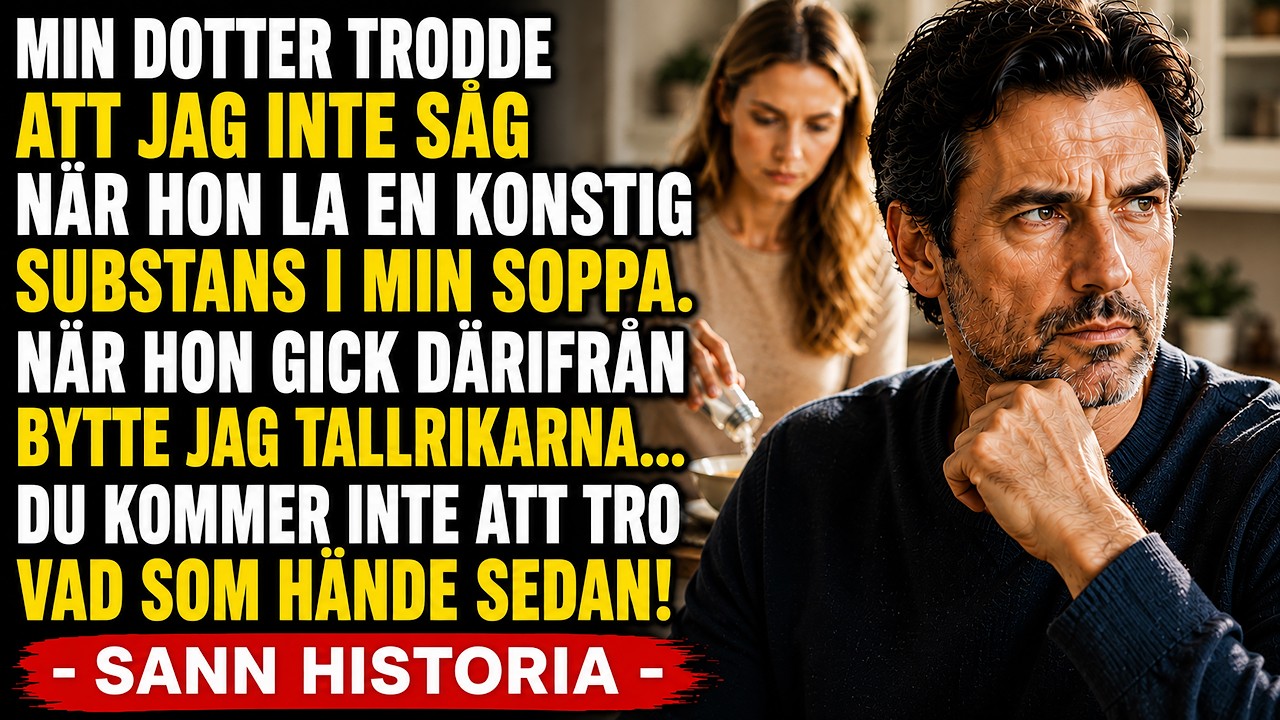
A little slower with the years. A little lonely since Ingrid died. But my head was as clear as the glassware I once handled at KTH. I saw the small blue bottle trembling in her hand.
I saw the clear liquid fall into my pumpkin soup—the kind with cream, nutmeg, and a pinch of Västerbotten cheese that she knew I loved. When she turned her back to fetch a spoon, I did what a father could do. A father who had just paid off his daughter’s debts without receiving even a real thank-you. I swapped the bowls.
It took three seconds. When she turned back, I was sitting exactly where she had left me. My hands were folded. My face was stone.
Then Markus came in. My son-in-law. He reeked of cheap cologne, sweat, and desperation. “Smells incredible, Sofia,” he said, too loud, too cheerful.
He clapped me on the shoulder. “Ready for some hot soup, Erik? ”
I looked at his upper lip. The house was twenty degrees.
Why was he sweating? Sofia carried the bowls. She put the clean one in front of me. She put the poisoned one in front of her own place.
“Sit down, Pappa. Eat while it’s warm. ”
I lifted my spoon. I saw them both tense.
I dipped it into the soup, blew on it, and took a slow sip. “Excellent,” I said. Markus exhaled. Sofia smiled like a cramp.
“What a relief you like it, Pappa. ”
She raised her own spoon. I watched her. The woman I taught to ride a bicycle.
The girl I taught the periodic table. Chemistry doesn’t care about apologies, I used to tell her. Cause and effect. Reagent and reaction.
She had just introduced a foreign substance into her own system. “Sofia,” I said softly. “You’ll need your strength. ”
We ate in silence.
Every spoonful of that soup was meant to be my last. It tasted like nutmeg, cream, and survival. Markus ate fast, glancing between me and his watch. Then he started the conversation I had been waiting for.
“You know, Erik, this house is a lot for you. The snow, the roof, the heat pump, the bills. ”
“We’re just worried,” Sofia said. “We’ve looked at a special residence outside Stockholm.
A nice place. Calm. Safe. ”
Safe.
The word hung in the air, heavy with irony. Then Sofia frowned. She dropped her spoon. She grabbed her throat.
“What is it? ” Markus asked. “I don’t know. It tastes bitter.
”
“Probably the sage,” I said calmly, taking another spoonful. “Mine tastes excellent. ”
She coughed at first, then deeper. Color left her face.
I recognized it immediately. Digitalis. Foxglove. Beautiful in a garden, deadly in the wrong dose.
Nausea, visual disturbances, arrhythmia. A heart attack in a bottle. A perfect weapon against an old man with high blood pressure. But Sofia was not me.
“My vision,” she stammered. “The lamps—there are rings around them. ”
She vomited onto the floor. Then she convulsed and slid off the chair.
“Call an ambulance if you don’t want her to die on the kitchen floor,” I told Markus. Sofia lay gasping, her eyes rolling back. Then, for one moment, her gaze found me. She looked at her empty bowl, then at mine.
She understood. “Pappa,” she hissed. “Don’t try to speak, darling,” I said, kneeling beside her without touching her. “Save your strength.
You’ll need it when you explain this to the police. ”
When she fell, a tissue had slipped from her pocket. Inside was the empty blue bottle. She hadn’t even had time to throw it away.
Amateur. I picked it up and put it in my own pocket. Exhibit A. The ambulance came.
They loaded Sofia onto a stretcher. Markus cried. Maybe for real. Maybe for himself.
“She’ll make it, right? She has to make it. ”
“It depends on the dose,” I said. At the hospital, the doctor identified digitalis poisoning.
Markus spun around and pointed at me. “It was him! The old man. He grows foxglove at home.
He dries herbs. He must have mixed up the jars. ”
I let my shoulders slump. I let my hands shake.
“I don’t know. I have plants. I dry herbs. Maybe I took the wrong jar.
” I looked down. “I thought it was parsley. The jars look alike. My eyes.
Oh God. Did I hurt Sofia? ”
The police softened. They saw a tragedy, not a crime.
Markus almost smiled. But I saw him at the vending machines, pale and sweating. He answered his phone in a whisper. “I know.
It’s a complication. No, not me. The asset. The asset.
Five million. I swear it will come. Seven days. Seven days or a finger.
”
Five million kronor. That was the price of my life. I followed him into Sofia’s hospital room. “You look like hell,” Sofia rasped.
Markus whispered, “Plan A is dead. Plan B: we force it. Not just a care home. Legal guardianship.
Total control. We don’t need him dead. We need the court to declare him incompetent. ”
“But the doctor said he seemed alert.
”
“The doctor doesn’t know him. We’ll be the worried family. We’ll get him into a locked unit. Then we control the property.
”
I stood in the doorway, listening. They thought they were playing chess. They were still playing Sorry! At home, they tried to break me.
They turned the heat up until the house was a sauna, then gave me my winter coat. “Pappa, when your body is freezing, it can think it’s warm. Put it on. ” I wore it and sweated.
They hid my glasses in the refrigerator and said I had done it myself. They invented a cat we never had and said I let it out last winter. They had removed the lock from my bedroom door weeks earlier for my own safety. That night, Markus went to the wall cabinet behind the painting.
He pounded codes. I had prepared. An invisible powder, harmless, reacted with skin oils and glowed red under ultraviolet light. He left his guilt all over the cabinet.
I filmed him prying at it with a fireplace poker. Sofia came in. “We should have used twice as much,” she said. “We should have doubled the dose.
The old man would have died after the soup. We should be planning a funeral now, not standing in front of a safe. ”
Markus said, “If Nyström doesn’t sign, we’ll suffocate him with a pillow and say his heart gave up. ”
I stopped filming.
The last thread between me and my daughter burned away. At nine the next morning, Doctor Nyström arrived. He looked like a man who had sold his soul on an installment plan. He asked me the year, the prime minister’s name.
I gave some correct answers, some shaky ones. Then he said: “You poisoned your daughter. Did you know what you were doing? ”
“I thought it was parsley.
”
“Parsley doesn’t come in a blue bottle, Erik. ”
He wrote “serious cognitive impairment and imminent danger. ” A social worker came. Compulsory psychiatric transport was booked for the next morning.
Because of the snow. Until then, I was to remain in the home under family supervision. Markus locked me in the bedroom and drilled a lock onto the door. I waited.
Then I attacked the door frame, not the lock. Wood gives differently than steel. The door opened with a wet crack. In the living room, they were celebrating with my wine.
On the table lay the pink document, their key to my cage. I lifted it carefully. Nyström’s signature was already fading—the pen I had given him during the test held disappearing ink. By the time they showed this to a court, it would be blank.
I put it back exactly where it had been and left through the sliding glass door. The cold hit me like a wall. I walked through the snow for forty minutes to a gas station. My feet went numb.
Every step was a signature. I chose this. I was in my right mind. I called the driver Lennart used.
No app. No tracking. Cash. By six I was in Lennart’s office above Torsplan.
He had everything. The accounts were frozen. Markus had tried to log into a Luxembourg account at three in the morning. Nyström had debts and an open disciplinary case.
Sofia had sent an application claiming I was violent, disoriented, and missing, and asking for the right to represent me—to pay off their loans. I gave him the blue bottle. “Analyze it. There’s one drop left.
”
“Digitalis. Concentrated. Clumsy. Lethal.
”
“Pack it. Private lab. ”
The court hearing was the next morning. For eighteen minutes I let them lie.
Sofia’s voice came through the door, shaking, perfect. “He’s not my father anymore, Your Honor. He looked at me with hatred. He poured something into my soup and laughed while I ate it.
If my husband hadn’t gotten me to the hospital—”
Then Lennart opened the doors. We walked in. I didn’t stagger. I didn’t shake.
I was a man who owned the ground under his shoes. Sofia and Markus turned. Their faces froze. “He’s dangerous!
He should be in a hospital! ”
“I’m not psychotic,” I said. “I’m not missing. I’m standing here, and I’d like to talk about the murder attempt in my own home.
”
Lennart placed a folder on the judge’s desk. “Doctor Nyström is already under investigation for false certificates. Here are the cash withdrawals from Markus Holm. Here are the logs from attempts to access Erik Lundgren’s accounts.
Here are photographs from the safe—UV traces, audio recordings, film. ”
He held up a USB drive. “Here is my son-in-law’s conversation with illegal lenders. Here is my daughter saying she should have used more digitalis.
Here is their attempt to break open my safe at night. ”
Sofia screamed, “You can’t record us! ”
“It’s my house,” I said. “My property.
My safety. When a crime is in progress, you protect your life with whatever you have. ”
The judge read the transcript. Her face hardened.
“Close the doors. ”
Markus tried to run. A police officer stopped him at the side door. Sofia sat white as paper.
Exhibit one, bank logs. Exhibit two, laboratory report. Exhibit three, sound file. Exhibit four, photographs.
Each one was a nail in the coffin they had built themselves. The judge looked at Sofia. “Sofia Holm. Did you try to poison your father?
”
Sofia began to cry for real. “He has so much money! He has millions and he made us struggle. He owes us!
”
“I owe you nothing,” I said. “I gave you life. You tried to take mine. The balance is settled.
”
They were led out through the back door. I felt no triumph. Only a clean, heavy ending. Later I visited Sofia at Kronoberg jail.
She sat behind the glass in detention clothes, hair tangled, eyes red. “Pappa, you have to get me out. The public defender is useless. They’re talking years.
Markus told me about the patent. You have one hundred fifty million. Use them. Hire a real lawyer.
I’ll sign anything. I’ll disappear. Just get me out. ”
I lifted the phone slowly.
“I don’t have one hundred fifty million, Sofia. ”
She froze. “You’re lying. ”
“This morning,” I said, “the Lundgren Foundation’s private assets were liquidated.
” I held a document against the glass. “One hundred fifty million kronor donated. Half to work against gambling addiction and debt traps. Half to organizations that protect older people from financial violence and exploitation.
”
She stared at the zeros. “You gave it all away. ”
“Every krona. There is no inheritance.
No bail. No golden parachute. You wanted the money so badly you were ready to kill for it. Now the money is gone, and you’re still here.
”
“Why? ”
“Because you broke the heart of the only person who would have saved you. You chose money over your father. Now you have neither.
”
She screamed that she hated me. I hung up the phone. Behind the glass her mouth still moved, but I heard nothing. A silent film.
A tragedy I had already watched to the end. Lennart was waiting outside. He handed me the keys to a silver-gray motorhome. “The transfer is done.
You’re officially a man of modest means. ”
I took the keys. I drove north. The windshield opened onto the world.
A thermos of coffee, a map of Sweden and Norway, a notebook on the passenger seat. No one would complain about the temperature. No one would ask for money. No one would call me a burden.
My phone vibrated. A call from the jail. I turned it off, took out the SIM card, broke it in two, and put the pieces in the ashtray until I found a recycling station. I didn’t look back toward Stockholm.
The city where I built a life, buried a wife, and survived my own child’s murder attempt. I drove north, maybe west to the mountains, maybe all the way to northern Norway when spring came. It didn’t matter. The road was mine.
I was seventy years old, with no home left and no children, but when the motorhome rolled onto the highway, I understood that I had something better than everything I had lost. I had the rest of my life, and for the first time in forty years, it belonged entirely to me.