“Your sister signed something before they took her into surgery,” the nurse said, and I thought it was just another consent form. One of those routine pieces of paper you sign in a hospital without really reading. But the look on the nurse’s face said otherwise. She wasn’t looking at me.
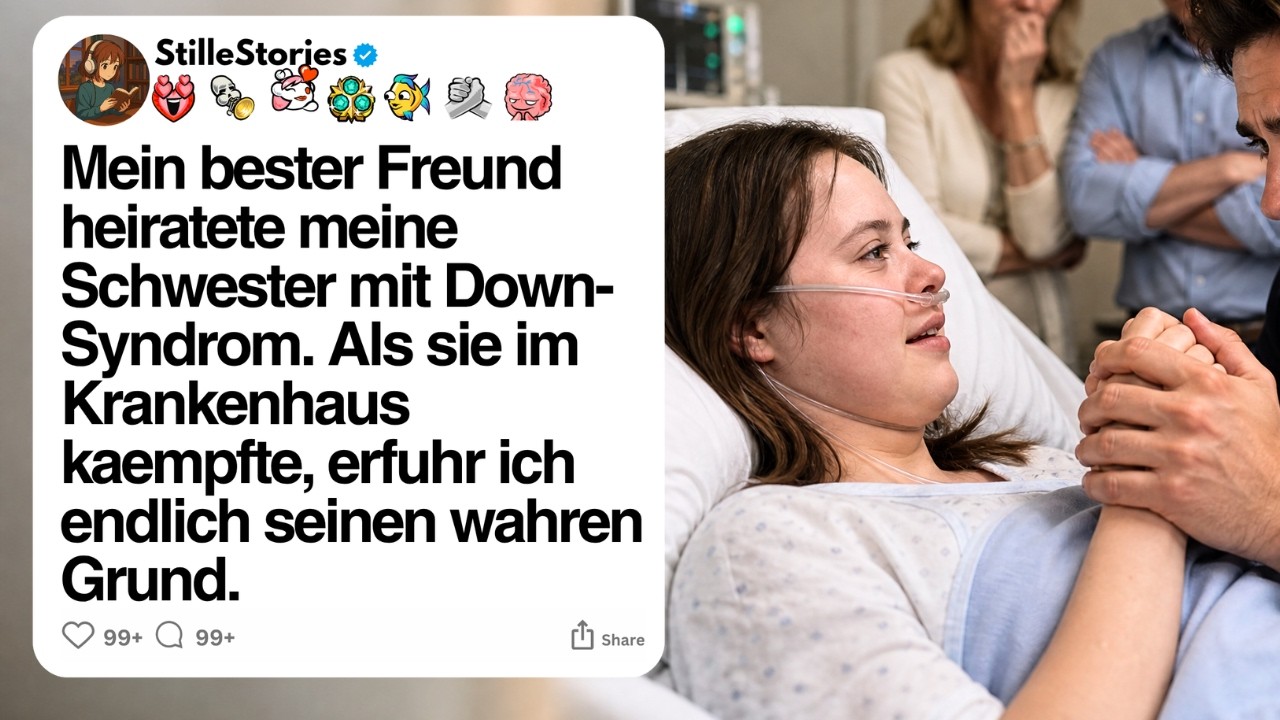
She was looking at my parents, and there was something in her eyes I couldn’t understand then. Pity. Not for my sister, but for them, because what was coming would turn their whole world upside down. “What document?
” my mother asked, her voice suddenly no longer that of a woman whose daughter was fighting for her life in the operating room. It was the voice of a woman who felt the ground crumbling beneath her. The nurse lifted a file. “I’ll explain everything in a moment, but first I need to speak with her.
”
She pointed at me. “Rosi specifically asked that she be informed, not her parents. ”
I stood there in the hospital hallway with the folded contract trembling in my hand, my brother-in-law Ben on the floor, my mother’s face as white as the hospital walls. In minutes, I would learn more about my own family than I had in twenty-two years.
I need to go back for this to make sense. I was a few months older than Rosy. Just old enough to always feel responsible. Never old enough to actually decide anything.
Rosy was born with Down syndrome, and my parents, Ingrid and Volker Brenner, reacted the way they reacted to everything, with control. My father was a tax advisor at a mid-sized firm in Freiburg. My mother ran the household with the precision of an accountant. For them, a life was only successful if it could be entered into neat columns.
Rosy didn’t fit into any column. They never blamed her directly, but I felt it as a child. In the small pauses before my mother talked about Rosy. In the look my parents exchanged when Rosy laughed too loudly after falling off the couch.
I stood in front of her as early as I could. In primary school, when other children mimicked her. In high school, when someone posted a photo of her in a class group with a cruel comment underneath. I deleted it before Rosy could see it and fought the boy who posted it, almost literally.
The only one who never needed an explanation was Ben Feldhoff. He lived three houses away, and since we were ten, he was as much a part of our lives as the weather. For Ben, Rosy was just Rosy. He picked her first for his volleyball team in the garden, not out of pity, but because she actually had a decent serve.
He sat next to her when she mixed up the rules of board games and explained them to her patiently, without a hint of condescension. When Rosy was sixteen and afraid no one would take her to the formal for her special needs school, Ben knelt in front of her in the middle of the living room and said, “I’ll take you. I promise. ”
She glowed all evening.
I fell in love with him slowly, secretly, over years, the way you fall in love with something you don’t allow yourself to want. I never said a word. I told myself it wasn’t the right moment. Then that it was too late.
Then that it didn’t matter anymore. When I was twenty-two, Ben came to our house with a small velvet box. My heart pounded in my throat. I thought, finally, after all these years, he was here for me.
“Is Rosy here? ” he asked. Not me. Rosy.
I watched through the kitchen window as he knelt before her in the garden among the yellow marigolds she loved so much. She cried with joy. I cried too, for an ugly reason I couldn’t forgive myself for for years. Jealousy of my own sister.
What I didn’t notice then, or didn’t want to notice, was my parents’ reaction. No hesitation. None of the questions other parents might have asked. Whether Rosy really understood the significance of marriage.
Whether they were both prepared. Whether they should live together first. Nothing. Only my mother, saying with noticeable relief, “Ben will take good care of her.
”
My father, patting Ben on the shoulder at the wedding and saying, “You made a wise choice. ”
The words sounded wrong in my ears, like a business formula. Not a compliment between family. But I pushed the thought away.
I told myself I was just oversensitive, hurt by my own unrequited love, looking for flaws where there were none. The first years of the marriage looked like a fairy tale. Ben brought Rosy flowers on ordinary Tuesdays, no special occasion, just because he wanted her to know someone was thinking of her. He danced with her in the kitchen to songs on the radio.
Rosy called me almost every week to tell me what they had done together. I listened and was happy for her, while inside me remained that quiet, shameful crack I showed no one. The first strange detail I noticed was when I helped Ben organize some papers, because Rosy struggled with numbers and had asked me to. I found a monthly transfer.
Always on the tenth, always the same amount, from an account I didn’t recognize, into a savings account that was solely in Rosy’s name. I asked Ben about it casually at the kitchen table. He said it was an old family arrangement from his parents, a kind of advance on inheritance. I didn’t push it.
I convinced myself it was normal in some families for parents to support their children financially, especially when a disabled family member was involved. But my stomach still felt wrong. A quiet pull I breathed away. Second oddity, a year later.
My mother casually mentioned a facility called Willow Grove at Sunday dinner. A beautiful assisted living project, as she called it, in case someone ever needed more support. She said it in the same tone she used to talk about the weather. I asked who she meant it for.
“Just in general,” she said, and changed the subject to Ben’s new job. I swallowed the question. I told myself my mother was just planning ahead, the way she planned everything, with charts and folders. But my hands were cold when I walked up the stairs later.
Third oddity. Ben and I were standing together in the kitchen while Rosy sang along with the TV in the living room, and I noticed how tense his shoulders got when my father called. Not annoyed, the way you sometimes are with in-laws. Tense like someone waiting for an interrogation.
Once he hung up and stared at his phone for minutes before putting it away. I asked if everything was okay. “Everything’s fine,” he said, with a smile that came a little too quickly. I let it go again.
Fourth oddity, the heaviest before the truth. Rosy told me on the phone, excited and quiet at once, that her parents had asked her to sign a paper for the future, they said. She didn’t know what exactly was in it. I asked if she had a copy.
She said, “Dad took it back with him. ”
I called my father. He dodged, talked about a pure formality and securing things for emergencies. I demanded to see the document.
He said he had to hang up. A client was waiting. My hands shook as I put down the phone, but I did nothing more. I had no proof, only a feeling.
And a feeling isn’t enough to tear apart a family that looked so flawless from the outside. When Rosy got pregnant with twins, my unease disappeared almost completely under anticipation for a few months. I helped set up the nursery, bought yellow blankets because Rosy loved yellow above everything. But in the 34th week, there were complications.
Preeclampsia that escalated faster than the doctors expected. We drove to the Freiburg university hospital with flashing lights. Ben and I sat in the waiting area of the maternity ward. His knee tapped against the chair edge in a monotonous, nervous rhythm that seemed to fill the whole corridor.
A doctor came out. White coat, name tag, Dr. Medionas Feldmann, senior physician in gynecology and obstetrics. “The babies are here.
Two girls, both stable, in the neonatal unit. ”
Relief flooded through me for two seconds. Then he continued, his voice quieter. “Rosi’s condition is critical.
We’re fighting for her. I can’t tell you anything more right now. ”
The ground seemed to tilt. I heard a rush in my ears, as if someone had turned down the volume of the world.
Ben stood up abruptly, grabbed my arm, and pulled me into an empty corner of the hallway, away from my parents who were just coming out of the elevator. His hands shook as he reached into his jacket pocket. “Before they took Rosy into surgery, she made me promise something,” he said. His voice almost broke.
“If she doesn’t wake up, I have to tell you everything. ”
“Tell me what? ” My voice sounded foreign in my own ears. He pulled a folded document from the inside pocket of his jacket.
I recognized the letterhead immediately. Brenner and Sattler, the firm where my father had worked as a partner for over twenty years. My hands trembled as I unfolded the paper. It was a contract.
A private agreement, not notarized, but signed. My father’s signature. My mother’s signature. Ben’s signature.
A six-figure sum, divided into monthly payments over ten years, totaling 220,000 euros. In return:
Marriage to and permanent care for Rosalie Brenner. I read the sentence three times because my brain refused to process it. “You lied to me,” I screamed, louder than I intended.
“For six years. ”
“I never kept a cent for myself,” Ben said quickly, almost pleading. “Every payment went to the savings account that only Rosi owns. I have the statements.
You can look at everything. ”
“Why sign it at all, if not for the money? ”
Ben slid down the wall until he sat on the cold linoleum floor, knees pulled up like a child. “Because I knew what they had planned for her otherwise.
”
My stomach twisted into a cold, hard knot. “What do you mean? ”
“A facility. Willow Grove.
Your mother showed me the brochure back then, right before I proposed to Rosy. She said you deserve your own life without Rosy as a burden. She said it would be better for everyone if Rosy received professional care far away, and that if I truly loved her, I could spare her that future by marrying her. ”
I couldn’t breathe.
The air in the corridor felt thick, sticky. “I would never have abandoned her,” I said. “Never. ”
“They knew that,” Ben said.
His voice finally broke completely. “That’s why they wanted to tell you only after everything was arranged. When you could no longer change anything. ”
At that moment, the elevator doors opened at the end of the corridor.
My mother, wool coat neatly folded over her arm, as if she had come from a business meeting. My father beside her, calm, with that controlled expression he always wore when negotiating. They walked directly toward us. Their heels clicked rhythmically on the floor.
“How is she? ” my mother asked. Her eyes flickered across my face, then to the contract in my hand, and I saw them widen, a fraction of a second too long. I held up the contract.
My hand shook so badly the paper rustled. “You wanted to send her away. ”
My mother froze. My father opened his mouth, then closed it again.
“This is neither the time nor the place,” my mother hissed, her eyes darting to the other families in the waiting area who were starting to turn around. “The right time was years ago,” I said. My voice carried through the entire corridor now. I couldn’t make it quieter even if I wanted to.
“When you decided Rosy was a problem instead of asking her what she wanted. ”
My father opened his mouth again to answer, his chin rising into the position he always took before delivering one of his calm, devastating statements. But just then, another door opened behind us, and the nurse stepped out. Her face was serious, composed, professional.
She looked directly at my parents. “You should probably know this too,” she said. “Before we took Rosy into the operating room, she signed something else. ”
The nurse’s name was Sabine Herzog.
I read that later on her name tag, when I had calmed down enough to read anything at all. She led us into a small consultation room next to the ward. A room with too-bright lighting and a box of tissues on the table that looked like it had seen too many families in their worst moments. “Rosi was responsive before the anesthesia began,” Herzog explained.
“She was afraid, but clear-headed. She explicitly asked to speak with our social worker before going into surgery. She said she was afraid something would happen to her daughters that she couldn’t control if she didn’t wake up. ”
At that moment, a woman entered the room.
Mid-fifties, with a clipboard and a calm, practiced presence. “I’m Karin Ostermann, hospital social services, responsible for families with special support needs,” she said, sitting across from us. “I spoke with Rosy this morning. She told me she was worried her parents might make decisions for her children and for herself that were not in their interest.
She asked me to help her set up an advance health care directive, specifying who may make decisions for her and the twins in an emergency. ”
My mother sat down abruptly, as if her legs had given way. “That’s absurd. Rosy can’t sign legally valid documents.
She has a cognitive impairment. That wouldn’t hold up in any court. ”
Ostermann looked at her calmly, with a look that had heard many such sentences before. “Mrs.
Brenner, your daughter has a mild to moderate cognitive impairment, but she is not under legal guardianship. She is legally competent as long as no court determines otherwise. To be safe, we brought in our in-house specialist in psychiatry, Dr. Anneegret Wisser, who confirmed Rosy’s capacity for judgment beforehand.
The document was also accompanied telephonically by a notary and will be officially certified tomorrow. ”
My father found his voice again, cold and controlled. “I want to see this document. ”
“You will,” Ostermann said, “as soon as it is legally processed.
But I’ll tell you this much now. Rosi has named her sister as her authorized representative for her own medical and financial affairs. And for the children, in the event of her death or permanent incapacity, she has appointed her sister and Ben jointly as guardians. ”
I stared at her.
Rosy had done this. Silently, fearfully, right before being wheeled into an operating room where she would fight for her life, she had found the strength to protect her own family from her own family. My mother stood up. Her face was now white, almost gray.
“She can’t just decide this. We are her parents. ”
“She’s thirty-two years old,” I said. My voice trembled, but I didn’t stop.
“She’s an adult woman. She has the right to decide who she trusts, and obviously that’s no longer you. ”
The next thirty-six hours blurred in my memory into one long gray fog of waiting room chairs, vending machine coffee, and the monotonous beeping of machines behind closed doors. Rosi survived the surgery, but barely.
An emergency hysterectomy had stopped the bleeding, but she remained on the intensive care unit for seventy-two hours on a ventilator, while the twins, Mia and Lotte, fought for every gram of weight on the neonatal unit two floors below. During that time, I began to understand how deep this went. Ben showed me everything he had. Six years of account statements documenting the monthly transfers from a corporate account belonging to my father, always on the fifteenth, always forwarded to Rosi’s own savings account.
He showed me text messages with my father from before the wedding, in which my father used phrases like: “Once the agreement is signed, I’ll transfer the first installment, and my wife has already prepared the Willow Grove documents in case the engagement doesn’t happen. ”
I read those messages with a feeling as if my entire childhood image of my parents was breaking apart in real time. I hired a lawyer. Miriam Foss, specialist in family law with a practice in downtown Freiburg, recommended by Karin Ostermann.
In our first meeting, she said a sentence that stuck with me: “What your parents did moves in a gray area between financial exploitation of a person with a disability and potential fraud. We need to clarify whether Rosy even knew a contract existed when she got engaged. A contract made over her head. ”
That was the core of it.
Rosy had never known about the contract. She had believed all those years that Ben loved her. Without conditions, without money, without agreement. Which, as it turned out, was actually true.
Ben himself, by his own account, had only signed to protect Rosy from Willow Grove and had kept not a single euro for himself. But my parents had exploited Rosy’s ignorance to maneuver her into a marriage they saw as a solution to a problem that in truth had never been one. We brought in a second expert, attorney Dieter Kramel, specialized in guardianship law, who explained that in Germany it could be criminally relevant under certain circumstances if assets or contractual obligations were arranged in the name of a person with a disability without their informed consent, especially when the parents’ financial interests played a role. “We need to check whether your father, in his role as tax advisor, co-managed or had access to your sister’s savings account in any way,” he said.
“That would shift this toward breach of trust. ”
That’s exactly what we found out two weeks later, with the help of the account documents Ben voluntarily handed over. My father had registered himself as a second signatory on Rosi’s savings account shortly after the wedding, officially for administrative support, as stated in a form Rosi had signed without real understanding of its implications, because her father had presented it to her with the words, “Just a formality, sweetheart. ”
Foss subsequently notified the police.
We were called to the station for questioning, where Detective Nadin Brand received us. Seventeen years on the force, the last nine in the fraud division. She listened to our statements with a calm that both reassured and frightened me, because she seemed so professional, so unruffled by something that had turned my entire life upside down. “We are opening an investigation on suspicion of breach of trust and possibly coercion,” she said.
“Pushing a person with limited legal capacity into a financial agreement without informing them of its contents is not a trivial offense, Ms. Brenner. This is structural exploitation, regardless of how good the intention may have been for Ben in the end. ”
I had hoped that my father, confronted with the police, would finally show remorse.
Instead, he hired a lawyer, largely refused to testify, and had his firm communicate that family support payments were nothing criminal. My mother reacted differently, almost worse. She called me three times a day, left voicemails alternating between anger and self-pity. In one of them she said a sentence I will never forget: “You don’t understand how hard it was to see you be free and know that Rosy would never be that free.
We didn’t want to ruin that life for you. ”
I played that voicemail for Foss. She said dryly, “That’s basically a confession. ”
And she was right.
That recording was later entered as evidence, designated internally as XBD, along with the contract, the account statements, and the text messages. While the investigation was ongoing, Rosy slowly regained consciousness. When she was strong enough to have a conversation, I sat by her bed, held her hand, and had to tell her what had happened. I didn’t know how to begin, so I simply told the truth as gently as I could.
Rosy listened. Her eyes filled with tears, but she didn’t interrupt me. When I was done, she said quietly, “But Ben still loves me, right? ”
That was the only question that truly mattered to her, and I could answer it honestly.
“Yes. He signed because he wanted to protect you, not because of the money. ”
Rosy cried for a long time, then she said something that hit me harder than everything my parents had done: “I thought they just loved me. Everyone always said parents love their children.
”
I had no answer that wouldn’t hurt too. The twenty-four hours that followed were the worst. Foss called me on a Thursday morning, her voice tenser than usual. My parents had filed an urgent motion with the family court through their lawyer to obtain legal guardianship over Rosi.
Their reasoning: due to the medical complications and emotional strain, she was currently unable to make her own decisions, and they were petitioning to be appointed as her guardians. If the court granted it, they could effectively override the power of attorney Rosy had signed in the hospital, regain control over her assets, and possibly even custody of the twins. The hearing was scheduled for the next day. We had twenty-four hours to present counter-evidence.
My heart raced as I spoke with Foss. My hand clenched the phone so hard my knuckles turned white. “Can you really do this? ” I asked.
“Theoretically, yes, if the judge is convinced that Rosy is actually not capable of making decisions,” Foss said. “That’s why we need a current psychiatric evaluation by tomorrow morning confirming her legal capacity, and ideally a statement from Rosy herself before the court, if her health condition permits. ”
I ran through the clinic, spoke with Dr. Wisser, the psychiatrist who had already evaluated Rosi before the operation.
She agreed to prepare an additional current evaluation, that very evening, despite a full schedule. “In seventeen years I’ve seen many cases where families tried to undermine the self-determination of people with disabilities,” she told me as she organized her notes. “I will not let your sister become another statistic. ”
At the same time, I struggled with a different problem.
Rosy was physically too weak to appear in court. Foss filed a motion for a video link from the hospital room, which was possible in such urgent proceedings, but not guaranteed. I remember that night as a sequence of short, frantic moments. The clacking of my fingers on the keyboard while I compiled documents with Ben.
The beeping of Rosi’s monitors in the background. The feeling that time was slipping through my fingers like sand. At three in the morning, I sat beside Rosi’s bed, unable to sleep. She woke up, looked at me, and whispered, “I’m so afraid they’ll be right.
”
I held her hand and told her I would do everything to prevent that, even though at that moment I myself wasn’t sure if it would be enough. The next morning, with sleepless eyes and a file folder under my arm, we sat before the Freiburg Guardianship Court. Judge Thomas Alborn, a man with gray temples and a voice that knew no hurry, presided over the hearing. My parents sat on the other side of the room.
My father in an immaculate suit, my mother with an expression that was supposed to simulate care but in my eyes looked like an ill-fitting mask. Dr. Wisser presented her evaluation, clear and unambiguous. Despite her cognitive impairment, Rosy was able to understand and make essential decisions about her life, especially with appropriate support on more complex matters.
Karin Ostermann confirmed that Rosy had repeatedly and on her own initiative expressed her wish in the hospital to appoint her sister as a trusted person. And then the video link to the hospital room was set up. Rosi appeared on screen, pale, with IV lines in her arm, but awake, her voice shaky. But clear.
The judge asked her gently why she had appointed her sister as her representative and not her parents. Rosi was silent for a moment. Then she said slowly, but distinctly: “Because my sister always asked me what I want. My parents told me what’s good for me.
That’s not the same. ”
The room fell silent. Even my father, who had sat with a blank expression until then, lowered his eyes. Judge Alborn rejected my parents’ urgent motion.
In his reasoning, delivered directly in the courtroom, he said a sentence that would later be quoted in a newspaper article: “The court sees no evidence of a lack of legal capacity on the part of the person concerned. It does, however, see considerable evidence that the applicants attempted to undermine the self-determination of their adult daughter in order to regain their own financial and emotional control. ”
The story could have ended there, but it didn’t. A court reporter for the Badische Zeitung, Lena Vogt, had been sitting in the audience because she was originally covering a different case.
She recognized the significance immediately and asked after the hearing whether Foss or I would be willing to talk to her. I hesitated at first, afraid of exposing Rosi to more attention. But Rosi herself, when I asked her, said something that surprised me: “I want people like me to know they’re allowed to fight back. ”
The article appeared ten days later with the title “Contract Instead of Love: How Parents Bought Their Disabled Daughter’s Marriage—and Failed.
” It documented the entire case, anonymized in names, but with all the relevant facts. The contract. The police investigation. The failed guardianship lawsuit.
Within a few days, the article was shared thousands of times and picked up by regional and then national media. My father lost two major clients of his firm within three weeks, who publicly stated they could no longer work with a tax advisor being investigated for breach of trust against a vulnerable person. The firm itself publicly distanced itself from him and suspended him until the investigation was complete. Four months later, charges were filed for breach of trust under Section 266 of the Criminal Code, in a particularly serious case due to the exploitation of a special position of trust toward a person with a disability.
My father received a suspended sentence of one year and nine months, along with a monetary penalty and the condition of submitting to supervision by the probation service. It wasn’t prison, which disappointed me at first. But Foss explained that the conviction alone, combined with the public loss of reputation for a man like my father, for whom reputation meant everything, was a form of punishment that hit him deeper than any cell would have. My mother was not criminally convicted, as her involvement was legally harder to prove.
But the civil proceedings Foss pursued in parallel on Rosy’s behalf ended with a settlement. My parents had to permanently surrender all access rights to Rosi’s accounts and make an additional compensation payment that went into a trust fund for Mia and Lotte. The social fall of my parents, however, was the real price. The circle of friends they had cultivated for decades collapsed almost entirely when the article made the rounds.
My mother, who once sat on the board of the local charity association, was asked to resign her position after several members threatened to leave otherwise. Rosy recovered slowly, physically and emotionally. Ben stayed by her side, now without any shadow of a contract over him, because the money that was still outstanding was converted directly into Rosi’s name after the conviction, without any conditions. I remember the day Rosy asked if she could ask Ben once more whether he truly, truly loved her without the contract.
Ben didn’t answer with words. He got the small velvet box he had kept all those years, opened it, and placed the ring on the table in front of her once again. “I never bought this ring because of a contract,” he said. “I bought it because I couldn’t imagine a life without you.
The contract came later, because I thought it was the only way to keep you. ”
A year later, I sat in Rosi’s garden among the yellow marigolds she had planted herself, with Mia on my lap and Lotte on Ben’s arm. Rosi had become stronger, healthier, freer, in a way I had never seen in her before, because for the first time in her life, she truly knew that the people around her loved her without conditions. I had barely seen my parents since my father’s conviction.
A few curt messages from my mother, more justification than remorse, went unanswered. That afternoon, as Rosy laughed so loudly she almost fell off her garden chair, the way she had done as a child, I thought back to the moment in the hospital corridor. The contract in my trembling hand. The feeling that my entire life was breaking apart in that instant.
It had broken apart. But from the ruins, something more real had grown. Something my parents could never have bought, no matter how much money they offered. My parents had tried to get rid of my sister because they believed love could be administered like an account.
They were wrong. Rosy never needed a bought husband. She only needed someone who asked her what she wanted, and who listened when she answered.