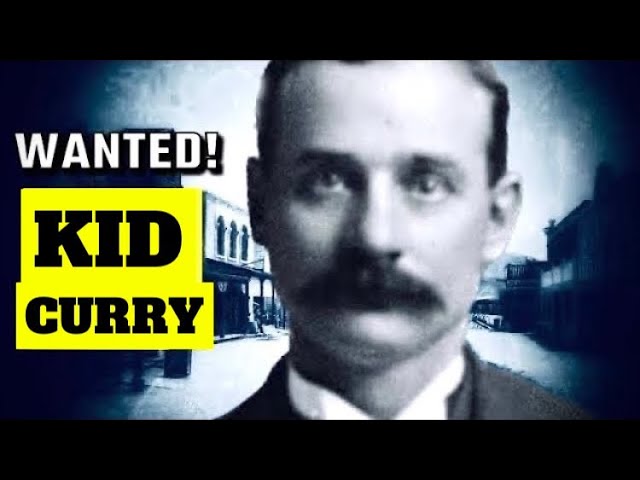
Harvey Logan, better known to history as Kid Curry, was one of the most dangerous and infamous outlaws to ride through the waning hours of the American Wild West. His reputation was built on a foundation of violence, cunning, and an almost uncanny ability to escape the long arm of the law. He rode with the Ketchum Gang and the Wild Bunch, but he also freelanced several jobs on his own, working alone or with a small crew of trusted accomplices whenever the situation called for it.
It has been reported that he killed over 30 men over the course of his criminal career, though the true number may never be known with certainty. His story is one of blood, betrayal, revenge, and relentless pursuit across the rugged landscapes of the American frontier.
 Logan was born in central Iowa in 1867, coming into the world at a time when the frontier was still being settled and the old ways of the West were slowly giving way to modernization. He was the third of six children in a family that would eventually be scattered by tragedy and hardship. His parents died when he was young, leaving the children to fend for themselves in a harsh and unforgiving world.
After their deaths, he spent time living with his aunt before making the decision to move to central Texas along with several of his brothers, seeking new opportunities and a fresh start in the cattle country of the Lone Star State.
Until around 1883, Harvey made his living working with horses on the Cross L Ranch near Rising Star, Texas. It was honest work, the kind of labor that built character and taught a young man the value of hard effort, but it was also there that he met flat-nosed George Curry, a man who would become a close friend and a fateful influence on his life. It was from this friend that Harvey and his two brothers took their new last name, adopting the surname Curry as their own and leaving their original identity behind.
The choice to take a new name was a practical one for men who were beginning to walk a darker path, and it would serve them well as they moved deeper into a life of crime.
During the early 1880s, Kid Curry picked up various cowboy jobs across Wyoming, Colorado, and Montana, drifting from ranch to ranch and town to town as work demanded. It was there in Montana where trouble showed up in a way that would change the course of his life forever. After several prior skirmishes with a local minor named Pike Landuski regarding his daughter, a situation that had been simmering with tension and bad blood for some time, a deadly confrontation occurred at a local saloon.
The exact details of what happened that day have been debated over the years, but this time around, Logan put hot lead right between the old man’s eyes, ending the dispute in the most final and violent way imaginable. The killing marked a turning point in his life, transforming him from a working cowboy into a wanted fugitive on the run from justice
Before the smoke had even settled over the saloon floor, Logan knew he had to flee, and he wasted no time in making his escape. He fled to New Mexico, a territory that was known for harboring outlaws and offering refuge to those who needed to disappear from the notice of the law. He started riding with the Blackjack Ketchum gang, a crew of desperadoes who operated in the rugged terrain of the Southwest and made their living through robbery and violence.
However, he returned to Montana when he received word that a friend of Landuskis, a rancher named James Winters, had been trying to get the reward on his bounty. The prospect of being hunted down by a bounty hunter was a serious threat, and Logan was not the kind of man to let such a threat go unanswered. In January 1896, Harvey along with brothers Johnny and Lonnie confronted Winters at his ranch, intending to settle the matter once and for all.
 When a shootout erupted, brother Johnny Logan was killed in the exchange of gunfire, a loss that would haunt Harvey for years to come and fuel a burning desire for revenge that would not be quenched until much later. Harvey and Lonnie managed to escape the ranch alive, but they were now more determined than ever to avoid capture and to strike back at those who had wronged them
They returned to New Mexico, joining Blackjack Ketchum’s gang once again, but the alliance was not destined to last. When the brothers argued with Thomas Blackjack Ketchum over the take in a train robbery, a dispute over money and shares that was all too common among outlaw gangs, the pair left the gang and struck out on their own. Before long, however, Harvey started another gang that included brother Lonnie, Walt Putman, Tom OD, and his old friend George Curry, assembling a crew of men he trusted and who shared his willingness to take risks and shed blood when necessary.
In April 1897, Harvey was involved in the killing of Deputy Sheriff William Dean of Powder River, Wyoming, when he and his gang were wrestling horses from a local rancher. The encounter turned deadly when the deputy attempted to intervene, and Logan did not hesitate to use lethal force to protect himself and his men
A few months later in June, Harvey Logan and his gang robbed a bank in Belffor, South Dakota, a bold daylight robbery that netted them a substantial haul but also brought the full weight of the law down upon them. Fellow bandit Tom O was captured when his horse spooked and ran away, leaving him stranded and easy prey for the pursuing authorities. The others escaped but were soon caught up to in Fergus County, Montana, where the long arm of the law finally caught up with them.
During the inevitable shootout, Logan was shot through the wrist and captured, a painful wound that marked the beginning of a period of incarceration. Also apprehended were Walt Putnham and George Curry, and the three bandits were jailed in Deadwood, South Dakota, a town that was itself famous for its lawless history but was now determined to hold onto its prisoners. However, on October 31st, 1897, they managed to escape from the Deadwood jail, a daring breakout that demonstrated Logan’s resourcefulness and his determination to remain free at all costs
On July 14th, 1898, Logan joined the Sundance Kid and Flat-Nose George Curry in the robbery of a Southern Pacific shortly after it pulled out of the Humbult House train station in Humbult, Nevada. The three outlaws worked together with precision, boarding the train and moving through the cars with practiced efficiency. Much to their disappointment, they only made off with about $450, a meager sum that hardly justified the risk they had taken.
On June 2nd, 1899, a year later, the Wild Bunch robbed a Union Pacific Railroad Overland Flyer near Wilcox, Wyoming, in what would become one of the most famous train robberies in the history of the American West. Aggressively pursued by law enforcement, a gunfight erupted between the Trailing Posi and the robbers, and Sheriff Joe Hazen was killed in the exchange of gunfire. The gang managed to escape to the hole-in-the-wall hideout, a remote and rugged natural fortress that had long served as a refuge for outlaws seeking to evade capture.
 Pinkerton detective Charlie Seringo was tasked with bringing in the outlaw gang, a formidable challenge given the remote nature of their hideout and the determination of the men he was pursuing
Logan soon fled to New Mexico along with Butch Cassidy and several others, seeking the relative safety of familiar territory. On July 11th, 1899, Harvey, Elle, and Sam Ketchum robbed a train near Folsam, New Mexico, continuing their campaign of robbery across the Southwest. A posi led by Sheriff Ed Farre cornered the gang near an area called Turkey Creek which resulted in a gun battle that wounded both Ellay and Sam Ketchum.
Sheriff Farre was killed in the exchange and his deputy Henry Love was also wounded, but the cost to the outlaws was also high. Later Sam Ketchum and Deputy Love would die from their wounds, a grim reminder that violence in the West often claimed victims on both sides of the law. Logan and Butch Cassidy were able to escape the chaos of the gun battle, slipping away into the rugged terrain while their pursuers were occupied with the wounded and the dead
Kid Curry fled to San Antonio where he holed up in Fanny Porter’s brothel, a establishment that was known to provide refuge to outlaws seeking to disappear from the notice of the law. It was there he met Dela Moore, also known as Annie Rogers, a woman who would become his lover and companion over the next several years. The two began an 𝒶𝒻𝒻𝒶𝒾𝓇 that would last over the next several years, bound together by circumstance and a shared life on the run from justice.
In February 1900, brother Lonnie was killed by law men while visiting his aunt in Missouri, another devastating loss for Harvey who was already angry over the death of his brother Johnny years earlier. He was already angry and even more upset when his friend flat-nosed George Curry was killed by lawman just two months later while wrestling cattle near Moab, Utah, a death that struck particularly close to home given that Curry had been his friend and the source of his adopted surname. The next month in March, Harvey and Will Carver were recognized in St.
John’s, Arizona, while Harvey was spending currency suspected of being from the Willox robbery. Local Sheriff Edward Beer went after the pair, determined to bring them to justice. When deputies caught up with the pair on March 28th, the outlaws shot them dead, adding more names to the long list of lawmen who had fallen to Logan’s guns
On the run, Harvey and Carver made their way towards Elma, New Mexico, meeting up with Butch Cassidy and Eli, where they were working on the WS ranch, a remote ranch that provided cover for outlaws seeking to lie low between jobs. Along the way, Sheriff George Scarboro and cattleman Walter Birfield began to follow their trail, but Curry was too smart for them, and he was not about to let himself be taken without a fight. Discovering they were being followed, he and Carver ambushed the pair on April 5th, wounding Birfield and killing Scarboro, eliminating the threat before it could materialize into something more dangerous.
 Before long, Logan set out to settle the score with the men who had killed his friend George Curry and headed north, driven by a burning desire for vengeance that had been building ever since he learned of his friend’s death. On May 26th, Harvey rode into Moab and killed Grand County Sheriff John Tyler and his deputy Sam Jenkins, exacting his revenge in blood and leaving another trail of death behind him
Harvey then rejoined the Wild Bunch, reuniting with his old associates in crime. And on August 29th, 1900, the gang robbed a train near Tipton, Wyoming, taking nearly $55,000, one of the largest hauls of his criminal career. Afterward, the gang split up with Logan and Ben Kilpatrick heading for Fort Worth, Texas, seeking to lie low and enjoy the fruits of their labor.
Meanwhile, Butch Cassidy, the Sundance Kid, und Will Carver robbed a First National Bank in Winnamaka, Nevada on September 19th, making off with about $2,000, a smaller haul but one that kept the pressure on law enforcement across the region. By this point, Harvey Logan was an infamous outlaw, his name known across the West and his face plastered on wanted posters from Texas to Montana
On July 3rd, 1901, Logan and several other Wild Bunch members returned north and they robbed a Union Pacific train near Wagner, Montana, making off with an estimated $40,000, another substantial haul that added to their growing legend. The gang split up, going various directions again, but Harvey was not yet done with his revenge, and the memory of his brother’s death still burned hot within him. On July 26th, 1901, he shot and killed Jim Winters, the rancher who had killed his brother John back in 1896, finally settling the score that had been outstanding for over five years.
He then headed to Tennessee where in October his girlfriend Annie Rogers was arrested in Nashville for spending cash from the Montana train robbery, a development that threatened to unravel his network of support and refuge. Two months later in December, Logan killed two Knoxville policemen when they tried to apprehend him, adding yet more bodies to his grim tally and demonstrating once again that he would not be taken without a fight. Despite heavy pursuit by the law, he evaded capture until a year later in a Knoxville pool hall, he was arrested after a lengthy physical fight with lawmen, a struggle that was said to be one of the most violent and desperate of his career.
They couldn’t convict him on the murder of the two policemen due to lack of evidence, a frustrating outcome for prosecutors who were determined to see him punished. So, he was convicted of robbery and received a sentence of 20 years of hard labor and a $5,000 fine, a harsh sentence that reflected the determination of the courts to put an end to his criminal career
After a year and a half behind bars, Curry escaped on June 27th, 1903, demonstrating once again his remarkable ability to slip the bonds of captivity. A year later, he participated in robbing the Denver and Rio Grand train near Parachute, Colorado, returning to his old ways with a bold robbery that showed he had lost none of his nerve during his time in prison. Two days later, Aposi caught up with the outlaws and in the confrontation, Logan was wounded, a serious injury that left him weakened and facing the prospect of capture.
However, rather than go back to prison, he took his own life, choosing death over the loss of his freedom. He was 37 years old when he died on June 9th, 1904, ending his violent career in a final act of defiance. Logan is buried in Pioneer Cemetery overlooking Glenwood Springs, Colorado, his grave a final resting place for a man who had spent his entire adult life on the run from the law.
His story remains one of the most violent and compelling tales of the American West, a reminder of the thin line between freedom and lawlessness that defined the frontier era.