When I pushed open the front door and saw the leash hanging empty on its hook, I knew before a single word was spoken that I was about to lose something I could never get back. Sixteen years. Sixteen years that dog had waited at that door every single day, whether I was gone five minutes or five hours. And now nothing.
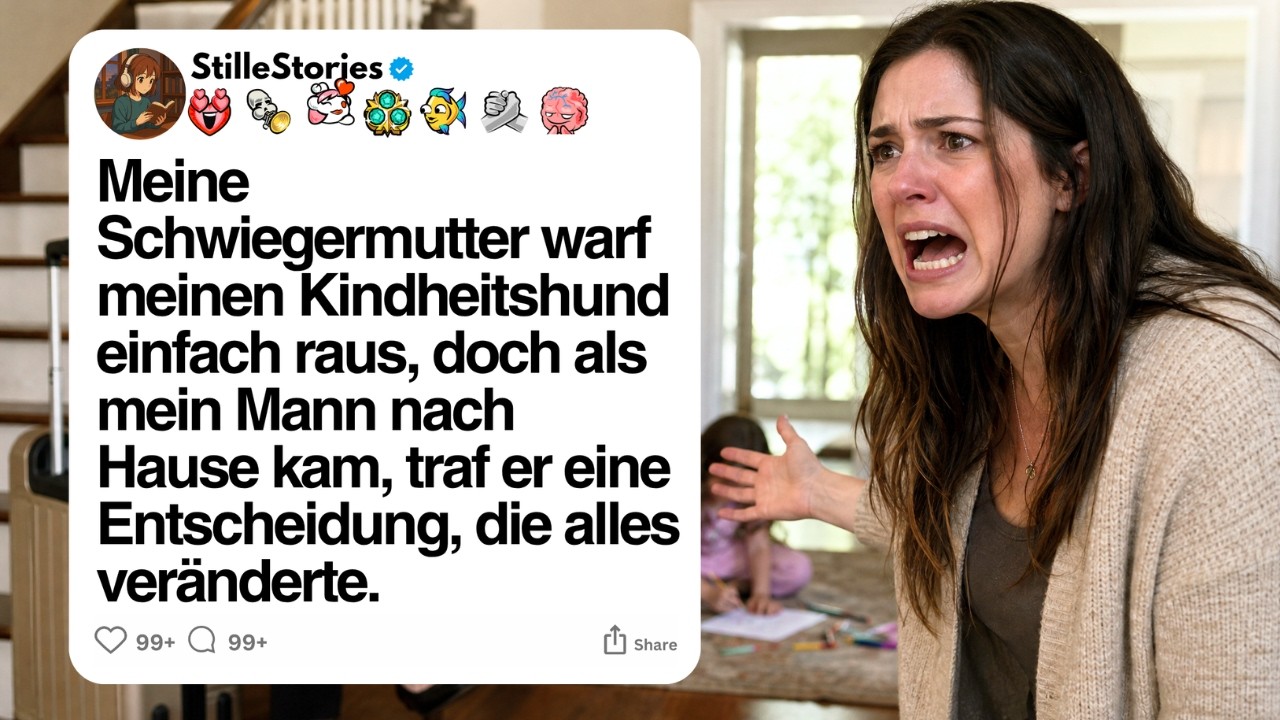
No clicking of claws on the hardwood, no sleepy, happy grunt. Just Diane, my mother-in-law, sitting at the kitchen table like it was an ordinary Tuesday afternoon, her suitcase already packed and waiting by the stairs, as if she knew she’d be needing it soon. I should have realized then that this was only the beginning. I’m Andrea, forty years old, married to Kenny, mother of Jillian, seven, and Lawrence.
We lived in a quiet suburb of Columbus, Ohio, in a house with a too-big yard and a too-old dog named Frankie, whom I’d adopted from the shelter when I was twenty-three, long before I ever met Kenny. Frankie wasn’t a family dog. He was mine. The only one who’d gotten me through a divorce, two moves, and a miscarriage without ever saying a word about how much I cried.
When I married Kenny, I brought Frankie with me like part of the dowry. Kenny loved him almost as much as I did. The kids had never known life without him. He was the reason Lawrence could fall asleep at night as a toddler—the warm weight of an old dog at the foot of his bed calming him more than any nightlight.
Jillian had treated him like her own stuffed animal when she was a baby, his gray fur as familiar as our own voices. Diane, on the other hand, had disliked Frankie from the start. She called him “that beast” when she thought I couldn’t hear. She complained about dog hair on the sofa, about the smell, about the clicking of his claws when he padded to his water bowl at night.
At every family dinner she’d casually mention how much healthier a house without pets was, how many allergies she’d read about that old dogs triggered. I always listened politely and changed the subject, thinking she was just an older woman who didn’t particularly care for animals. A year and a half ago at Thanksgiving, she’d struck him with her handbag because he got too close to her new shoes. Kenny had exploded.
For the first time in his life, he told his own mother she could only enter our house when we explicitly invited her. Diane cried, swore it would never happen again, and stayed distant for a few months. Looking back, that was my first mistake. I believed distance meant remorse.
I would soon learn it only meant she was waiting. During those months of distance, Diane found other ways to justify her visits. She called Kenny—not me—asking for small favors. Bring a book for Jillian.
Pick up a forgotten toy. Watch the kids for five minutes while we worked. Each request sounded harmless on its own. Only in hindsight did I see the pattern.
She was testing how often she could get into the house unnoticed, without either of us being present. The first crack appeared in March. I came home from work and found Frankie’s water bowl empty, even though I’d filled it to the brim that morning. Diane had happened to stop by that day to drop off a book for Jillian.
I asked if she’d touched the bowl. “Why would I? ” she said, smiling that smile I would later learn to fear. I told myself I must have forgotten to refill it.
My stomach told me otherwise, but I stayed silent. I didn’t even tell Kenny, afraid of how ridiculous it would sound. My mother-in-law and an empty water bowl. Who would get upset about that?
In April, I found the garden gate open a crack, though I was sure I’d closed it. Frankie was still inside, confused but unharmed, standing in the middle of the hallway with his head lowered, as if he didn’t understand what had just happened either. Again, Diane had stopped by that afternoon, supposedly to check on things while Isabella, our neighbor who helped with the kids, was out shopping. Again I told myself: coincidence, wind, a forgotten latch.
I didn’t want to be the woman who suspected her mother-in-law without reason. I didn’t want to break the family peace myself. So I swallowed it down, until my stomach clenched every time I saw her name on my phone screen. In May, our neighbor Carol Alvarez called.
A retired elementary school teacher who’d lived two houses down for twenty years, she’d known Frankie since he was a puppy. “Andrea, was that your mother-in-law letting Frankie run loose in the front yard without a leash? ” My heart skipped a beat. I was at work at the time.
Diane had claimed she was only checking on the kids briefly. I called home. Diane assured me Carol must have been mistaken. Frankie had been on the leash the whole time.
I believed her because I wanted to believe that a grandmother who loved my children would never deliberately put our dog in danger. My hands trembled all afternoon anyway, without me knowing exactly why. In June, Diane complained to Kenny on the phone that the old animal would die soon anyway, and maybe it was time to think about alternatives. Kenny didn’t respond at the moment.
He told me about it days later with a look I’d never seen on his face before—something between shame and anger. “I think my mother means it seriously,” he said quietly. I asked if we should do something. He shook his head.
“I’ll talk to her. ” He did. It didn’t help. Two weeks later, without telling me, he bought a small GPS tracker for Frankie’s collar.
“Just to be safe,” he said when I discovered it. I thought it was almost excessive at the time, almost paranoid. I would later thank him on my knees for it. In early July, just days before everything happened, I sat with Kenny on the porch while Frankie snored at our feet and said something I’ve never forgotten: “I feel like your mother is waiting for something.
” Kenny looked at me for a long time. “For what? ” I couldn’t say exactly then. I know now.
She was waiting for a moment when no one was watching. An afternoon when Isabella was too busy to look closely and Kenny was too far away to intervene in time. Then came the day everything fell apart. I came home to find the patio door open, the garden gate swinging in the wind, and Diane sitting at the kitchen table with her packed suitcase, as if nothing had happened.
“Where’s Isabella? ” I asked. Our neighborhood helper who was supposed to be watching the kids while I was still at the office. “I sent her home,” Diane said.
“I wanted to surprise you all. ” My eyes searched the floor. No Frankie. “Frankie!
” I called. Nothing. “Diane, where is my dog? ” She stirred her coffee as if discussing the weather.
“He kept getting in my way while I was bringing in my bags. So I put him out by the gate. ” “He’s sixteen,” I shouted, my voice nearly breaking. “He’s almost deaf.
He never goes outside alone. ” “He did today,” she said, and in that one sentence there was a coldness I never would have expected from her. I grabbed my car keys, my hands shaking so badly they clattered against the doorframe. That’s when the door flew open.
Kenny stood there, out of breath, dirt on his pants, holding a stack of papers. Diane jumped up. “Kenny, thank God, your wife has completely lost it over that animal. ” Kenny looked at her, then at me, and nodded once, calmly.
“Frankie’s safe in the truck. Tired, but okay. ” My knees nearly gave out. Kenny turned to his mother, his voice low, cold as ice.
“Mom, I need to show you something. ”
He spread the papers on the table. Photos from our door camera. A GPS log.
A map with a red line running through the neighborhood. “After you hit him with your bag last year, I secretly put a tracker on his collar,” he said. “I just had a feeling. ” He tapped the first photo.
“You leashed him yourself, walked him two streets down to the intersection by the elementary school, where cars go forty. Then you came back alone and hid the leash in the garage. ” Diane’s mouth opened. No words came out.
“My phone alerted me the moment he left our property,” Kenny said. “I was twenty minutes away. When I got there, he was standing right at the curb. Deaf.
He couldn’t hear the cars. Mrs. Alvarez saw you. Isabella called her.
She was already on her way when I arrived. ”
Diane’s face went pale, then red. “I just wanted to give him fresh air. He’s old.
Wouldn’t it have been more merciful if he’d fallen asleep peacefully somewhere instead of suffering? ” In that moment, everything became clear. The complaints, the uninvited visits, the empty water bowl in March, the open garden gate in April, Carol’s call in May, the suitcase already packed as if she knew the house would soon be quieter. This wasn’t an accident.
This was a plan prepared over months, step by step, while I told myself every time that I was the one overreacting. “It was never about the dog,” I said. “You wanted him gone. ” Diane said nothing more.
Kenny set her suitcase by the front door. “You’re not welcome here again until you can look us in the eye and admit what you actually did. ” She picked up her bag and left without another word. I thought that was the end.
I had no idea how wrong I was. Frankie trembled for three more days whenever someone opened the patio door. He flinched at every clatter, every gust of wind, as if his body had stored the fear deeper than his mind. At night he no longer slept in his bed, but right next to ours, so close I could hear his shallow breathing in the dark.
We took him to Dr. Melissa Grant the next morning, our veterinarian of eleven years. She examined him thoroughly, checked his paws for injuries from the asphalt, and found mild dehydration and elevated cortisol levels—a clear sign of acute stress. “He got lucky,” she said, looking at me over her glasses.
“For a deaf dog on a forty-mile-per-hour road, that’s not a residual risk, Andrea. That’s pure luck that a car could brake in time. ” She wrote a detailed report and sent it to me digitally, with timestamps and diagnosis. “Just in case you ever need it,” she said.
I didn’t yet know how literally to take that. Two days later, a woman from the animal control office rang our doorbell. Officer Renny Tucker, who’d worked in animal welfare and traffic safety for nine years. Carol Alvarez had filed a report without asking me, because as a witness she’d seen an unleashed, obviously helpless dog standing in the middle of the road.
I showed Officer Tucker the GPS log, the photos, the veterinarian’s report. She nodded slowly, typed everything into her tablet, and said, “This is enough to issue a formal warning against the person who left the dog unattended on public property. If this happens again, we’ll be talking about charges for animal cruelty by neglect. ” I signed an affidavit describing the incident.
It felt so real, naming my own mother-in-law as the accused party on an official form. I thought that would be the end. Diane would retreat, be offended, maybe not call for months, like she’d done before when she felt mistreated. Instead, she escalated.
A week after the warning, Kenny got a call from Aunt Ruth, Diane’s younger sister, who excitedly reported that Diane was telling the whole family I’d reported her for no reason and was keeping the children from their own grandmother out of pure malice. The same evening, I found a long public post in the neighborhood Facebook group in which Diane, without naming names but unmistakably identifiable, wrote about people who loved a dog more than their own family and were willing to separate children from their grandmother to prove a point. More than forty comments in two hours. My stomach turned as I saw my own name appearing in the comments, written by people who knew half the story.
Some wrote they’d known Diane for years from church and couldn’t imagine her capable of something so cruel. I sat there staring at the screen, not knowing whether to cry or throw my phone against the wall. Then came the call that truly frightened me. A worker from Child Protective Services, Mrs.
Patricia Owens, seventeen years on the job, called and told me in a calm, professional voice that an anonymous report had been filed. It claimed child neglect—that the children had been left unsupervised with a dangerous animal and that the parents reacted disproportionately aggressively to harmless family conflicts. I knew immediately where it came from. My hands shook so badly I could barely hold the phone.
Mrs. Owens explained that such reports had to be routinely investigated, no matter how unfounded they seemed, and that a home visit would be scheduled within the next twenty-four hours. Twenty-four hours. I had twenty-four hours to prove my children were safe in my own home, that I never should have had to defend myself.
I called Kenny, who was at a construction site. My voice was so shaky he started driving on the second word. We called a family attorney that evening, recommended by Carol. Lawyer Denise Marsh, twelve years specialized in family and custody law, with a calm, almost frighteningly precise way of speaking.
She asked us to send her everything we had immediately. The photos. The GPS log. Dr.
Grant’s veterinary report. The animal control warning. Screenshots of Diane’s Facebook post and the comments. That night I didn’t sleep.
I sat at the kitchen table—the same one where Diane had sat two weeks earlier stirring her coffee—and sorted documents into a folder that lawyer Marsh would call Exhibits A through F. My stomach cramped at every sound in the house. Kenny sat beside me, barely speaking, just staring at his phone as if he could will away the knock on our door tomorrow that would judge our ability to parent. Around three in the morning he asked quietly, “Do you think she knew what this would trigger?
” I didn’t know the answer, but I knew it didn’t matter anymore. At some point that night I quietly went into the children’s rooms, just to watch them sleep, to remind myself what I’d be fighting for the next day. The next morning, Mrs. Owens arrived promptly at ten.
She spoke individually with Jillian and Lawrence in their own rooms, calmly and in age-appropriate ways, while Kenny and I waited in the living room, my heart so loud I feared she might hear it through the wall. After forty minutes she came back, sat down across from us, and said, “Let me be direct. Your children appear safe, well-cared-for, and emotionally stable. There’s no indication of neglect whatsoever.
” She flipped through her notes. “However, your documentation gave me pause. The incident with the dog, the GPS log, the Facebook post—this doesn’t look like a case of child endangerment, Mrs. Reyes.
This looks like a family conflict being fought through a false report. ” She made an official note that the report was unfounded and added that repeated, demonstrably malicious false reports could become criminally relevant. Lawyer Marsh advised us to become active rather than keep waiting. We formally filed for what’s called a contact restriction.
Not a complete ban, but a court-documented agreement stating Diane could only see the children in the presence of Kenny or me, and could never enter our property unannounced. The petition was filed with a family court judge who scheduled a hearing for the following week. That week of waiting was perhaps the longest of my life. I kept going to work, kept cooking dinner, kept helping with homework, but everything felt like moving through cotton, as if my real life was paused somewhere until that appointment was over.
On the day, I sat in a courtroom for the first time in my life, my hands so cold I clasped them together to hide the shaking. Diane sat on the other side with her own lawyer, an older gentleman who tried to present the incident as a harmless mistake by a loving grandmother. But when lawyer Marsh presented the evidence—Exhibit A, the GPS log with exact coordinates and timestamps; Exhibit B, the door camera photos; Exhibit C, Dr. Grant’s medical report on the elevated stress hormone levels; Exhibit D, the animal control warning; Exhibit E, the Facebook post with comments; Exhibit F, the official CPS note about the unfounded report—the older gentleman gradually fell silent.
The judge flipped slowly through the documents. Her face remained professionally neutral, but I saw her eyebrow rise when she reached Exhibit D. The judge asked Diane directly whether she disputed the incident. Diane, her voice trembling, tried her version again.
The dog simply got away from her. The judge held up the door camera photo showing Diane herself putting the leash around Frankie’s neck and leading him out of the garden. “That doesn’t look like it got away, Mrs. Ryan Senior,” she said dryly.
The courtroom was completely still for a moment. Diane lowered her gaze. The judge granted the contact restriction as requested, with an additional clause: should Diane file another unfounded report with CPS or take any further action that could be interpreted as retaliation, a complete contact ban would be considered. As we left the courtroom, lawyer Marsh said quietly to me, “You didn’t just protect your children today.
You drew a line that never really existed before. ” I nodded, unable to speak. My legs were so unsteady Kenny had to support me as we walked to the car. The truth, once spoken, couldn’t be taken back.
Within two weeks, the extended family learned what had actually happened—not through us, but through Aunt Ruth, who saw the court documents from a mutual acquaintance and, horrified by what she read, stopped defending Diane’s version. The church group where Diane had been active for years, regularly sitting on the charity committee, slowly distanced itself after one of the other women there, who happened to know Carol Alvarez, heard the whole story. Diane wasn’t officially excluded, but the invitations became fewer, the conversations shorter. Her own brother, with whom she’d gotten along well for decades, called Kenny and said only, “I’ve heard what happened.
That’s not the woman I know. ” Or maybe it was, and I just never looked closely enough. The Facebook post disappeared eventually, without comment, but the screenshots remained in our folder forever, archived as Exhibit E. Diane herself didn’t contact us for three months.
No calls, no messages, no attempt to apologize or repeat her version. To this day I don’t know if it was shame or pride that kept her silent. Maybe both. When she finally called, it was Kenny she spoke to, not me.
She said she understood now that she’d made a mistake, but she never explained exactly which one. Kenny listened, polite, distant, and said at the end only, “If you really understand, show it not with words, but with time. ”
She’s been trying since then, slowly, carefully, always in our presence, as the court intended. She’s never touched Frankie again without asking us first.
She’s never again mentioned alternatives for him. Sometimes on quiet Sundays she comes over, rings the bell, waits at the door instead of just walking in like she used to. I watch her through the kitchen window, planting flowers in the garden with Jillian, always glancing over at us as if making sure we see that she’s doing it right this time. It wasn’t forgiveness.
It was something smaller, more careful. A ceasefire that had to be re-earned every single day. Lawrence, with the innocent directness of a nine-year-old, once asked me why Grandma Diane always rings the bell now. I told him that some people have to learn that trust isn’t a gift, but something you have to earn back.
Step by step, like a staircase you can’t skip. Frankie lived another fourteen months after that day. Happy, spoiled, every evening pressed firmly against our side. He got his own soft cushion in the living room right next to the sofa, and Kenny, who had never been a sentimental man, began stroking his head every night before bed and murmuring quietly, “Good night, old friend.
”
When Frankie passed in his sleep, peacefully in his own bed, in his own home, surrounded by the people who truly loved him, I sat beside him and thought back to all those afternoons. The empty water bowl. The open garden gate. Carol’s call.
All the things I’d rationalized for so long because I didn’t want to believe what people are capable of, people you love. I never threw away the folder with the exhibits. It’s still in a drawer in my office. Six pieces of evidence that once made the difference between doubt and truth.
Sometimes when I see it, I think about how easy it would have been to keep silent, to keep rationalizing, to keep choosing peace over truth. But sometimes the only way to truly protect a family is to be willing to break it first.